Cheek by jowl.
Amatriciana.
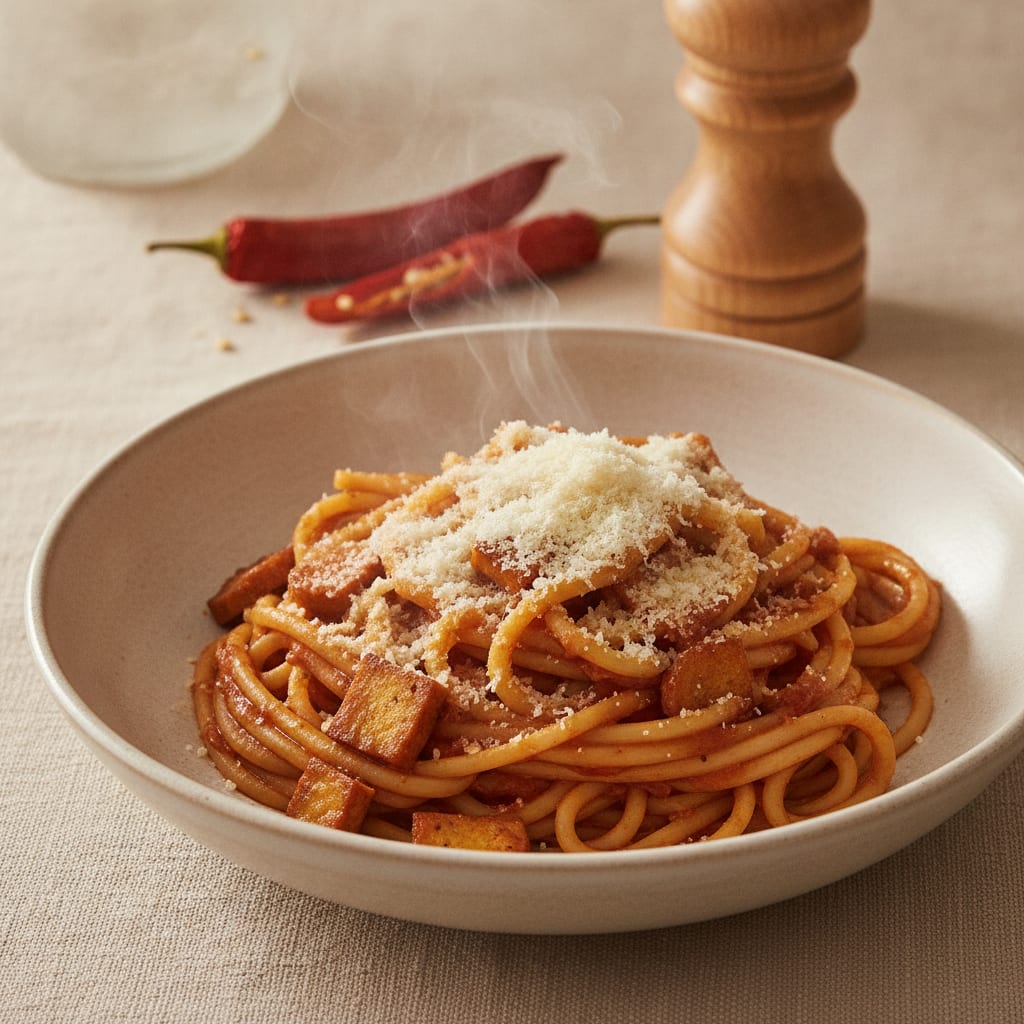
The Roman bucatini — tomato, pecorino, black pepper — with smoked king oyster mushroom rendered crisp in place of the guanciale. The dish, exactly the dish.
- Prep
- 20 min
- Cook
- 25 min
- Total
- 45 min
- Servings
- 4
- Difficulty
- Easy
Getting ready…
Ingredients
For 4 servings · 16 items
The mushroom guanciale
The sauce
The pasta
To finish
Method
8 steps · check as you go
- →
Serve
One nest per bowl, eaten hot, the sauce still bubbling when it hits the table. A glass of Frascati or a young Cesanese on the side. The crisp lardons go on last so they stay crisp — don't bury them.
The story
This is the amatriciana I make at home in Washington, in the kitchen I’ve been cooking in since 2025. The classical version from Amatrice — the small town up in the mountains of Lazio that gives the dish its name — is built on guanciale: pork cheek, salt-cured and air-dried for weeks, cut into lardons and rendered slowly until the fat melts out and the edges crisp. That rendered fat is the dish. The tomato, the pecorino, the black pepper, the bite of peperoncino — all of it is arranged around the fat and the smoke and the salt that the guanciale brings.
So that is the thing to rebuild. Not “leave the meat out.” Rebuild the job the guanciale was doing.
After a handful of batches across May and June 2026, the version that landed was king oyster mushroom cut into lardons, marinated to rebuild the cure — smoked paprika for the smoke, white miso and soy for the salt-aged funk, tomato paste and a little maple for the color and the faint sweetness of rendered fat — then rendered slowly in olive oil until the edges go crisp and the oil turns rosy. Pull half the lardons out to stay crisp; leave the rest, and all that flavored oil, to become the base of the sauce.
The technique never moved. You render the fat, you deglaze with white wine, you add the tomato, you finish the pasta in the pan, you melt the cheese in off the heat. Every step is the amatriciana step. Only the thing being rendered changed.
What the other recipes get wrong
Most “vegan amatriciana” recipes online — I checked the top of the results in June 2026 — solve the guanciale problem by leaving it out and leaning on the tomato. You get a thin tomato pasta with chile. It is fine. It is not amatriciana, because the rendered-fat-and-smoke backbone is simply gone, and the dish was built on that backbone.
The next tier reaches for plain mushrooms tossed in at the end, soft and pale. That adds a vegetable, not a guanciale. Without the slow render, there’s no crisp, no rosy oil, no smoke — just mushroom sitting on top of sauce.
The smoked paprika is the part almost everyone skips, and it’s the part that matters most. Guanciale doesn’t taste like pork so much as it tastes like cured, smoked, aged — and smoked paprika delivers that note straight, in the right register. Mushroom for the texture and the oil, paprika for the smoke, miso and soy for the cure: that is the combination that makes the dish read as amatriciana and not as mushroom pasta.
The line I draw
I render the mushroom properly or I don’t make the dish. The whole architecture depends on that slow render — the crisp edges, the meaty centers, and above all the oil going rosy and smoky, because that oil is the fat the rest of the sauce is built on. Toss raw mushroom into hot sauce and you’ve skipped the only step that makes it amatriciana.
And the pecorino goes in off the heat. Always. This is true of the pork version and it is true of this one. Cheese — dairy or cashew — hits a pan that’s too hot and seizes into grainy clumps. Off the heat, it melts into a creamy bind. That one rule predates all of us and it does not change for plants.
When this can fail
- The mushrooms steamed instead of crisping. The pan was too crowded or too cool. Fix: medium heat, single layer, and leave them undisturbed for the first 3 minutes before you touch them. If your pan is small, render in two batches.
- The sauce tasted flat, like tomato pasta. You skipped or under-dosed the smoked paprika. Fix: it is the smoke — a full teaspoon, bloomed into the marinade so it coats the mushroom and renders into the oil. Don’t add it raw at the end.
- The cashew pecorino went grainy. You added it to a pan still on the burner. Fix next time: pull the pan off the heat completely, then add the cheese and toss. Heat is the enemy at that step.
- Too salty. The miso, soy, and pecorino stack up fast. Fix: salt the tomato last and light — a quarter teaspoon, taste, then decide. You can always add; you can’t take back.
This is the mountain pasta of Amatrice, cooked the way it has always been cooked — render the fat, deglaze, build the sauce on what rendered out, finish in the pan, cheese off the heat. It is the same dish, made with what is in my cupboard. The guanciale was never the point. The rendered, smoky, savory backbone was the point, and it stayed exactly where it always was — pulled from a different source.
Cook it on a Tuesday. The amatriciana asks for one pan and forty-five minutes, and it gives back the whole of Lazio.
— Alexandre Teulade Washington, D.C.
FAQ
QWhy king oyster mushroom in place of the guanciale?
Guanciale gives amatriciana three things: rendered fat, a crisp-chewy bite, and a cured, smoky, salty depth. King oyster mushrooms (eringi) are the one mushroom dense enough to deliver the texture — cut into lardons and rendered slowly in olive oil, the edges crisp and the centers stay meaty, just like cut guanciale. The oil takes the place of the rendered fat, and the marinade — smoked paprika, miso, soy, tomato paste, a touch of maple — rebuilds the cure. It is not a garnish standing in for meat; it is the component the dish is built around now, doing the exact job guanciale did.
QWhat is the smoked paprika actually doing?
It is the smoke. Guanciale's flavor is mostly fat and salt, but the unmistakable note — the thing your brain reads as 'cured pork' — is the smoke and the aging. Smoked paprika (pimentón) delivers that smoke directly, in the right register, without overwhelming the tomato. Skip it and the dish is good but reads as 'mushroom pasta'; include it and it reads as amatriciana. It is the one ingredient I will not cut.
QCan I use smoked tofu or tempeh instead of mushrooms?
Yes. Thick-cut smoked tofu, cut into lardons and crisped in the oil, is the closest second — it already carries some smoke, so cut the smoked paprika to 3/4 teaspoon. Tempeh works too but is nuttier and a little bitter; steam it for 5 minutes first to mellow it, then marinate and render as written. Shiitake caps, sliced thick, are the easiest swap if king oyster is unavailable — they crisp well but shrink more, so start with a little extra.
QWhat replaces the Pecorino Romano?
A cashew pecorino — toasted cashews, nutritional yeast, and salt blended fine, pushed sharper and saltier than a cashew parmesan to match Pecorino Romano's bite. See the Parmesan recipe on the site and add an extra pinch of salt. The one rule that does not change from the original: add it off the heat. Pecorino — dairy or cashew — clumps in a pan that's too hot. Off the heat it melts into the sauce.
QIs it still amatriciana without the pork?
Yes. Amatriciana is defined by its profile — rendered savory fat, tomato, pecorino, black pepper, the Roman heat of the peperoncino — not by the specific animal that once provided the fat. Its own ancestor, gricia, is amatriciana before tomato ever reached Italy; the dish has been rebuilt around new ingredients before. Cooking it with smoked king oyster mushroom doesn't make it a substitute or a fake. It is the amatriciana, made with what is in the kitchen.