The ribbon.
Aligot.
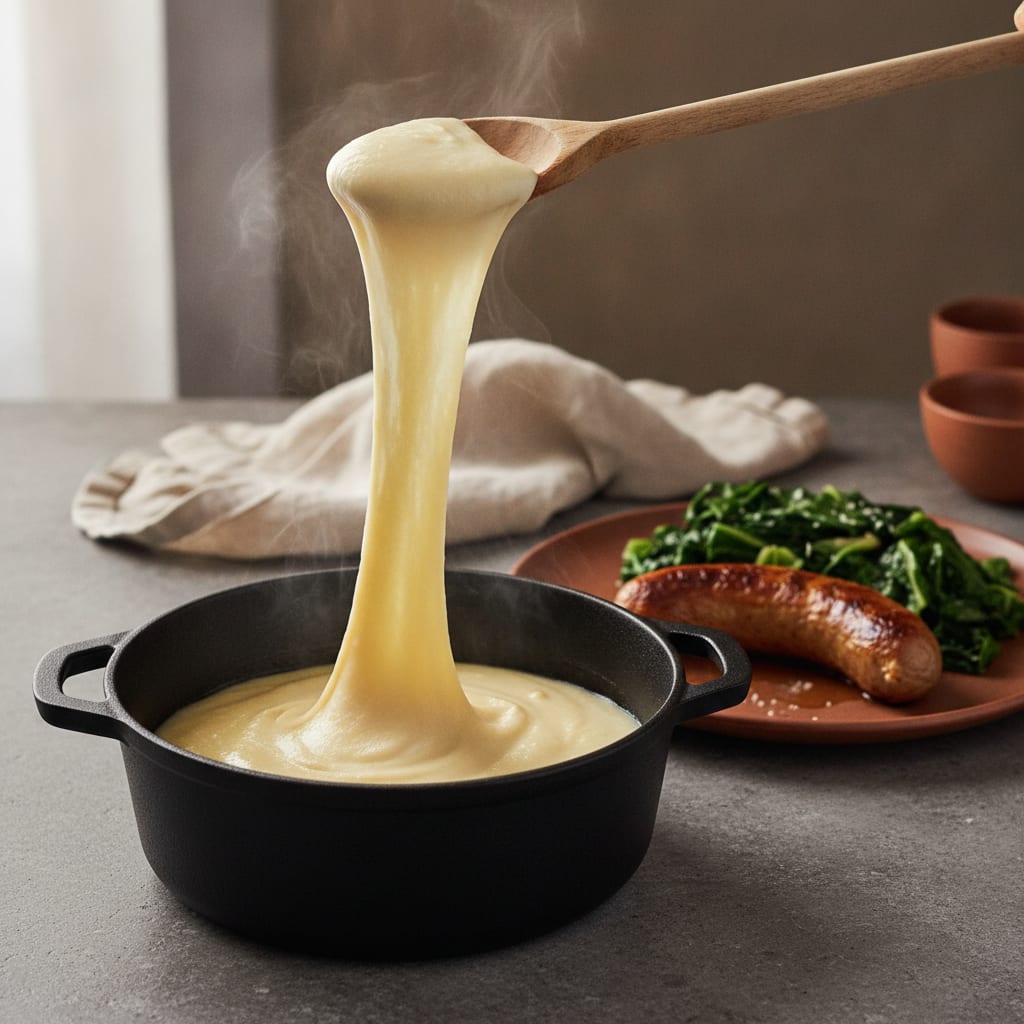
The stretchy Aubrac potato purée, two ways: riced potato beaten with a cashew-miso curd until it pulls in long ribbons, with the famous fil you lift on a spoon.
- Prep
- 20 min
- Cook
- 40 min
- Total
- 1h
- Servings
- 4
- Difficulty
- Medium
Getting ready…
Ingredients
For 4 servings · 13 items
For the potatoes
For the stretchy curd
Method
6 steps · check as you go
- →
Serve
Aligot is the Aubrac partner to a sausage and a glass of red. Serve it straight from the pot, beside a seared seitan or smoked-tofu sausage and a pile of bitter greens or a sharp green salad to cut the richness. Lift it high at the table so everyone sees the fil. A rustic red from the Aveyron — Marcillac, with its iron edge — is the regional pour.
The story
I learned aligot in the Languedoc, in the late autumn of 2022, on the Aubrac plateau where the wind comes off the high ground with nothing to stop it and the cooking turns frankly to survival food. I watched it made in a buron-style kitchen the old way: one cook with a long wooden spoon, beating a pot of potato and young tomme over a low fire, lifting the mass up over his head so the fil — the ribbon — stretched a full arm’s length and caught the light before he folded it back. He didn’t stir it. He fought it. “On travaille l’aligot,” he said. You work the aligot. The forearm gives out before the dish is done.
The history is older than the potato. Aligot belongs to the Aubrac monastery hospices on the medieval road to Santiago de Compostela, where the monks fed pilgrims a beaten dish of bread and tomme fraîche — the young, unripened curd of the region, full of meltable casein. Potatoes only arrived from the Americas centuries later and took the bread’s place after the wheat failed. The name is usually traced to the Latin aliquid, “something” — the something given to travelers at the door. The stretch was always the point: a local saying held that a host’s generosity was “as long as the pull of the aligot.”
So the curd is the heart of it, and I have rebuilt the curd. There is no tomme in this aligot. There is a cashew-and-soy curd run with tapioca starch — soy protein and tapioca for the stretch, miso and yeast and a squeeze of lemon for the savour and the faint lactic tang of a young Laguiole. Beaten warm into riced starchy potatoes, it pulls in a long ribbon off the spoon. It is not a “cheeseless aligot.” It is aligot — the same beaten, stretched, worked purée, lifted high so the fil shows.
À la maison
The weeknight reading is the recipe above, and it lives or dies on two rules. First, the right potato and a ricer: starchy potatoes, riced not blended, or you have no base. Second, keep it warm and keep beating — the stretch comes from working the mass over low heat, lifting and folding, not from stirring it fast over a high flame. The cashew-tapioca curd does the job the melted tomme used to do; cook it until it’s glossy and elastic before it meets the potato, then beat the two together until the spoon lifts a ribbon. It is more arm than skill. Have your plates and everything else ready, because aligot will not wait.
Au bistrot
The bistronomique reading treats aligot as the centre of a composed plate rather than a rustic side. Make the purée slightly looser and richer — an extra spoon of cream and butter — and quenelle it, or pipe a high swirl, so the stretch reads in the plating itself: a deliberate ribbon drawn up and laid across the plate as you spoon. Beside it, the Aubrac partner refined: a seared seitan sausage sliced on the bias to show its crumb, glazed dark with a reduction of red wine and a little of the bean cooking liquid until it’s sticky and deep. A small, sharp tangle of bitter greens — frisée, dandelion — dressed in a mustard-walnut vinaigrette cuts the richness exactly where the eye wants relief. Finish with a few toasted walnut halves for the iron-and-stone note of the plateau, a thread of brown butter — vegan butter cooked just past golden until it smells of hazelnut — and cracked pepper. The plate should feel like a mountain dish that came down to the city: same beaten, stretchy purée, plated with intent.
Le dressage — Low three-quarter, a touch of motion in the pull. Dark rustic plate, a high swirl or laid ribbon of glossy pale aligot off-centre, the fil visible where it was drawn up. Bias-cut dark-glazed sausage leaning against it, a small sharp pile of bitter greens, toasted walnuts, a thread of brown butter. Warm low light, stone surface. The plate should say Aubrac, refined — comfort with a spine.
What the other recipes get wrong
Most plant-based aligot recipes online — I read the top ten in October 2022 — reach for whatever “vegan cheese” melts and a fistful of cornstarch, and the result is a thick mash that gleams but never pulls. The stretch is the entire dish, so I built the curd as the variable. I ran the test over a week on the plateau in October 2022, four curds, same riced potatoes, same beating, same gentle heat, only the stretch engine changed:
- Melted vegan cheese + cornstarch: thick and glossy but it tore in short snaps instead of pulling — no real fil, gummy on the tongue.
- Tapioca starch + oat milk: better gloss, more give, but oat milk’s lack of protein meant the strands broke at a hand’s height.
- Tapioca starch + soy milk + cashew: long, elastic, genuinely arm’s-length pull — the only one that lifted a ribbon and held it.
- Tapioca + soy + cashew, overheated to a hard simmer: started stretchy, then tightened, split, and went greasy and short within a minute. A warning, not a winner.
The reason is protein and starch and temperature, and it mirrors the real thing closely. In a dairy aligot, melted casein from the young tomme forms long elastic strands when beaten warm, and that network is fragile to heat — below about 60°C the cheese won’t emulsify, and above roughly 80°C the proteins tighten and the emulsion breaks greasy. My curd uses hydrated tapioca starch as the long elastic network and soy protein to give it structure and elasticity that oat milk, lacking protein, simply can’t. The miso and yeast supply the savour the aged curd would, the lemon the faint lactic tang. Crucially, the temperature window is the same: beat it warm, around 70°C, never to a sizzle. The overheated batch failed for exactly the reason a real aligot fails when a nervous cook cranks the flame — too hot, and the network seizes and snaps instead of stretching. Across all four batches, soy-plus-tapioca, kept warm, was the only one that pulled a true fil.
The line I draw
I will not blend the potatoes. Not “just to save the ricer,” not a quick pulse, not ever. A starchy potato run through a blender or food processor ruptures its cells and floods the purée with free starch, and you don’t get aligot — you get wallpaper paste, a grey gluey mass that sets like cement and never recovers. The potatoes go through a ricer or a food mill, full stop, which keeps the cells intact and the purée smooth without over-working the starch. I have served a glue-pot aligot exactly once, to people I respect, and I have never made the mistake again. The ricer is not optional equipment for this dish; it is the dish.
When this can fail
Three ways, all from my own kitchen between 2022 and 2026:
- The broken, greasy mass. Beat the aligot over a flame that was too high to “speed the stretch”; the emulsion tightened, split, and turned oily and short, the fil gone. Fix: work it warm and gentle, around 70°C — if it’s sizzling, it’s too hot — and pull it off the direct heat while you beat.
- The glue pot. Tired one night and pulsed the potatoes in the processor instead of ricing. It set into grey cement before it ever reached the table. Fix: rice or mill the potatoes, always; there is no rescue once they’re over-worked.
- The stiff, sullen aligot. Made it ten minutes early to plate something else, and by the time it hit the table the network had set and the stretch was gone. Fix: treat it as à-la-minute — have everything else ready and beat-and-serve, or loosen a held one with warm soy milk and beat again, knowing it’ll never be quite as elastic.
FAQ
QHow do you make aligot stretchy without cheese?
The famous stretch of aligot comes from melted young tomme, whose casein proteins form long elastic strands when beaten warm. To recreate that pull without dairy, the engine is tapioca starch plus soy protein: a blended cashew-and-soy-milk curd with three tablespoons of tapioca starch, cooked until it seizes glossy and elastic, then beaten into riced starchy potatoes. The tapioca network does what the melted casein does — it stretches into long ribbons. White miso, nutritional yeast, and a little lemon give the savour and faint tang of a young Laguiole curd.
QWhat potatoes are best for aligot?
High-starch potatoes — Russet, Bintje, or another floury variety. Aligot needs a dense, almost gluey purée, and only starchy potatoes give that. Waxy potatoes (like new potatoes or fingerlings) hold their shape and stay firm, producing a loose, lumpy mash that will not stretch. Boil them whole or in large chunks, drain well, and pass them through a ricer — never a blender, which over-works the starch into wallpaper paste.
QWhy is my aligot not stretching?
Three usual causes. First, the wrong potato — waxy potatoes won't give the gluey base; use starchy ones. Second, not enough of the stretchy element or not enough beating — the long elastic strands only form when you beat and lift the mass repeatedly. Third, overheating: aligot must be worked warm, around 70°C, not hot. Above roughly 80°C the emulsion tightens and breaks, going greasy and short instead of stretchy. Keep the heat gentle and keep stretching.
QWhat is the history of aligot?
Aligot comes from the Aubrac plateau in southern France, where the dish traces to the monastery hospices on the medieval pilgrimage route to Santiago de Compostela. Monks are said to have served pilgrims a dish of bread (later potatoes, after they arrived from the Americas) beaten with tomme fraîche, the young unripened cheese of the region. The name is often linked to the Latin 'aliquid,' meaning 'something.' Potatoes replaced the bread after wheat harvests failed, and aligot became the signature dish of the Aubrac.
QCan you reheat aligot?
Aligot is best eaten the moment it's made, while the stretch is longest — it stiffens and loses elasticity as it cools. You can reheat it gently over low heat with a splash of soy milk or cream, beating it again to coax back some of the pull, but it will never be quite as elastic as the first serving. Treat it as an à-la-minute dish: have everything else on the table ready, then beat and serve.