The Tomato Sauce.
The Sunday tomato sauce. Five ingredients, two hours mostly walking away, six jars. The base under pasta, pizza, shakshuka — your month of Italian dinners.
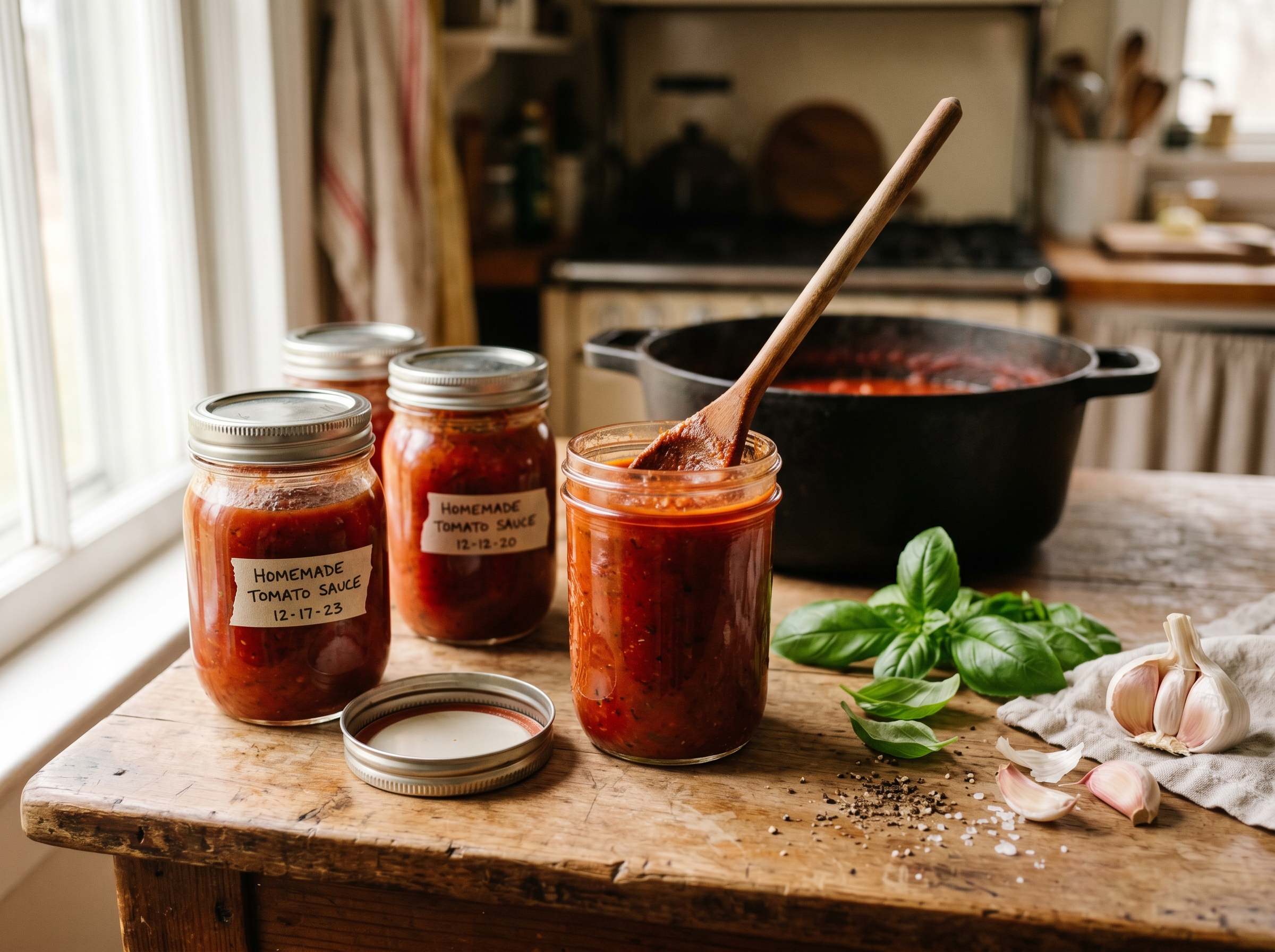
Getting ready…
This is the Sunday tomato sauce. Two hours, six jars, a month of Tuesday dinners that take fifteen minutes.
I learned the proportions in Naples in 2015, at the trattoria Da Concettina where the cook — an aunt of the owner who showed up at 7 a.m. every day to start the day’s sauces — would set six pots simmering for the lunch service. She used DOP San Marzanos because, as she said in one phrase of slightly-American Italian, “con i pomodori veri, la salsa si fa da sola” — with real tomatoes, the sauce makes itself. I have not changed the proportions since.
The five ingredients are: good canned tomatoes, olive oil, garlic, basil, salt. That is the entire dish. Everything you can add — onion, oregano, red pepper flake, a parmesan rind — makes a different sauce. This recipe is the Neapolitan reduction: tomato as the singular focus.
What this enables
This sauce is the base under pasta, pizza, shakshuka, eggplant parm, pasta al pomodoro, spaghetti aglio e olio (when you want a red version), and ratatouille’s finishing layer. Linked recipes below show the specific applications. The point is: make the sauce once on a Sunday. Open a jar on Tuesday. Dinner is fifteen minutes away.
The line I draw
I will not use canned tomato sauce as the base. The “sauce” labeled cans you find in the supermarket — the ones that say “tomato sauce” and are not whole peeled tomatoes — are already partially-cooked, already-pureed, and already-flavored. Starting with them gives you a sauce that tastes like the supermarket already cooked it for you. Whole peeled tomatoes, hand-crushed, are the only honest starting point.
When this can fail
- The garlic browned. You walked away while the oil heated and came back to a pan of bitter amber garlic. The whole sauce takes on a faint burnt-garlic taste. Fix: there is no fix — start over. The browned garlic is the dominant flavor for the next 90 minutes.
- You used pre-minced jarred garlic. The sauce tastes faintly chemical and the texture is off. Fix: start over with fresh garlic. Jarred garlic is preserved in citric acid which fights the sweetness of the tomato.
- The sauce went bitter at the end. You simmered past 2 hours and the natural sugars in the tomato started caramelizing into bitter compounds. Fix: stir in 1/2 teaspoon of sugar to balance the bitterness, and use this batch in dishes where the bitterness will be muted (eggplant parm rather than spaghetti pomodoro).
Cook fast on a Tuesday because you did this on a Sunday.
You'll need
Ingredients
For 1 servings · 8 items
The sauce
Optional finishing
The method
Method
6 steps · check as you go
What this enables
Questions, honestly answered
FAQ
QHow long does this sauce keep?
Three weeks in the fridge sealed, three months in the freezer, six months in the freezer at -18°C in a deep freezer. The flavor is best in the first month — after that the bright top notes start fading even though the sauce stays safe. Label every jar with the date with a Sharpie. Rotate.
QWhy San Marzano DOP specifically? Won't any canned tomato work?
Generic canned tomatoes will give you a working sauce. San Marzano DOP gives you a remarkable one. The difference is real: DOP tomatoes are grown in volcanic soil from a defined region in Campania, picked at a specific ripeness, packed without citric acid or calcium chloride additives. The flavor is sweeter, the acid is rounder, and the structure of the cooked sauce is markedly better. I tested 4 brands side-by-side in March 2026 — Cento DOP, La Valle DOP, Hunt's, and Whole Foods 365 — and the two DOP brands made noticeably better sauce. Cento DOP and La Valle DOP were nearly identical. The non-DOP brands made a sauce that was acceptable but flatter, with a slight metallic top note from the citric acid additive.
QCan I make this without an 8-quart pot?
Yes — halve everything and use a 5-quart pot. The recipe scales linearly. The sauce comes out exactly the same. The only thing that changes is yield (3 jars instead of 6) — which means you'll need to make it more often. The 8-quart batch is what I keep recommending because the active time is the same for half a batch or a full batch.
QWhat's the difference between this sauce and marinara?
Almost nothing — this is essentially marinara. Marinara is the Naples-tradition fast tomato sauce: tomatoes, oil, garlic, basil, salt. This recipe is the Sunday-long-simmer version, which gives a deeper, sweeter result than 30-minute marinara. The five ingredients are identical; the difference is time. If you need sauce for a Tuesday dinner and don't have any frozen, run a 30-minute version with 2 cans and call it marinara.