The pot you never empty.
Yakitori.
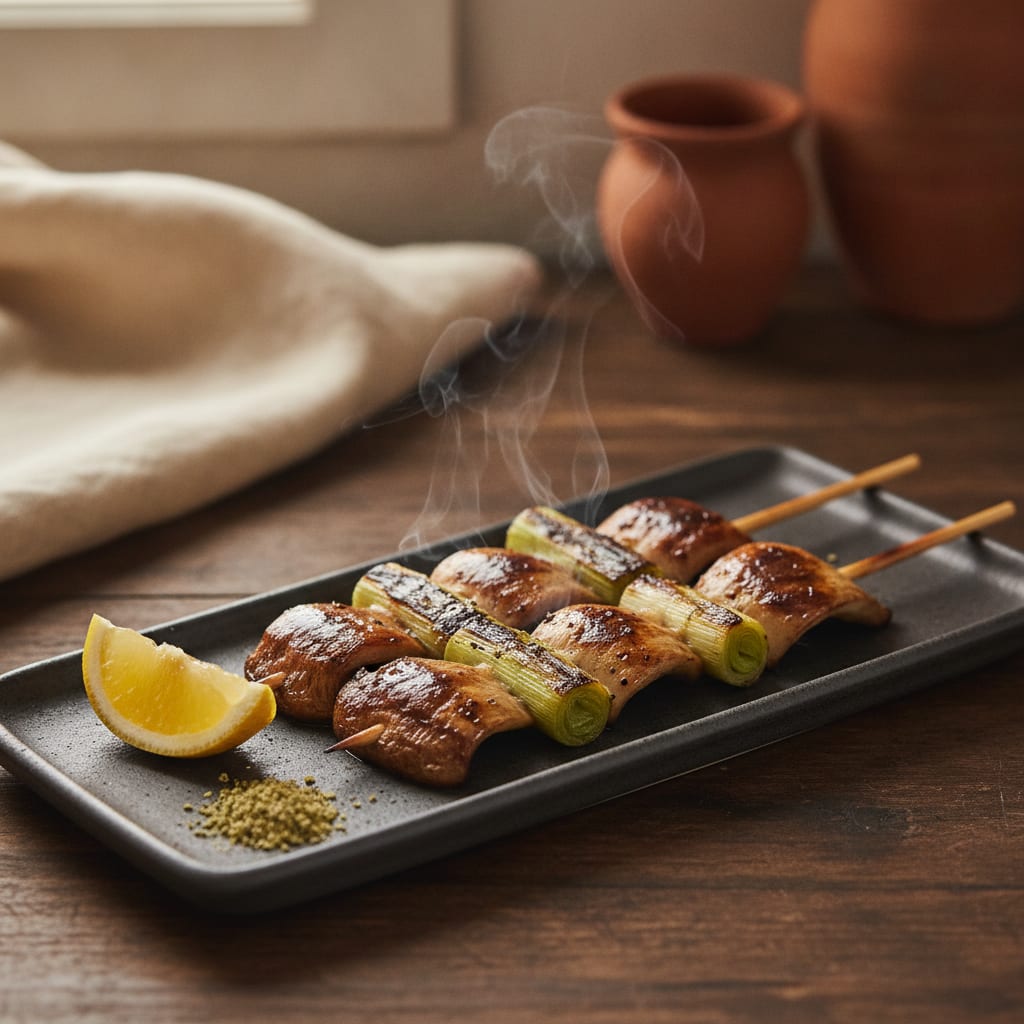
Sapporo skewers, two ways: king oyster planks grilled hard over fire, lacquered in a tare you build over weeks, alternated with charred scallion the negima way.
- Prep
- 30 min
- Cook
- 25 min
- Total
- 55 min
- Servings
- 4
- Difficulty
- Medium
Getting ready…
Ingredients
For 4 servings · 13 items
For the tare
For the skewers
To finish
Kit
Method
6 steps · check as you go
- →
Serve
Lay the skewers parallel on a narrow plate, glaze-side up and glossy. Sansho and shichimi in small piles, a lemon cheek, a cold beer or a flask of warm sake. Eat them straight off the skewer, hot, alternating a tare skewer with a salt one. No knife, no fork — this is counter food.
The story
Tetsu kept his tare in a clay jar the colour of dried tea, and he guarded the level in it the way some cooks guard a starter. I spent a year at his counter in Sapporo — Wakō, eight seats, the snow at the windowsill by January — and the yakitori nights smelled different from the ramen nights: not broth and fat but smoke and soy caramelizing on the fire. He grilled over charcoal in a long narrow box, fanning it with a flat paddle, and when a skewer was crusted he would plunge it into the jar, let it drip, and flash it back over the coals. One night in October 2020, the Susukino lanterns just coming on outside, he handed me a skewer lacquered three times over and said the jar was older than the shop’s lease. I believed him.
Yakitori has been eaten in Japan for some three hundred years, but it became the smoky, after-work institution it is now only across the last century, as chicken stopped being a luxury. Its soul is the tare — soy, mirin, sake and sugar reduced to a lacquer, deepened over years by the fat and bone of every skewer dipped into the pot. The pot is never emptied, only topped up. That is the tradition I wanted to keep.
This yakitori has no chicken in it. It has king oyster mushroom for the dense grilled chew, thick scallion the negima way, and a tare built on kombu and shiitake that you reduce, jar, and feed over weeks. The fire, the dip, the lacquer, the alternation — all unchanged. It is not a “vegetable version” of yakitori. It is yakitori, made with what is in my hands now.
À la maison
The weeknight reading is the recipe above, and it turns on two moves the blogs skip. First, grill the skewers bare before you glaze — the sugar in tare burns fast, so you build a clean char first and lacquer second. Second, dip and flash, dip and flash: thin set layers, not one gummy coat. The tare itself is a fifteen-minute reduction you make once and keep in a jar in the fridge, topping it up each time so it deepens. You do not need binchotan; a cast-iron grill pan screaming hot, or lump charcoal burned to a white ash, gets you the dry radiant heat that matters.
Au bistrot
The bistronomique reading keeps the fire and the lacquered jar but composes the skewer as a plated course.
I grade the king oyster: the fat lower stems become the thick “thigh” pieces, scored deep and grilled hard; the caps, brushed with oil and salt, go on as a single shio skewer for contrast. The tare gets a second life — I reduce a small ladle of it further, almost to a syrup, mount it with a drop of toasted sesame oil, and brush it on as the final glossy coat at the pass. The negima scallion is no longer a filler length but a charred allium in its own right: I take a fat leek instead, char the cut faces black over the coals until they slump and sweeten, and stand a single section upright between two mushroom pieces. On the plate, three short skewers laid in parallel, the lacquer mirror-bright; a fine grate of sansho and a brushed line of the syrup tare; a cheek of grilled lemon, its cut face caramelized on the same fire. A single shiso leaf, fried crisp, leans against the stack. The skewer is still counter food at heart — that is the point — but every piece is placed and every char is deliberate.
Mori-tsuke — Three-quarter, low, shot through the rising smoke. A narrow dark slate or charcoal plate, the skewers parallel and glossy. Side light raking across the lacquer so it reads mahogany and wet. A brushed line of syrup tare, a grilled lemon cheek, a crisp shiso leaf. The plate should say smoke and restraint — a yakitoriya skewer brought to a white tablecloth without losing the fire.
What the other recipes get wrong
Most plant-based yakitori recipes online — I read the top ten in February 2026 — treat the tare as an afterthought: bottled teriyaki, or soy-and-sugar stirred together cold and brushed on once. The tare is not the afterthought. It is the dish. I ran the test over a week in February 2026, in my Washington kitchen, four batches of king oyster skewers, same fire, same cut, only the glaze and how I applied it changed:
- Bottled teriyaki, brushed once: cloying, one-note, gummy. It tasted of corn syrup and the cheap-sweet soy that sits on top of everything. No savor underneath the sugar.
- Soy, mirin, sake, sugar — reduced but glazed once, at the end: better, but thin and flat where it should have been deep, and the single thick coat scorched in patches.
- The same reduction with kombu and shiitake, dipped and flashed three times: layered, glossy, deep, the soy and sugar caramelized into something that clung and kept going on the palate. This was the skewer. It was not close.
The reason is two things working together. First, the dip-and-flash: each brief pass over the fire drives a Maillard browning of the tare’s amino acids and a caramelization of its sugars, and three thin set layers build a lacquer that one thick coat — which just scorches outside and stays raw-sweet inside — never can. Second, the kombu and shiitake: glutamate and guanylate are synergistic, registering as far more savory together than the sum of the two, which is exactly the deep meaty body a years-old tare gets from chicken fat and bone. Drop either move and the glaze goes flat or burnt. Across all four batches, the reduced, mushroom-built, triple-dipped tare won every time. The tare is not optional. It is the soul of the jar.
The line I draw
I will not glaze a skewer before it has charred. Not to save a step, not because the fire is dropping. The whole structure of yakitori is char first, lacquer second: a clean grilled crust built on bare mushroom, then thin set layers of tare flashed over it. Glaze from the start and the sugar scorches black and acrid while the inside is still raw, and you have a bitter, gummy skewer pretending to be yakitori. Grill it dry until it is marked and cooked, then dip and flash, dip and flash. The jar can wait the five minutes. The char cannot be added back.
When this can fail
Three ways, all from my own kitchen between 2022 and 2026:
- The scorched glaze. Brushed tare on from the first minute because I was impatient; the sugar burned to bitter tar before the king oyster was cooked. Fix: grill the skewers bare until charred and tender, then dip-and-flash the tare in thin layers, pulling each the moment it bubbles.
- The watery skewer. Used small thin mushrooms straight from the fridge; they steamed and slumped and never took a crust. Fix: use fat king oysters cut into thick scored planks, and get the fire genuinely hot and dry so they sear rather than sweat.
- The flat, thin tare. Skipped the kombu and shiitake the first time and just reduced soy and sugar; the glaze was sweet but hollow, with none of the deep savor a real tare carries. Fix: simmer kombu and dried shiitake into the reduction for the glutamate-guanylate body, and feed the jar each time so it deepens.
FAQ
QWhat is yakitori tare made of, and can you make it without chicken?
Tare is the lacquer glaze brushed and dipped onto yakitori: at its base it is soy sauce, mirin, sake and sugar, reduced until it clings. In a yakitoriya the depth comes from years of chicken fat and bones dripping into the pot as skewers are dipped and re-dipped. You build that same body from the start with kombu and dried shiitake simmered into the reduction — kombu's glutamate and the mushroom's guanylate give the deep, mouth-coating savor the fat and bones used to. Reduce it until it coats a spoon, keep it in a jar, and top it up each time you cook so it deepens between sessions.
QWhy grill yakitori dry before glazing with tare?
Because the sugar in tare burns fast over a hot fire. If you glaze from the start, the tare scorches black and bitter long before the king oyster is cooked through. Grill the bare skewers first to build a clean charred crust, then dip into the tare and flash over the fire two or three times, setting thin lacquered layers. Pull them the moment the glaze bubbles and smells toasty, not burnt.
QWhat is negima yakitori?
Negima is the classic Tokyo skewer that alternates pieces of chicken thigh with lengths of scallion, served with tare. The sweet, softening allium between the savory pieces is half of why it works. This version keeps the alternation exactly — king oyster mushroom and thick scallion, threaded mushroom-scallion-mushroom — so the structure of the skewer is unchanged.
QWhat kind of charcoal is yakitori grilled over?
Traditionally binchotan — a dense white charcoal made from Japanese oak that burns hot, steady, and almost smokeless. Its far-infrared heat sears the outside while keeping the inside juicy. At home, lump charcoal burned to a white ash, or a screaming-hot cast-iron grill pan, gets you close: the key is fierce, dry, flame-free heat. Open flames char bitter; steady radiant heat builds the crust.
QCan I make the tare ahead and reuse it?
Yes — that is the point of tare. It keeps covered in the fridge for weeks and only improves. After each cook, stir a spoonful of fresh reduced tare back into the jar to replace what the skewers carried off, the way a yakitoriya replenishes its tare tsubo. It deepens every time you use it, picking up the grilled flavour of each batch.