The crispy skirt.
Gyoza.
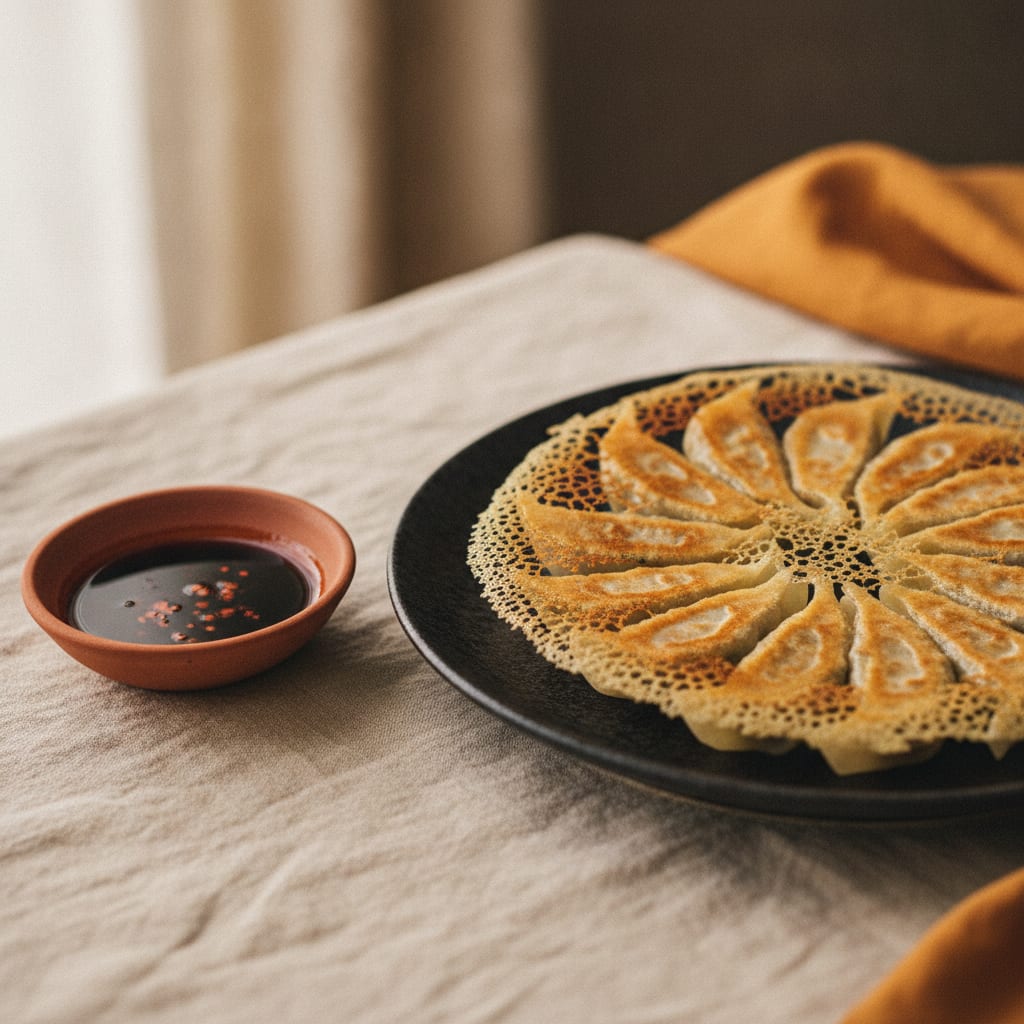
Japanese pan-fried dumplings, two ways: a salted-and-wrung cabbage, mushroom and tofu filling, pleated, then crisped into a lacy hanetsuki skirt in the pan.
- Prep
- 40 min
- Cook
- 15 min
- Total
- 55 min
- Servings
- 4
- Difficulty
- Medium
Getting ready…
Ingredients
For 4 servings · 18 items
For the filling
For wrapping and cooking
For the crispy skirt slurry
To serve
Method
7 steps · check as you go
- →
Serve
Serve the gyoza skirt-up on a warm plate so the lacy crust stays crisp, with a dipping sauce of black (or rice) vinegar, soy sauce and rayu mixed to taste — traditionally heavier on the vinegar than the soy. Eat hot, dipped, the crisp skirt snapped off and eaten with each dumpling.
The story
I spent a year at Tetsu’s counter in Sapporo, from February 2020 to February 2021 — Wakō, eight seats, the steam fogging the windows by mid-morning. Gyoza were the side that came with every ramen, and Tetsu made them in a battered black pan in a single move I watched a hundred times before I understood it. He’d sear the bottoms, pour in a cloudy slurry that hissed and spat, slam the lid on, and minutes later lift off a whole connected sheet of dumplings joined by a lace of golden crust — the hane, the wing. A Tuesday in January 2021, the snow squeaking underfoot outside, he finally let me run the gyoza pan, and the first batch I tried to crisp on plain water came out pale and limp. He shook his head, mixed flour into the water in front of me, and the next batch grew its skirt. “Hane,” he said, tapping it. The wing.
Gyoza came to Japan from China — they descend from jiaozi — and took root after the war, when people returning from the mainland brought the habit home. The pan-fried yaki-gyoza style, steamed then crisped in one pan, is Japan’s own. This version fills them with salted-and-wrung cabbage, shiitake and pressed tofu, and finishes them with the lacy hanetsuki skirt.
It is not a “vegetable version” of gyoza. It is gyoza: the wrung cabbage, the pleated seal, the steam-fry, the crisp hane, made with what is in my hands now.
À la maison
The weeknight reading is the recipe above, and it lives or dies on two moves. First: salt the cabbage and wring it bone-dry. The water in raw cabbage is what makes fillings weep and wrappers split — get it out and everything else gets easier. Second: the skirt is made with a starch slurry, not plain water. Whisk a little flour and cornstarch into the steaming water and, as it boils off, the starch dries into the lacy golden hane that joins the dumplings. Sear the bottoms first, add the slurry, cover to steam, then uncover and let the skirt brown hard before you flip the lot out crisp-side-up.
Au bistrot
The bistronomique reading keeps the same dumpling but plates the hanetsuki skirt as the showpiece it is.
I refine the filling: the shiitake is split, half finely chopped raw for texture and half cooked down with a touch of soy and mirin into a dark, almost meaty paste folded through, so the savor reads in layers. A little finely minced lotus root or water chestnut goes in for a hidden crunch. I pleat the gyoza tighter and smaller, a dozen to a pan, and arrange them in a perfect ring so the hane forms a single round lattice — a wheel of lace with the dumplings standing around its rim. The slurry is tuned thin, with a higher cornstarch ratio and a drop of vinegar, so the skirt fries paper-thin and shatters. Inverted onto a flat dark plate, the whole wheel comes out skirt-up, intact, golden and translucent at the edges. Alongside go three small dipping pools rather than one — black vinegar, a chili-rayu, and a grated-ginger ponzu — and a scatter of toasted sesame and fine scallion across the lace. The dish is the skirt as much as the dumpling.
Mori-tsuke — Overhead, the full lace wheel filling the frame. A flat matte-black plate so the golden hane glows. The gyoza standing evenly around the rim, the lattice intact and translucent at its edges. Three small dipping pools at the side, odd-numbered. A hard raking light to catch the crisp texture of the skirt. The plate should say one clean crisp sheet, not a pile.
What the other recipes get wrong
Most plant-based gyoza recipes online — I read the top ten in March 2026 — skip the cabbage-wringing step or hand-wave it (“squeeze out some water”), and many crisp the dumplings on plain water and call the result hanetsuki. So I ran the test: eight pans over a week in March 2026, in my Washington kitchen, identical filling and wrappers, changing only two variables — whether the cabbage was salted-and-wrung, and what liquid crisped the pan.
- Unwrung cabbage, plain-water steam: the filling wept, two wrappers split, and the bottoms went grey and soft instead of crisping. No skirt at all.
- Wrung cabbage, plain-water steam: a tight, clean filling and crisp bottoms — but still no lace; plain water just evaporates and leaves nothing behind.
- Wrung cabbage, flour-and-cornstarch slurry steam: tight filling, crisp bottoms, and a thin golden hane that browned into a shattering sheet joining every dumpling. This was the bowl Tetsu made. Not close.
The reason is, on both counts, the behavior of water and starch. Cabbage cells are turgid with water held by osmosis; salt floods the outside of the cells, water rushes out to balance it, and wringing carries it away — leaving a filling that doesn’t weep and a base that can actually reach crisping temperature instead of stalling at the boiling point of its own released water. The skirt is pure starch gelatinization: dissolved flour and cornstarch in the slurry swell and gelate as the water boils off, then, dried by continued heat, set and brown into a thin crisp film — a savory cracker. Plain water leaves no solids to set, so it can never form a hane. Across all eight pans, wrung cabbage plus a starch slurry won every time. Both steps are non-negotiable.
The line I draw
I will not skip wringing the cabbage to save the fifteen minutes, and I will not fake the skirt with plain water. The wrung cabbage is what keeps the filling tight and the wrappers whole; the starch slurry is what grows the hane. Leave the water in the cabbage and the dumplings weep, split and steam grey; crisp them on plain water and you get a bare browned bottom and call it hanetsuki when it isn’t. Both are shortcuts that quietly turn gyoza into something lesser while keeping the name. Salt the cabbage, wring it hard, mix the slurry. The fifteen minutes and the teaspoon of starch are the dish.
When this can fail
Three ways, all from my own kitchen between 2022 and 2026:
- The weeping, split filling. Skipped wringing the cabbage when I was in a hurry; the filling leaked, soaked the wrappers, and three dumplings burst in the pan. Fix: salt the chopped cabbage, wait 15 minutes, and wring it bone-dry in a towel before it ever meets the filling.
- The gummy, pale skirt. Got impatient and flipped the gyoza out while the starch sheet was still soft and translucent; it stuck to the pan and tore. Fix: once the water is gone, keep dry-frying the skirt until it is deep golden and lifts cleanly — only then invert it onto the plate.
- The stuck-and-shredded bottoms. Used a thin pan with too little oil and the gyoza welded to it, tearing as I tried to free them. Fix: a non-stick or well-seasoned skillet, a proper film of oil to start, and let the bottoms brown fully before adding the slurry — a properly seared base releases on its own.
FAQ
QWhy do you salt and wring the cabbage for gyoza?
Because cabbage is mostly water, and that water is the enemy of a good dumpling. Salting the chopped cabbage draws its moisture out by osmosis in about 15 minutes; wringing it hard in a towel then removes it. Skip this and the filling weeps, the wrappers turn soggy and split, and the dumplings steam grey instead of crisping. Wrung-dry cabbage gives a tight, cohesive filling that stays put when you pleat and lets the bottoms crisp properly. You will be surprised how much water comes out — that is the point.
QHow do you make the crispy lacy skirt on gyoza (hanetsuki gyoza)?
You steam-fry the gyoza in a thin slurry of flour, cornstarch and water instead of plain water. As the water boils off under the lid, the dissolved starch gelates, and once the water is gone you keep dry-frying until that starch sheet browns into a thin, lacy, shattering crust — the hane, or wing, that joins all the dumplings. The science is starch gelatinization: heated starch granules swell and burst, then set into a crisp film as they dry. A little cornstarch keeps it thin and crisp rather than thick and doughy; let it brown fully before you flip the gyoza out skirt-up.
QAre gyoza Chinese or Japanese?
Both, in sequence. Gyoza descend from Chinese jiaozi, dumplings eaten in China for centuries. They took hold in Japan around the mid-twentieth century — popular accounts tie their spread to soldiers and settlers returning from Manchuria after the Second World War, though historians caution that the often-repeated link to a specific army division in Utsunomiya is not firmly documented. What is distinctly Japanese is yaki-gyoza, the pan-fried style: the technique of steaming then frying the dumplings in one pan developed in postwar Japan and became the standard there, where Chinese cooking more often boils or steams them.
QWhat can I use instead of pork in gyoza filling?
Crumbled pressed firm tofu plus finely chopped shiitake mushrooms together do pork's two jobs: the tofu supplies bind and tender body, the mushroom supplies savory, almost meaty depth. A tablespoon of cornstarch and squeezing the filling until tacky give it the cohesion pork's proteins would. With the wrung cabbage, garlic chives, ginger and sesame, the filling tastes fully savory and holds in a tight ball when pleated. Press both the tofu and the cabbage dry — excess water is the only thing that undoes this filling.
QCan I freeze gyoza?
Yes, and raw freezes better than cooked. Arrange pleated raw gyoza on a tray so they don't touch, freeze until solid, then bag them. Cook from frozen exactly as fresh — sear the bottoms, add the slurry, cover and steam — adding a minute or two to the steaming time. Do not thaw first; thawed gyoza go soggy and stick. Frozen this way they keep a month and crisp up just as well, skirt and all.