Poco hecha, always.
Tortilla española.
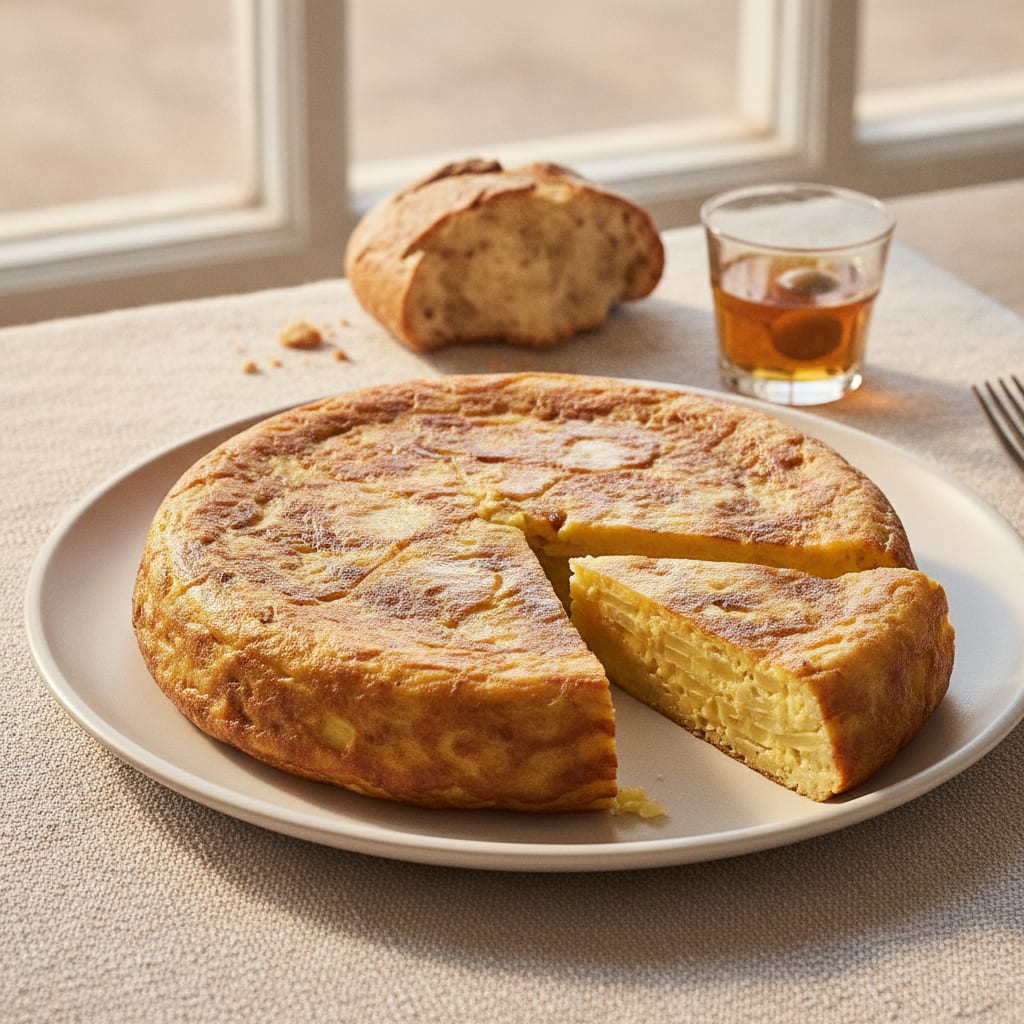
Spain's potato omelette, two ways: confited potatoes folded into a black-salt chickpea custard, set barely — the runny poco hecha middle intact.
- Prep
- 20 min
- Cook
- 40 min
- Total
- 1h
- Servings
- 4
- Difficulty
- Medium
Getting ready…
Ingredients
For 4 servings · 12 items
For the potatoes
For the custard
Method
7 steps · check as you go
- →
Serve
Serve in fat wedges, warm or at room temperature, with crusty bread and a glass of vermut. In a Valencia bar it comes as a pincho — a thick slice over a slice of baguette, eaten standing up. The barely-set middle, the poco hecha, is the point: it should be juicy, almost spoonable at the centre, never dry.
The story
The tortilla española is two ingredients and a fight. Potato, egg, and — if you are a concebollista — onion, argued over so hard that Spaniards have split into camps with names: the concebollistas who want the onion, the sincebollistas who refuse it. Nobody agrees on its history either. For years the first written record was thought to be an 1817 Navarrese document on the hard lot of the peasantry; then a 1798 Extremaduran text surfaced, and in 2017 the food historian Ana Vega found the dish named in a Valencian document from 1767. So the omelette I learned in Valencia may well have been first written down in Valencia, two and a half centuries before I got there.
I was cooking arroces at La Riuà in the summer of 2018, in the lanes off the Plaza de la Reina in El Carmen, and the tortilla was not on my station — it was the thing the cooks ate standing up at four in the afternoon, between services, cut from a pan that someone’s abuela logic had governed. The cook who made it, a woman who had been there longer than anyone could remember, pressed the back of a spoon into the centre before she’d serve it. If it didn’t give, she put it back on the heat for someone else and made a new one. Poco hecha, she said. Barely done. A tortilla you can stand a knife up in is a brick.
This tortilla has no egg in it. It has potatoes and onion slow-cooked in olive oil, folded into a custard of chickpea flour, soy milk, and aquafaba, seasoned with black salt for the sulphur that reads as egg. The method does not move: the confit, the fold, the rest, the single committed flip, the wobble in the middle. It is not a “vegan version” of a tortilla. It is a tortilla, poco hecha, made with what is in my hands.
À la maison
The weeknight reading is the recipe above, and it asks two things of you: cook the potatoes low and slow in the oil, and do not overcook the second side. The confit is where the texture is won — soft potato that melts into the custard, not fried potato that fights it. The black salt is what makes it taste like a tortilla rather than a chickpea pancake; add it raw and go gently. And when you flip, commit. One decisive turn with a plate and a steady wrist, and you have it. Rest it before you cut, and leave the middle barely set.
Au bistrot
The bistronomique reading keeps the poco hecha heart and dresses the plate around it. Cook the tortilla in a small pan — 16 cm — so it comes out tall and proud, the cross-section dramatic, the centre deliberately underset so it slumps a little when cut. While it rests, build two companions. First, a slick of alioli loosened to a sauce: aquafaba, garlic, and olive oil blended to a pale mayonnaise, brightened with lemon, spooned in a comma across the plate. Second, a confit-tomato jam — cherry tomatoes cooked down slow with a thread of smoked pimentón and a little sherry vinegar until jammy and dark, a sharp red counterpoint to the soft gold of the omelette.
Plate it as a single thick wedge, standing on its cut face so the layered interior faces the room and the just-set middle catches the light. Drag the alioli comma behind it. Drop a quenelle of the tomato jam at the wedge’s point. Scatter a few leaves of frisée dressed in only oil and salt, and a dusting of smoked pimentón across the plate’s edge. A glass of cold vermut rojo with an orange twist alongside. Everything on the plate exists to throw the runny centre into relief — the tortilla is the dish, the rest is framing.
El emplatado — Tight three-quarter, eye-level with the cut face. White plate, single tall wedge standing on its base, the glossy underset middle lit from the side. Alioli comma behind, a quenelle of dark tomato jam at the point, smoked pimentón dust on the rim. The plate should say this omelette has a secret, not this omelette is fussy.
What the other recipes get wrong
Most vegan tortilla recipes online — I read the top ten in February 2026 — reach for one of three binders: silken tofu blended smooth, a commercial liquid egg, or chickpea flour and water alone. I ran the test over a long weekend in February 2026: nine tortillas, same confited potatoes, same pan, same heat, only the custard changing across three builds plus their variations.
- Silken tofu blended: set firm and sliceable but bland and slightly bouncy, with a tofu coolness in the middle that no amount of black salt covered. It reads as tofu, not omelette.
- Chickpea flour and water only: the cleanest flavour but it set dense and a touch grainy, with none of the tender quiver of a real tortilla. A pancake with potatoes in it.
- Chickpea flour + soy milk + aquafaba + kala namak: tender, custardy, juicy at the centre, with the faint sulphur lift that makes your brain say egg. Not close. A different category.
The reason is protein and how it sets. Egg sets because its proteins coagulate into a soft, water-holding gel around 65–70°C. Chickpea-flour batter sets too, but on its own it sets dense. Soy milk brings extra protein and, crucially, the aquafaba — chickpea-brine albumins that whip and trap a little air — give the custard the give and lift egg white would. The kala namak does no setting at all; its hydrogen sulphide simply supplies the eggy aroma your nose expects. Drop any one piece and the tortilla loses a dimension: the body, the lift, or the smell. Together, across all nine batches, they made something that sliced and quivered like the dish from La Riuà.
The line I draw
I will not cook a tortilla until it is firm all the way through. The whole identity of a good tortilla española is the poco hecha centre — barely set, juicy, almost spoonable where the custard meets the potato. The moment you cook it solid, you have made a different and lesser thing: a dense potato cake that slices clean and tastes of nothing in particular. A tortilla should wobble when you set the plate down. If it doesn’t, you cooked the soul out of it. I would rather serve one a touch too loose than one cooked to a brick.
When this can fail
Three ways, all from my own kitchen between 2022 and 2026:
- The greasy slab. Didn’t drain the confited potatoes, poured the oil-logged lot straight into the custard, and the finished tortilla wept oil onto the plate. Fix: drain the potatoes well over a bowl for a full five minutes, keep the strained oil for cooking, and only the potato — not the oil — goes into the batter.
- The broken flip. Got timid at the turn, hesitated halfway, and the tortilla folded and tore across the plate. Fix: loosen the edges first, use a plate wider than the pan, and flip in one fast, committed motion — no half-measures.
- The curry tortilla. Heavy hand with the turmeric “for colour,” and the whole thing tasted of a spice tin. Fix: turmeric is for colour only — a quarter teaspoon at most. The egg note comes from the kala namak, not from spice.
FAQ
QHow do you make a tortilla española without eggs?
Build a custard from chickpea flour, unsweetened soy milk, and aquafaba, seasoned with kala namak (black salt) for the eggy sulphur note. The chickpea flour and soy protein set into a tender, sliceable body the way beaten egg would, and aquafaba adds lift. Confit the potatoes and onion slowly in olive oil first, fold them into the custard, then cook it in a pan and flip it once. It sets into a thick omelette with a barely-set middle — the same dish, made without eggs.
QTortilla española con cebolla or sin cebolla — which is correct?
Both are correct, and Spain has argued about it for decades. The concebollistas want onion for sweetness and moisture; the sincebollistas want only potato and egg. In a 2025 poll cited across Spanish press, roughly 73% preferred con cebolla — with onion. Slowly cooked onion also adds sweetness and moisture that helps a chickpea custard stay juicy, which is why this recipe uses it. Leave it out if you are a sincebollista; the method is otherwise unchanged.
QWhat is kala namak and why is it in the tortilla?
Kala namak, or Indian black salt, is a sulphur-rich rock salt whose hydrogen sulphide content smells and tastes startlingly of egg. A scant teaspoon gives the chickpea custard the savoury, faintly sulphurous note that reads as a potato omelette rather than a chickpea pancake. Use it sparingly and add it raw — heat dulls the aroma — and do not substitute ordinary salt, which adds none of that character.
QWhy is my vegan tortilla dry or chalky in the middle?
Two usual causes. First, the chickpea batter went into the pan before it had hydrated — rest it 10 minutes so the flour fully absorbs the liquid. Second, the second side cooked too long. For the traditional poco hecha texture, cook the flipped side only 3–5 minutes so the centre stays juicy and barely set. Resting the cooked tortilla 10 minutes lets it firm from residual heat instead of overcooking on the flame.
QCan I make tortilla española ahead of time?
Yes — it is arguably better the next day. Cook it, cool it, and keep it covered in the fridge up to 3 days. The chickpea custard firms as it chills and the flavour settles. Serve it cold or at room temperature, the way Spanish bars do, or warm a wedge briefly in a low oven. Do not microwave it hard, which dries the potato and tightens the custard.