Brava means fierce.
Patatas bravas.
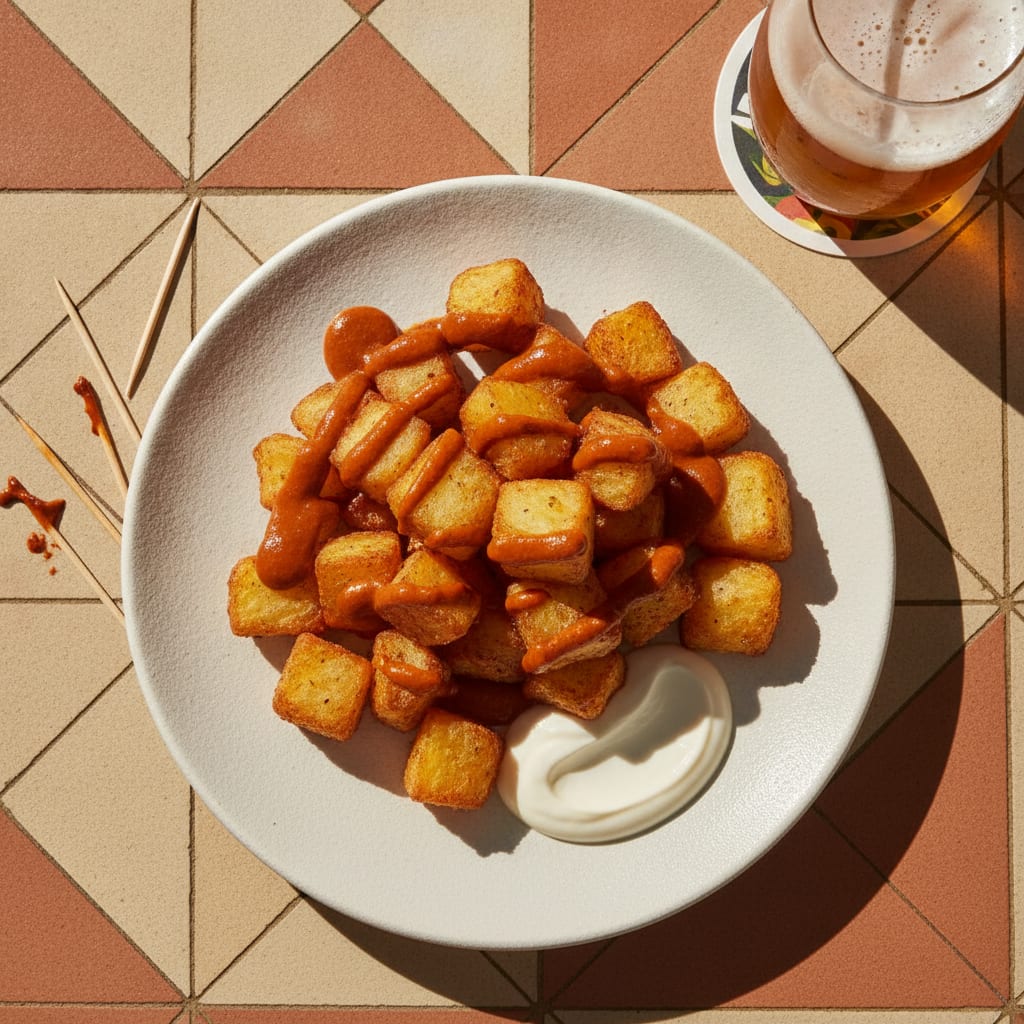
Madrid's bar potatoes, two ways: twice-cooked crisp cubes under a real pimentón salsa brava — paprika, never ketchup — and a garlic-bright alioli.
- Prep
- 15 min
- Cook
- 35 min
- Total
- 50 min
- Servings
- 4
- Difficulty
- Easy
Getting ready…
Ingredients
For 4 servings · 17 items
For the potatoes
For the salsa brava
For the alioli
Method
6 steps · check as you go
- →
Serve
Serve straight from the fry, sauced and on the table within two minutes, with toothpicks and cold beer or vermut. In Madrid bars the sauces often arrive separate so the potatoes stay crisp until the last second — do that if you like. The two-sauce plate, red brava and white alioli, is the Madrid standard; purists in some bars serve only the brava.
The story
Patatas bravas are the most argued-over plate of potatoes in Spain, and most of the argument is about a sauce that, outside Spain, is almost always made wrong. The dish itself is young — food historians trace it to the Madrid of the 1950s and 60s, to bars like the now-vanished Casa Pellico on Calle Toledo, where queues formed for fried potatoes under a fierce red sauce. The sauce is the whole point, and the sauce is pimentón — Spanish paprika — not tomato, and under no circumstances ketchup. That is the line the whole dish stands on.
I learned that the summer I spent at La Riuà in 2018, cooking arroces in the lanes of El Carmen in Valencia. Bravas weren’t ours — they came from the bar two doors down, where the owner made his brava sauce in a battered saucepan every morning and went quiet and offended if you called it tomato sauce. “No lleva tomate,” he told me the first time, jabbing a finger. It has no tomato. He bloomed his pimentón off the heat, for ten seconds, no more, because paprika burns to bitterness in the time it takes to answer the phone. I watched him do it a dozen times before I understood the timing was the recipe.
These bravas have nothing animal in them, and they never needed anything animal. Twice-cooked potatoes, a real pimentón salsa brava, and an alioli built on aquafaba instead of egg. The method does not move — the parboil, the steam-dry, the gentle fry then the fierce one, the paprika bloomed off the flame. It is not a “vegan version” of bravas. It is bravas, the way the man two doors down made them, made with what is in my hands.
À la maison
The weeknight reading is the recipe above, and it asks for two things: dry potatoes and a careful hand with the paprika. The crisp is won before the fry — parboil, then let the cubes steam-dry until their surface is matte, not wet. Then fry twice if you can, gentle then fierce, or roast them hard in a hot oven. The sauce is the soul: bloom the pimentón off the heat for ten seconds and no more, because burnt paprika is bitter and there is no coming back from it. Sauce at the last second, eat at once.
Au bistrot
The bistronomique reading takes the same three elements and composes them instead of piling them. Cook the potatoes as fondant cubes: trim them into neat 3 cm dice with flat tops and bottoms, parboil and dry them, then start them in a hot pan with oil to gild every face before finishing crisp — so each cube is a square, deliberate, browned on all sides. Reduce the salsa brava further, until it is glossy and clings, and pass it through a fine sieve so it pools clean and bright. Whip the alioli a touch firmer so it pipes.
Plate it as a line of cubes, not a pile: five fondant potatoes set in a row down a long plate, each one a little tower. Pipe a precise dot of alioli on top of each. Spoon the reduced salsa brava in a single clean swipe beneath the row, so the rust-red reads as a base, not a drizzle. A dusting of sweet pimentón across the plate’s edge and a single fried bay leaf for scent. Each cube is a one-bite version of the whole bar plate — crust, fluffy middle, fierce red, garlic white — built to be eaten in order down the line.
El emplatado — Straight overhead, long rectangular plate. Five gilded potato cubes in a row, a dot of piped alioli crowning each, a single clean swipe of reduced brava beneath. Pimentón dust on the rim, one fried bay leaf. The plate should say the bar dish, read slowly — order and restraint where the bar version is glorious chaos.
What the other recipes get wrong
Most patatas bravas recipes online — I read the top ten in March 2026 — get the sauce wrong in the same way: they reach for tomato, or worse, a tomato-and-mayonnaise-and-hot-sauce blend, and call the potatoes done after one fry. I ran the test over two days in March 2026: eight plates, same potatoes, comparing the sauce builds and the frying method side by side.
- Tomato-based “brava”: pleasant, but sweet and ketchup-adjacent — it tasted of a different dish, a saucy potato, not the dry-edged paprika heat of a real brava. No fierceness.
- Single fry: crisp for ninety seconds, then leathery; the interior never went properly fluffy, and the crust collapsed the moment the sauce touched it.
- Pimentón sauce + twice-fried: the real thing. Rust-red, smoky, with a clean paprika heat and a crust that held under the sauce long enough to eat.
The reason the sauce works is the paprika and how you treat it. Pimentón is dried, smoked red pepper ground fine; its colour and aroma compounds are fat-soluble and fragile, and they bloom — release into the oil — at gentle heat, but scorch and turn acrid above it within seconds. That is why it goes in off the flame, stirred for ten seconds into hot oil, never fried. The authentic Madrid brava has carried this paprika base since the 1950s precisely because it is paprika, not tomato, that makes the sauce brava. The twice-fry, meanwhile, is simple physics: a low first fry to gelatinise and fluff the starch inside, a high second fry to dehydrate and vitrify the surface into a hard crust. Drop either the paprika discipline or the second fry and the plate falls apart — bitter sauce, or soft potatoes. Together, across all eight plates, they gave the bar plate I remember.
The line I draw
I will not put tomato in a salsa brava. Not “just a little for body,” not a spoon of passata to round it out. The sauce that makes patatas bravas brava is a paprika sauce — pimentón, garlic, stock, vinegar — and the moment tomato goes in, you have made a different and lesser plate: saucy potatoes that could be from anywhere. Brava means fierce, and fierce comes from the paprika’s dry, smoky heat, not from tomato’s sweetness. If you want tomato sauce on potatoes, make that honestly and call it that. But it is not bravas.
When this can fail
Three ways, all from my own kitchen between 2022 and 2026:
- The bitter sauce. Threw the pimentón into the pan over full heat and let it cook, and the whole sauce turned acrid and dark. There is no rescuing burnt paprika. Fix: pull the pan off the flame, stir the pimentón in for ten seconds only, then add the liquid straight away.
- The soggy cube. Fried wet potatoes once, sauced them early, and served a plate of soft, oil-logged squares. Fix: steam-dry the parboiled cubes until matte, fry twice, and sauce them at the very last second — within two minutes of the table.
- The split alioli. Poured the oil in too fast and lifted the blender too early; the emulsion broke into a greasy slick. Fix: keep the blender flat on the bottom and the oil stream slow until it visibly thickens, then lift slowly. If it splits, start with a fresh tablespoon of aquafaba and dribble the broken mix back in.
FAQ
QDoes real salsa brava have tomato in it?
No — the authentic Madrid salsa brava is built on pimentón (Spanish paprika), not tomato, and certainly not ketchup. The classic bar version is onion and garlic softened in oil, thickened with a little flour, bloomed with sweet and hot pimentón, and loosened with stock and vinegar. The tomato-and-ketchup versions common abroad are a later shortcut. The heat and the rust-red colour come from the paprika, which is what makes the potatoes brava — fierce.
QWhy are my patatas bravas not crispy?
Almost always moisture or a single fry. Parboil the cubes first, then steam-dry them in the colander so the surface is dry before frying. Then fry twice: once gently at 150°C (300°F) to cook the inside, once fiercely at 190°C (375°F) to form the crust. And sauce them at the very last second — potatoes sitting under sauce go soft within minutes. Use floury potatoes, not waxy, for a proper fluffy interior under the crust.
QWhat kind of potato is best for patatas bravas?
Floury, high-starch potatoes — Maris Piper, King Edward, or russet. Their low moisture and high starch give a fluffy interior and a crust that crisps hard. Waxy potatoes hold together but go leathery rather than crisp, and never get that shattering shell. Cut them into generous 3 cm cubes so there is enough soft interior to contrast the crust.
QHow do you make alioli without egg?
Use aquafaba — the brine from a can of chickpeas — in place of egg yolk. Blend it with garlic, lemon, and salt, then drizzle in neutral oil slowly with a stick blender until it emulsifies into a thick, glossy garlic mayonnaise. The aquafaba proteins stabilise the oil the way yolk would. Keep the oil stream slow and the blender still at the start so the emulsion sets rather than splits.
QCan I make patatas bravas in the oven instead of frying?
Yes. Parboil and steam-dry the cubes, toss them in 4 tablespoons of oil, and roast at 220°C (425°F) for about 25 minutes, turning once, until deep golden and crisp. They will be a little less shatteringly crisp than twice-fried but genuinely good. The sauces are unchanged — make the pimentón salsa brava and the aquafaba alioli exactly the same way.