Bowl meets world.
Kinoko Ramen.
An eight-hour mushroom-and-kombu broth, coal-blackened onion, soy-tare, alkaline noodles, and the lessons Tetsu's broth taught me in Sapporo.
- Prep
- 30 min
- Cook
- 8h
- Total
- 8h 30min
- Servings
- 4
- Difficulty
- Ambitious
Getting ready…
Ingredients
For 4 servings · 27 items
For the broth (start the night before or 8 hours ahead)
For the tare (the seasoning base, one tablespoon per bowl)
For the aromatic fat (one teaspoon per bowl)
For the toppings
Method
10 steps · check as you go
- →
Serve
Serve immediately — within 60 seconds of plating. Set warm bowls, chopsticks, and a deep soup spoon (a *renge*) on the table. Sapporo ramen is eaten leaning over the bowl, slurping the noodles to cool them, alternating between noodle bites and broth sips. A cold *Sapporo* beer is the local pairing. No bread.
The story
I spent a year at Tetsu’s counter in Sapporo, from February 2020 to February 2021 — a ramen-ya called Wakō, eight seats, a tiled wall behind the pass, the windows fogging from the steam by ten in the morning. Tetsu was in his late fifties then, second-generation, his father’s apron still hanging on a nail above the prep table. He did not speak English. I did not speak Japanese well enough to follow him at speed. What we shared was technique — the gestures of a shared kitchen, the skimming spoon, the kombu pulled at the exact second before the boil, the onion held over the flame until it was visibly black. The morning I want to write about was a Tuesday in November 2020, when the snow first came down to street level and Tetsu let me work the broth station for the first time. He skimmed foam off the broth ninety times in six hours. I counted.
The version below is the closest I have gotten to that broth in my Washington kitchen. It uses kombu, dried shiitake, dried porcini, ginger, garlic, scallion whites, and the coal-blackened onion Tetsu taught me. It simmers for eight hours at a bare tremble — never a boil. It is finished with a soy-mirin-sake tare and a garlic-ginger aromatic fat that floats on the surface and releases its perfume at every spoonful. It is, to my taste, the most ramen-like ramen I can make without using pork bones.
It is not Tetsu’s broth. Tetsu’s broth had bonito and bones and thirty-two years of muscle memory. What this broth has is the same technique, the same temperature discipline, the same eight hours of patience — and what it does not have is what makes it the Maison Teulade version. The dish is the dish. The fact that I’m not using bones does not make it a different dish. It makes it my ramen.
A few notes before you begin.
The cold extraction of kombu is the foundation. Four hours minimum. Overnight is better. The water will turn pale gold without ever being heated. This is the umami base — pulling out the glutamates without the bitterness.
The bare simmer is non-negotiable. Frémissant, the French say — trembling. Small bubbles rising occasionally to the surface, not breaking. A hard boil ruins the broth: it makes it cloudy, sharp, slightly bitter. If your stove won’t go low enough, use a heat diffuser or transfer to the smallest burner and watch carefully.
Skim diligently. Every 30 to 40 minutes, lift the foam off the surface with a wide flat skimmer. This is what Tetsu did, ninety times in a morning. The foam is the off-flavor compounds rising out. Don’t skip it.
The coal-blackened onion is the trick. Hold an onion half over an open flame with tongs until both cut surfaces are visibly black. This takes 60 to 90 seconds. The char dissolves into the broth and gives you the deep caramelized backbone that the absent pork bones used to provide. There is no plant-based ramen worth eating without this step.
The aromatic fat is the lipid load. Garlic and ginger and scallion infused gently into neutral oil over low heat for 8 to 10 minutes, then strained. A teaspoon of this oil goes onto each bowl just before the broth. It floats. It releases its perfume into the steam. It is doing the structural job that rendered pork fat does in real tonkotsu — adding richness, carrying flavor, signaling to the diner that this is the real thing.
The noodles cook separately and are added at the absolute last second. Ramen noodles that sit in broth — even for a minute — become soft and gummy. Cook them in unsalted water, drain, divide into warm bowls, add the tare and oil and broth, then top. The diner should start eating within sixty seconds of plating. This is a non-negotiable rule of ramen and the most common failure mode of home cooks.
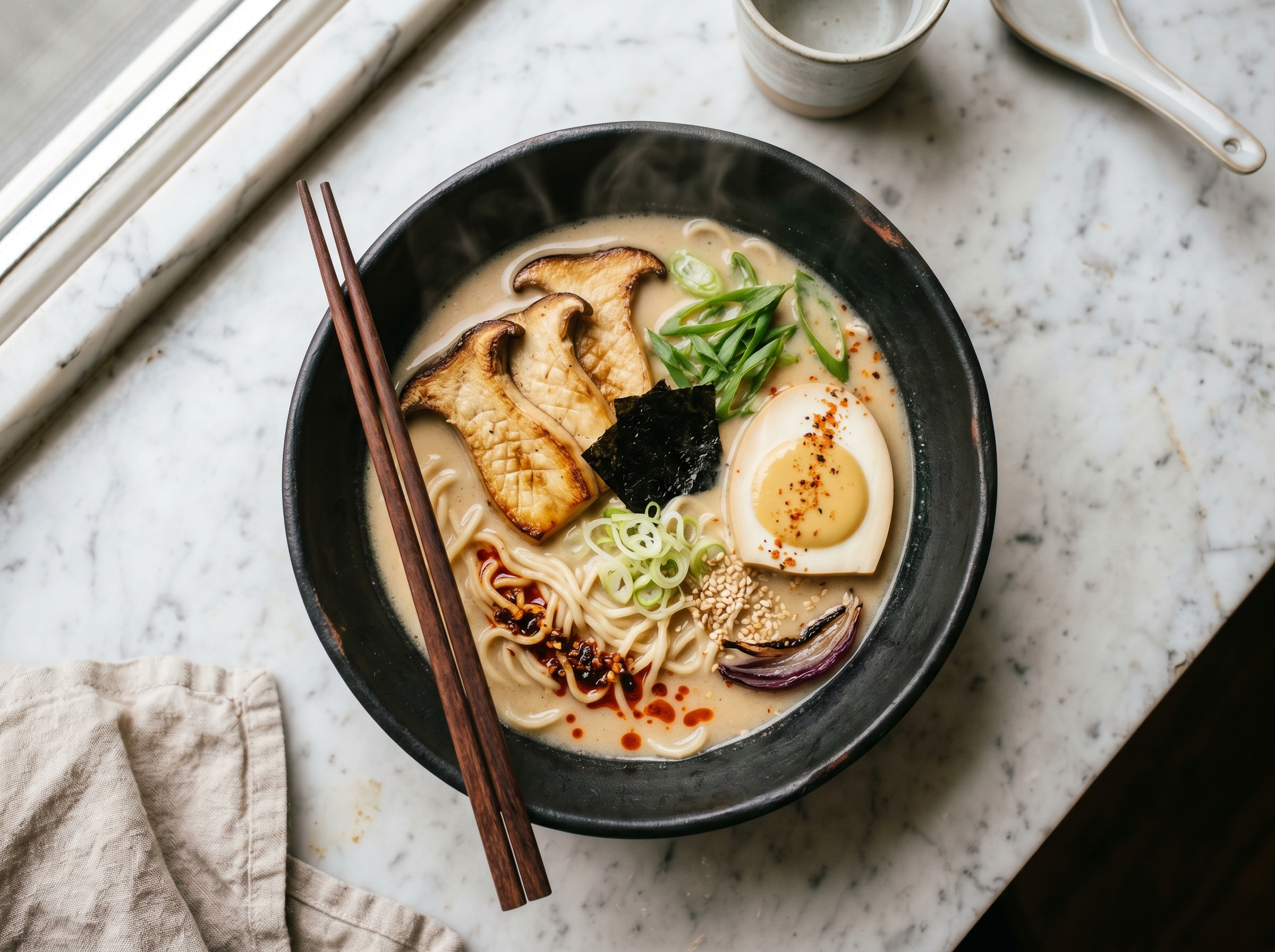
The toppings are spare. One disc of marinated and seared tofu. A small mound of bamboo shoots (menma). A single sheet of nori standing in the broth. A generous handful of sliced scallion greens. Sesame seeds. Chili oil on the side for those who want it. That is the bowl. Resist the urge to overload it.
What the other recipes get wrong
Most plant-based tonkotsu recipes online — I checked the top ten in March 2026 — solve the body problem with either kombu alone, shiitake alone, or a thickener like cornstarch slurry or roasted soy milk. I tested three eight-hour broths in a row over a long February weekend in 2026, in my Washington kitchen, controlled to the gram: one kombu-only, one shiitake-only, one kombu-plus-shiitake-plus-porcini. Here is what I found:
- Kombu alone: clean umami, glassy mouthfeel, almost no body. The broth tasted like a refined dashi and looked like one. Beautiful for a chawanmushi. Not ramen.
- Shiitake alone: deep mushroom flavor, a slight sulphur edge, a slick of body from the polysaccharides. Closer to ramen than kombu-only, but the flavor profile leaned woodsy rather than savory.
- Kombu + shiitake + porcini, plus coal-blackened onion: amber, glossy, the surface beading slightly when you ladled it. The collagen-like body that tonkotsu broth gets from pork bones came from the combined polysaccharides of the two mushroom varieties plus the kelp glutamates. The blackened onion gave the caramelized backbone.
The combination that worked, every time, across all three broth tests: kombu cold-extracted overnight, dried shiitake and porcini in tandem, coal-blackened onion held over a gas flame until visibly black, eight hours at a bare tremble. Drop any one and the broth thins. The coal-blackened onion in particular is what Tetsu taught me, and the difference is the difference between a soup and a ramen.
The line I draw
I will not serve this broth clear. The broth must be murky — slightly cloudy, the way pork-bone tonkotsu is cloudy, the way Tetsu’s broth was cloudy. The cloudiness is the emulsified polysaccharides and the dispersed aromatic fat. A clear broth is a dashi. A murky broth is a ramen. If your broth comes out clear after eight hours, you did not simmer hard enough at the very tail end, you did not use enough mushroom, or you strained it through a paper coffee filter. Strain through a fine-mesh sieve, not paper. Reduce at medium heat for the last twenty minutes if the broth still looks thin. The murkiness is the dish.
When this can fail
Three ways, all from my own kitchen between 2022 and 2026:
- The hard boil. Forgot the broth on the stove and turned to chop scallions; came back to a rolling boil with the kombu still in the pot. The broth turned cloudy in the wrong way — slimy, sharp, faintly bitter, with a fishy edge from the over-extracted kombu. Eight hours of work compromised in ninety seconds. Fix: pull the kombu the moment the surface starts to tremble, and use a heat diffuser or the smallest burner on your stove for the long simmer.
- The under-charred onion. Held the onion over the flame for thirty seconds — pale brown, not black. The broth tasted clean but flat, lacking the caramelized backbone Tetsu’s broth had. Fix: hold the onion over the flame until the cut face is visibly black at the edges, with a coal-tar smell rising. Sixty to ninety seconds per side. If it scares you, you are doing it right.
- The noodles sitting in the broth. Plated four bowls, walked away to find the chili oil, came back two minutes later. The noodles had soaked up broth and gone soft, and the bowls’ worth of broth had thinned. Fix: have every topping ready before the noodles hit the pot. Drop noodles, drain at ninety seconds, divide into bowls, ladle broth, hand the bowl to the diner immediately. Sixty-second rule from pot to chopsticks.
This is a Saturday dish. Start the kombu soaking on Friday night. Begin the simmer on Saturday morning at nine. Eat at five. Pour yourself a cold Sapporo beer. Eat leaning over the bowl, slurping the noodles to cool them, the way the Japanese eat ramen, the way Tetsu’s customers ate at Wakō in Sapporo.
This is dinner. The whole dinner. Made with the technique I learned from a man I could not talk to, in a city that was teaching me without using any words.
FAQ
QHow do you make a vegan ramen broth as rich as tonkotsu?
Three techniques combined. First, a long cold extraction of kombu (4 hours minimum, overnight ideal) to build a deep umami foundation without bitterness. Second, an 8-hour bare-simmer with dried shiitake, dried porcini, ginger, garlic, and coal-blackened onion — the blackened onion is critical, providing the deep caramelized backbone normally supplied by pork bones. Third, a garlic-ginger-infused aromatic fat that floats on the finished broth, supplying the lipid richness tonkotsu broth gets from rendered pork fat. The combination produces a broth with body, depth, and structure that reads as ramen.
QWhat kind of noodles should I use for ramen?
Fresh alkaline wheat noodles — *chukamen* in Japanese, often labeled 'ramen noodles' in American supermarkets. These contain *kansui*, an alkaline mineral water that gives ramen noodles their springy bite and yellow color. Refrigerated *Sun Noodle* brand is widely available in the US and excellent. Dried chukamen are acceptable; Italian dried wheat noodles, soba, udon, and rice noodles are not — they have different protein structures and produce a different dish.
QWhat is tare in ramen and why does it matter?
Tare is the concentrated seasoning base that goes into each bowl before the broth is added. The broth itself is unseasoned — its job is to provide body and depth. The tare provides salt, sweetness, and flavor character (soy-based for shoyu ramen, miso-based for miso ramen, salt-based for shio ramen). Keeping the seasoning separate from the broth means the cook can serve multiple ramen styles from a single base broth, and the diner gets a hot, freshly-balanced bowl every time. One tablespoon of tare per bowl is the standard ratio.
QCan I make ramen broth in less than 8 hours?
A 4-hour version is acceptable — same ingredients, same technique, but the broth will be lighter and less concentrated. A pressure-cooker version (2 hours at high pressure) gets close to the 6-hour result. Anything under 2 hours total cook time produces a broth more akin to a clear dashi than to tonkotsu-style ramen broth. The cold-soak step is non-negotiable regardless of cook time — without it, the umami foundation is thin.
QWhy coal-blacken the onion for ramen broth?
The deep char on the onion creates compounds (similar to those produced by aging or smoking) that dissolve slowly into the broth and contribute a caramelized, almost meat-like backbone. In animal-stock ramen, this depth comes from the bones and connective tissue. Without the bones, the coal-blackened onion is the closest plant equivalent — and it's the trick that ramen chefs across Japan have been using to add depth to *gyokai* (seafood) and other lighter broths for decades. Tetsu at Wakō in Sapporo taught me this. Read the [Sapporo postcard](/postcards/from-sapporo) for the full story.