Sour from lime, never from vinegar.
Tom Yum.
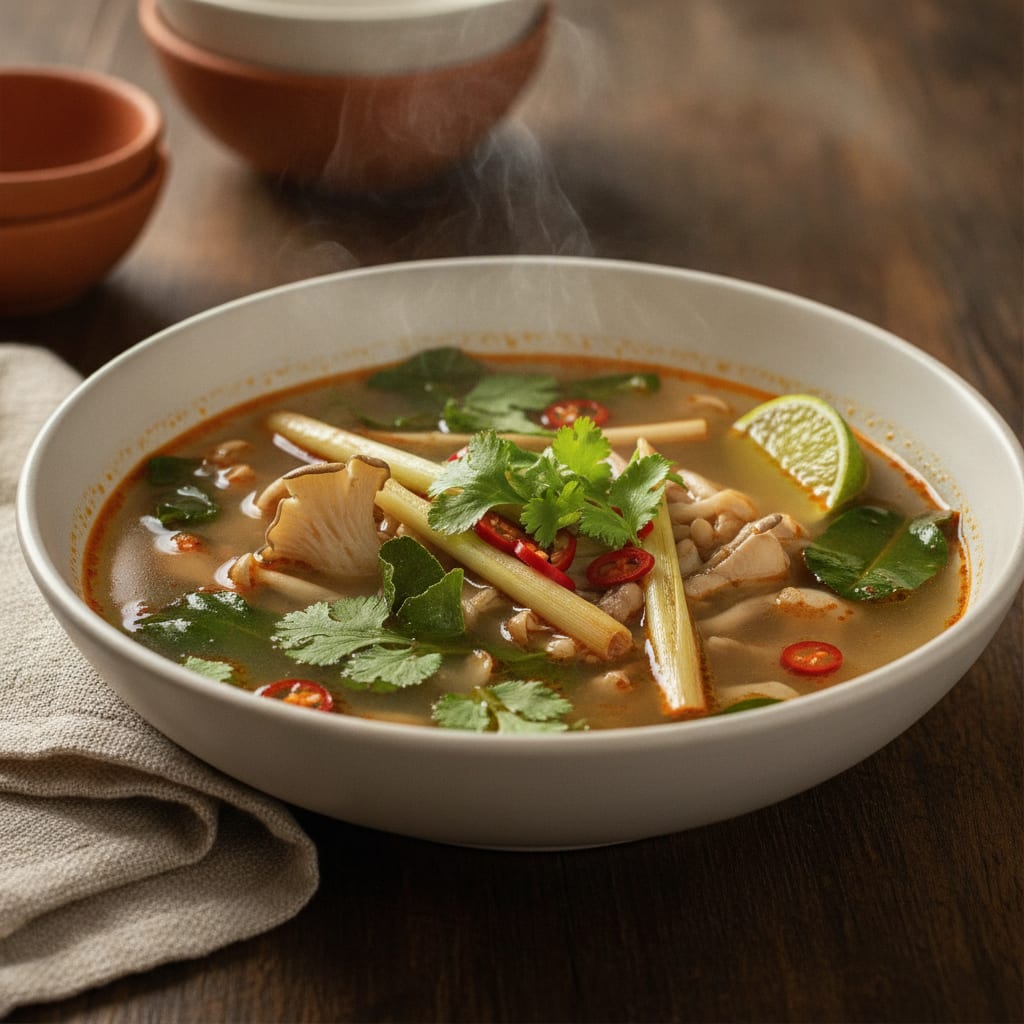
Thailand's hot-and-sour soup, two ways: a clear broth on lemongrass, galangal and makrut lime, with mushrooms and a sourness from lime, not vinegar.
- Prep
- 15 min
- Cook
- 20 min
- Total
- 35 min
- Servings
- 4
- Difficulty
- Easy
Getting ready…
Ingredients
For 4 servings · 15 items
For the aromatic broth
For the body
To finish (off the heat)
Method
6 steps · check as you go
- →
Serve
Serve screaming hot, in bowls, ideally before or alongside a plate of jasmine rice — tom yum is a soup eaten with a meal, not as a separate course. Leave the lemongrass, galangal, and lime leaves in; they are understood to be inedible and pushed aside. Set out lime wedges, sliced bird's eye chili, and a little dish of extra nam prik pao so each person can sharpen their own bowl.
The story
I first cooked tom yum properly in March 2025, in my own kitchen in Washington, D.C., after a Saturday run to the Asian grocery up Rockville Pike with a friend who grew up eating it in Bangkok — she is the one who stopped my hand at the stove. I had the lime juice in the pot, the broth at a hard boil, and she reached over and turned off the burner. “Not yet,” she said. “It dies if you boil it.” She made me taste the broth before the lime, then after, off the heat, the citrus suddenly bright and alive on the top of the soup. The galangal smelled of pine and something almost medicinal. That was the lesson: tom yum is a soup of timing, and the timing is the lime.
The aromatic trinity of tom yum is lemongrass, galangal, and makrut lime leaf — a citrus-pine-floral chord that no single ingredient can fake. They are not chopped to be eaten; they are bruised, simmered, and pushed aside. Around them you build heat from chili, smoke from roasted chili paste, and a sourness that comes — this is the rule — from fresh lime, never from vinegar.
This tom yum has no shrimp in it. It has a mushroom-kombu broth for body, oyster and straw mushrooms where the shrimp would be, and light soy where the fish sauce would be. The trinity is unchanged, the lime-last rule is unchanged, the heat is unchanged. It is not a “vegetable version” of tom yum. It is tom yum, made with what is in my hands now.
À la maison
The weeknight reading is the recipe above, and it asks two things of you. First, bruise the aromatics and leave them big — you want their oils in the broth, not their fibers in your teeth. Second, and this is the whole soup: take the pot off the heat before the lime goes in. Season in the order salty, sweet, sour, tasting as you go, and let the soup land sour-forward. Everything else — the mushrooms, the tomatoes, the chili paste — is forgiving. The lime is not. Serve it the moment it is balanced; tom yum does not improve sitting.
Au bistrot
The bistronomique reading keeps the soup clear — nam sai, the original — and turns it into a composed first course, the broth poured tableside over a still-life of garnish.
Clarify the aromatic broth: simmer the trinity, then strain it through a cloth-lined sieve until it is brilliant and free of solids, and reserve it hot. Sear a few oyster mushrooms hard in a dry pan until their edges crisp and brown, so they read as deliberate rather than poached. Confit a few cherry tomatoes in a little oil with a thread of chili until they slump but hold. Make a small quenelle of nam prik pao softened with a spoon of the broth. In a wide, shallow bowl, arrange the seared mushrooms, the confit tomatoes, a single curl of makrut lime leaf cut into a fine chiffonade, a few coins of red chili, and a brushstroke of the chili paste off-centre. Squeeze the lime directly into the hot clarified broth in a jug at the last second — never before — then pour it over the arrangement at the table, so the steam carries the lemongrass up as the bowl fills. The sourness arrives bright because it has not seen heat.
Le dressage — Overhead, then a second frame at the pour. Wide white bowl, garnish arranged off-centre in odd numbers, broth poured tableside catching an orange chili-oil sheen. A fine chiffonade of lime leaf, two coins of red chili, negative space. The plate should say clarity and heat held in balance — a street soup read at a white tablecloth.
What the other recipes get wrong
Most tom yum recipes online — I read the top ten in February 2026 — sour the soup too early and too dully. They tell you to add lime juice while the pot is simmering, or worse, to reach for vinegar or tamarind as the main acid. I ran the test over a week in February 2026, four pots, same broth, same aromatics, same mushrooms — only the souring changed.
- Vinegar, added while simmering: flat and harsh. A one-note sharpness that sat on top and fought the makrut lime leaf. It tasted like hot-and-sour soup, not tom yum.
- Lime juice, boiled in for 5 minutes: the citrus had gone tired and dull, the bright top note cooked off. Sour, but lifeless — the soup tasted like it had been sitting an hour.
- Tamarind as the main acid: rounder and fruitier, but muddy and brown; it pushed the soup toward a massaman register and lost the high citrus clarity.
- Fresh lime juice, off the heat, at the very end: bright, layered, alive. The sourness sat in the same citrus register as the lemongrass and lime leaf and lifted the whole bowl. This was not close.
The reason is chemistry, not opinion. Lime juice carries volatile aromatic compounds — the same citrus terpenes family that the lemongrass and makrut lime contribute — and those volatiles flash off quickly under heat. Add lime early and you keep the citric acid but lose the perfume, leaving a dull sourness. Vinegar’s acetic acid has no aromatic top note at all to lose or keep; it reads as flat. The fix is mechanical: kill the heat, then sour. Every pot, across the week, the off-heat lime tasted like tom yum and the others tasted like soup that was almost tom yum.
The line I draw
I will not sour tom yum over the heat. Not “just to warm it through,” not to save a step. The entire identity of the soup is a bright, perfumed sourness that lives in the same register as its aromatics, and that brightness is volatile — it cooks off in a minute or two of simmering. The moment the lime hits boiling broth, the top note flattens and you are left with a dull, flabby acidity that tastes tired before it reaches the table. Off the heat, then lime, then serve. The friend who turned off my burner was right.
When this can fail
Three ways, all from my own kitchen between 2022 and 2026:
- The dull, tired sour. Added the lime while the pot was still on a low simmer, told myself it would be fine, and served a soup that tasted an hour old — flat sourness, no lift. Fix: take the pot fully off the heat, then add lime juice a spoon at a time, tasting, right before serving.
- The bitter broth. Left the makrut lime leaves and galangal simmering for half an hour while I did something else; the broth turned harsh and faintly bitter. Fix: extract the trinity for about 10 minutes, no longer, then move on to the mushrooms and finish.
- The accidentally-not-vegan bowl. Stirred in a jar of nam prik pao without reading the label; it was full of dried shrimp. Fix: check every roasted chili paste for shrimp, buy a vegan jar, or make your own from shallots, garlic, chili, and tamarind.
FAQ
QWhat is the difference between tom yum nam sai and nam khon?
Nam sai is the clear version — the original — a translucent broth carried entirely by the aromatic trinity, lime, and chili. Nam khon is the creamy version, made by stirring in evaporated milk (or coconut milk) along with extra nam prik pao, which clouds the broth and softens its edges. The recipe above is nam sai. To make nam khon, whisk 120ml of coconut or evaporated milk and an extra spoon of chili paste into the finished soup off the heat. The clear version is sharper and more aromatic; the creamy version is rounder and richer. Both are real tom yum.
QWhy must the sourness come from lime and not vinegar?
Tom yum's signature is a bright, perfumed sourness that sits in the same register as its citrus aromatics — lemongrass and makrut lime. Fresh lime juice provides exactly that, layered citrus acidity with floral top notes. Vinegar gives a flat, one-dimensional sharpness that fights the lime leaf instead of harmonizing with it. The lime also goes in off the heat, at the very end, because its volatile aromatics cook off quickly — a tom yum soured early and boiled tastes dull and tired.
QCan I use ginger instead of galangal?
Not without changing the dish. Galangal is sharper, more citrusy, piney, and almost medicinal; ginger is warmer and sweeter. Substitute ginger straight across and the broth tastes noticeably, unmistakably wrong — a different soup. If galangal is truly unavailable, the least-bad workaround is a little ginger plus extra lemongrass and makrut lime to push the citrus side, but it will lack galangal's grounding, woodsy depth. Frozen galangal, sold at any Asian grocery, is far better than fresh ginger here.
QHow do I make tom yum without fish sauce or shrimp?
Tom yum is defined by its aromatic trinity, its lime sourness, and its chili heat — not by shellfish. Build the broth on a kombu-shiitake or mushroom stock for savory body, use mushrooms in place of the shrimp, and season with light soy sauce or a vegan fish sauce instead of the fish-based one. Check your nam prik pao label, as many roasted chili pastes contain dried shrimp; vegan jars are widely sold, or you can make your own from shallots, garlic, chili, and tamarind. The soup reads as tom yum because it follows tom yum's rules.
QDo you eat the lemongrass and lime leaves in tom yum?
No. The lemongrass batons, galangal coins, and makrut lime leaves are aromatics — left in the soup to keep perfuming it, but pushed to the side of the bowl, not eaten. They are too fibrous and woody to chew. This is why you cut them into large, recognizable pieces rather than mincing them: so they are easy to see and avoid. The mushrooms, tomatoes, and broth are what you eat.