Soy, the old way.
Shoyu Ramen.
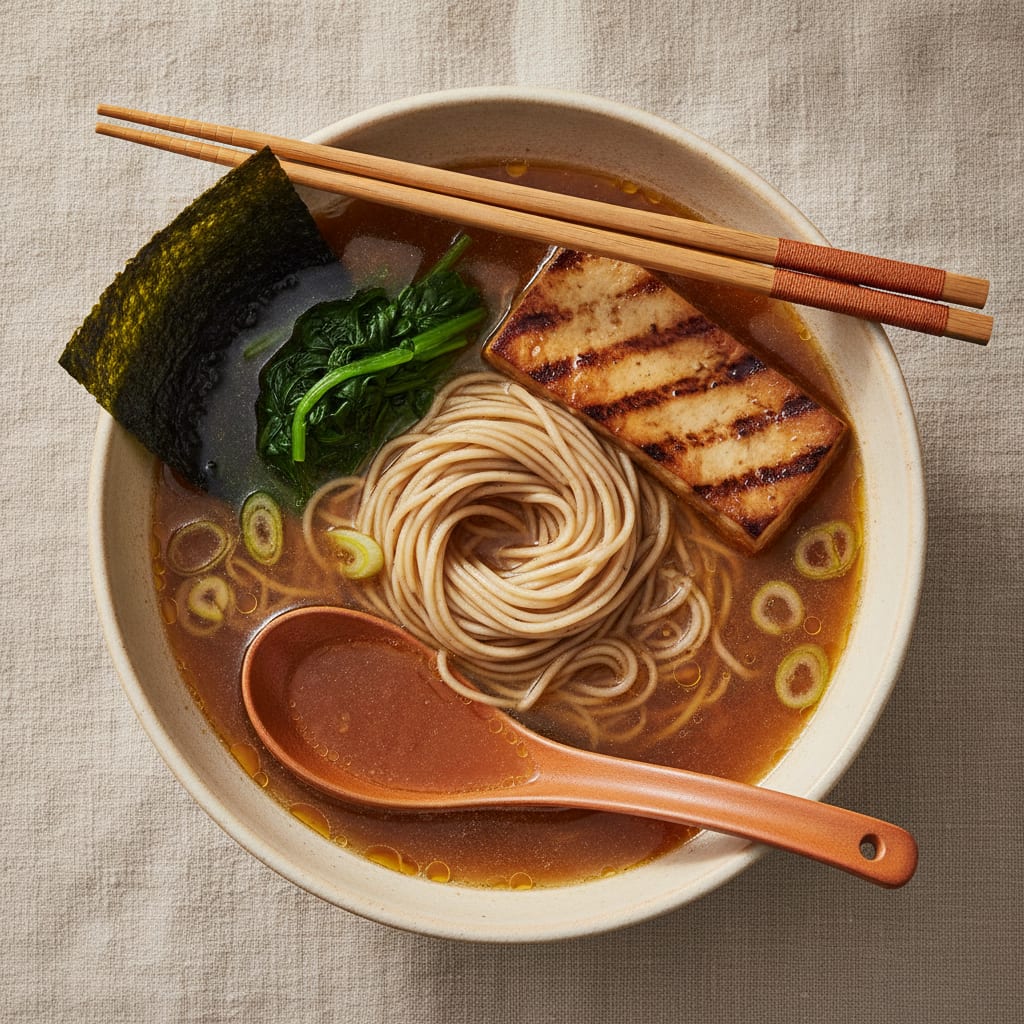
Tokyo-style soy ramen, two ways: a clear kombu-shiitake-roasted-vegetable chintan broth, a layered shoyu tare, alkaline noodles, restraint in the bowl.
- Prep
- 40 min
- Cook
- 2h 30min
- Total
- 3h 10min
- Servings
- 4
- Difficulty
- Ambitious
Getting ready…
Ingredients
For 4 servings · 22 items
For the chintan broth (clear)
For the shoyu tare (1.5 tbsp per bowl)
For the aroma oil (1 tsp per bowl)
For the toppings
Method
8 steps · check as you go
- →
Serve
Serve immediately, within a minute of building the bowl. Set out warm bowls, chopsticks, and a renge spoon. Eat leaning over the bowl, slurping the thin noodles to cool them and aerate the broth. A clear shoyu ramen is meant to taste light and deep at once — drink the broth between noodle bites while it is scalding.
The story
I spent a year at Tetsu’s counter in Sapporo, from February 2020 to February 2021 — a ramen-ya called Wakō, eight seats, the windows fogged with steam by mid-morning. Tetsu cooked a heavy Hokkaido broth most days, but on the slow Mondays he would make a clear one, a chintan, and serve it shoyu. He treated it with a different kind of care entirely. The murky broth forgave a hard boil; the clear one did not. “Sukoshi,” he’d murmur, turning the flame down and down — a little, a little — until the surface only shivered. A Monday in October 2020, the first cold rain on the glass, he handed me a bowl of it: amber, see-through, light as tea and deep as a well at once. I had been chasing the murk for months. He was showing me the other half of ramen.
Shoyu ramen is the oldest face of the dish. In 1910, a Tokyo restaurant called Rairaiken, in Asakusa, served what is remembered as Japan’s first soy-sauce ramen — Chinese noodles in a broth seasoned with Japanese shoyu — and it spread from there across the country. This bowl follows that line: a clear broth of kombu, dried shiitake and roasted vegetables, a layered soy tare, thin alkaline noodles, almost nothing in the bowl.
It is not a “vegetable version” of shoyu ramen. It is shoyu ramen: a clear broth, a soy tare, the restraint of a translucent bowl, made with what is in my hands now.
À la maison
The weeknight reading is the recipe above, and it asks for the opposite of the murky broth’s discipline. There, you boil and char; here, you roast to gold and hold a tremble, because the whole point of shoyu ramen is a broth you can see through. Two moves carry it: roast the vegetables sweet but never black, and never let the pot boil. The tare does the rest — a soy-mirin-sake blend steeped with a little extra kombu and shiitake, so it tastes deep instead of just salty. A teaspoon of aroma oil on top gives the fatless broth its gloss and its perfume.
Au bistrot
The bistronomique reading keeps the clarity sacred and builds a more deliberate bowl around it.
I take the chintan one step further toward a true consommé: I whisk a few tablespoons of aquafaba into the cold strained broth, bring it to a bare tremble without stirring, and let the foam set into a raft that traps every last fine particle, then ladle out a broth so clear you can read through it. The tare gets its own refinement — I steep it cold for a day with an extra strip of kombu and a dried shiitake, so the soy rounds out and loses its raw edge. For the plate, the tofu becomes a single seared, shoyu-glazed batonnet rather than a slice; the menma is warmed in a little tare; the greens are blanched, squeezed and rolled into a neat log and cut, so they stand up in the bowl. A few drops of scallion aroma oil are placed, not poured, so they bead on the surface like the old chi-yu. The noodles are nested high and tight. Then the consommé is poured at the table, in front of the guest, clear and scalding, so the steam climbs as the bowl fills. The whole composition is about transparency — a bowl you look into.
Mori-tsuke — Overhead, and a second frame at the pour. A shallow dark bowl so the amber clarity glows. Toppings placed in a quarter-arc, odd numbers, off-centre, with real negative space — the broth is the subject, not the garnish. The aroma-oil beads catching a hard side light. The plate should say clarity, not abundance.
What the other recipes get wrong
Most plant-based shoyu ramen recipes online — I read the top ten in March 2026 — make the clear-broth mistake in reverse: they char the vegetables black, or boil the pot hard, treating shoyu like tonkotsu and ending up with a cloudy, heavy broth wearing a soy tare. So I ran the test: five broths over a week in March 2026, in my Washington kitchen, same kombu-shiitake base, same tare, changing only how the vegetables were treated and how hard the pot ran.
- Black-charred onion, hard simmer: cloudy, heavy, slightly bitter. It tasted like an under-built tonkotsu, not a shoyu. The murk fought the delicate soy tare.
- Raw vegetables, gentle simmer: clear, yes, but thin and green-tasting — no depth, the tare sitting on top of water.
- Deep-roasted (golden, not black) vegetables, bare tremble, strained without pressing: translucent amber, sweet and deep, the tare reading clearly through a clean broth. This was the bowl. It was not close.
The reason is food science, not preference. Clarity is a function of how much insoluble matter you drive into suspension: a rolling boil emulsifies fat and churns fine particles back into the liquid, while a bare tremble lets them coagulate and rise as skimmable foam. Roasting to deep gold builds Maillard and caramel depth that dissolves cleanly; pushing to black char produces carbon and bitter compounds that cloud and muddy. And the tare’s job — layering kombu glutamate and shiitake guanylate onto soy’s own savor — only registers against a clean broth; in a murky one it is lost. Across all five, golden-roasted-plus-tremble won every time. A clear broth is a discipline, not an accident.
The line I draw
I will not char the vegetables black for a shoyu ramen, and I will not let the pot boil. Shoyu ramen is a clear soup — that translucency is the dish, the thing Tetsu turned the flame down and down to protect. The moment you blacken the onions or push the broth to a rolling boil, you have made a cloudy broth, and a cloudy broth is a different dish: it belongs under a miso or a tonkotsu tare, not a delicate soy one. The black char and the hard boil are the right moves for a murky bowl, and the wrong moves here. If I want murk, I make the Kinoko Ramen. If I want shoyu, I keep it clear.
When this can fail
Three ways, all from my own kitchen between 2022 and 2026:
- The cloudy broth. Walked away and let the pot climb to a rolling boil; the clear amber I had built went hazy and flat, and the soy tare had nothing clean to read against. Fix: hold the bare tremble, skim as foam rises, and if it does cloud, clarify with an aquafaba raft rather than starting over.
- The flat tare. Made the tare with soy, mirin and sake alone, no kombu or shiitake steeped in; it tasted sharply salty and one-note in the bowl. Fix: steep a little kombu and dried shiitake into the warm tare and let it sit 30 minutes, so glutamate and guanylate round it out before it ever meets the broth.
- The bloated noodles. Cooked the noodles a minute early and let them sit while I arranged toppings; they swelled, went soft, and thinned the broth they sat in. Fix: every topping ready first, noodles boiled and drained last, into the bowl and to the table inside a minute.
FAQ
QWhat is the difference between shoyu ramen and tonkotsu ramen?
Shoyu ramen is built on a clear broth (chintan) seasoned with a soy-sauce tare; tonkotsu is built on a cloudy, emulsified broth boiled hard until fat and collagen disperse. They are nearly opposite disciplines. For shoyu you protect clarity — gentle roasting, a bare tremble, no pressing the solids — and let a layered soy tare carry the flavor. For a murky mushroom broth in the tonkotsu spirit, see our [Kinoko Ramen](/recipes/tonkotsu-ramen). Shoyu is the lighter, older, more translucent bowl.
QWhere did shoyu ramen come from?
Tokyo. In 1910, a restaurant called Rairaiken opened in Asakusa, run by Kanichi Ozaki, who staffed his kitchen with cooks from Yokohama's Chinatown. Rairaiken served what is widely credited as Japan's first soy-sauce ramen — Chinese-style wheat noodles in a broth seasoned with Japanese shoyu rather than salt — and it was a sensation, reportedly serving thousands of bowls a day. That soy-seasoned Tokyo bowl became the template for shoyu ramen. Rairaiken closed in 1976 and was later revived as a museum stall.
QWhat is tare and why is the broth unseasoned?
Tare is the concentrated seasoning base — for shoyu ramen, a soy-sauce blend — that goes into the empty bowl before the broth. The broth itself is left unsalted; its job is body, depth and clarity, not seasoning. Keeping them separate means one base broth can become shoyu, shio or miso ramen depending on the tare, and every bowl is balanced fresh at the moment of serving. The standard ratio is roughly 1.5 tablespoons of shoyu tare per bowl, adjusted to taste.
QHow do I keep the broth clear?
Three moves. Roast the vegetables to deep gold, not black char — char is for murky broths and clouds a clear one. Hold the pot at a bare tremble the whole simmer, never a rolling boil, skimming foam as it rises. And strain through a fine sieve without pressing the solids, letting it drip, so fine particles stay behind. Pull the kombu the moment the surface trembles, before it can boil and turn the broth slick and bitter.
QWhat noodles suit shoyu ramen?
Thin, straight alkaline wheat noodles (chukamen) suit a clear shoyu broth — they carry the light, savory soup without overwhelming it, and their springy bite comes from kansui, the alkaline mineral water worked into the dough. Thicker, wavier noodles are more at home in a heavier miso or tonkotsu bowl. Fresh refrigerated chukamen are best; good dried chukamen are fine. Soba, udon and rice noodles are different doughs and make a different dish.