Pick me up — Treviso's coffee cloud.
Tiramisu.
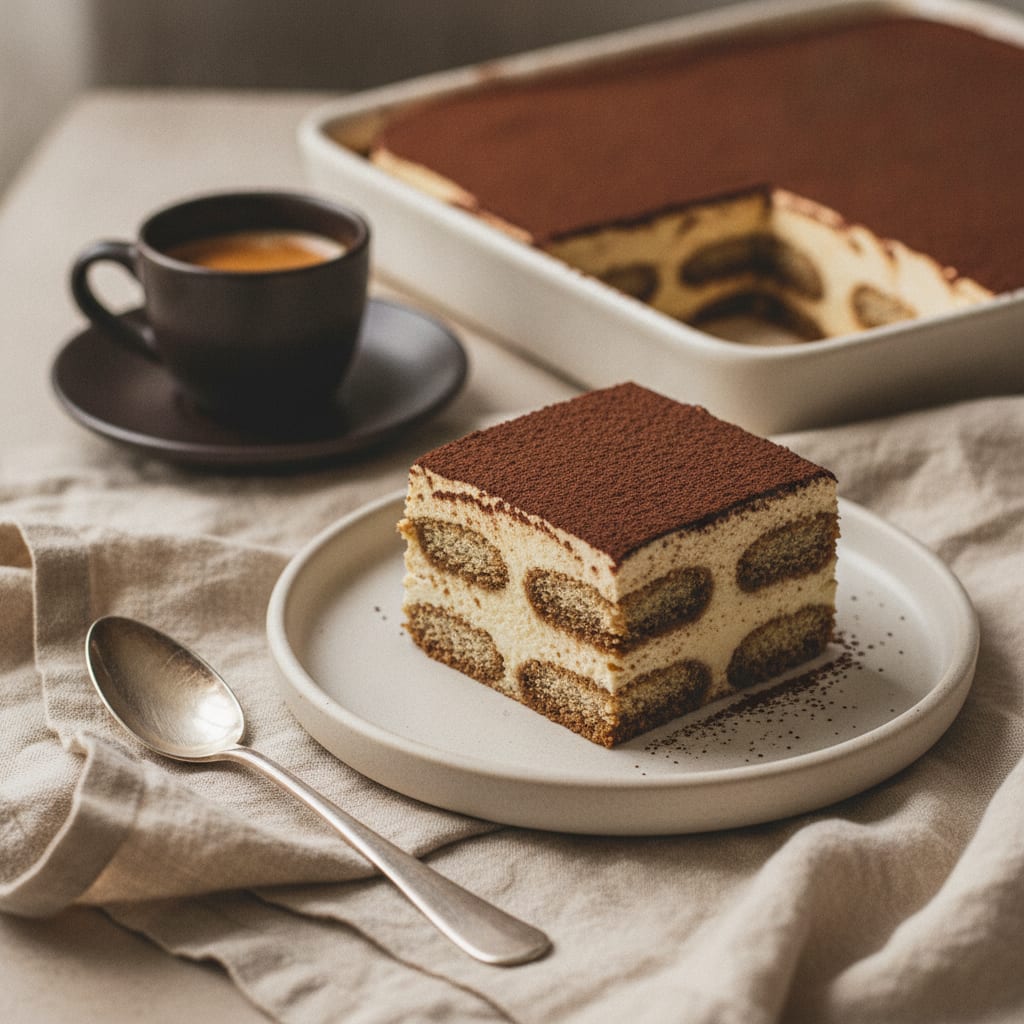
Treviso's coffee dessert, two ways: a whipped cashew-and-silken mascarpone set with aquafaba, espresso-soaked savoiardi, dusted bitter cocoa. No-bake, no egg.
- Prep
- 30 min
- Cook
- 0 min
- Total
- 6h 30min
- Servings
- 8
- Difficulty
- Medium
Getting ready…
Ingredients
For 8 servings · 14 items
For the mascarpone cream
For the aquafaba foam
For the soak and assembly
Method
8 steps · check as you go
- →
Serve
Serve cold, cut into neat squares with a warm knife, each dusted thick with bitter cocoa and a little grated dark chocolate. Tiramisu wants nothing alongside but a small, strong espresso — the same coffee it's built on. It keeps 3 days covered in the fridge and the flavour only deepens, though the top cocoa is best dusted fresh per serving.
The story
Tiramisu is younger than almost anyone wants it to be — barely older than the espresso machine that defines it. There’s no trace of it in old Italian cookbooks; the most widely cited story puts its birth at a restaurant called Le Beccherie in Treviso, in the Veneto, where tiramesù — “pick me up,” for the coffee — appeared on the menu in 1972, the work of Alba Campeol and a pastry chef named Roberto Linguanotto who, the story goes, stumbled on the cream while messing about with mascarpone and egg yolks meant for ice cream. Others claim it earlier and elsewhere — a Treviso baker says 1969, a Friuli account says 1959, and in 2017 the Italian government sided with Friuli and listed it as a regional specialty. The fights are part of the charm. What no one disputes is that it’s a modern dessert, invented in living memory.
I learned to make it in Naples, far from Treviso, in the spring of 2015, at Da Concettina, where I spent two years. The dessert station was run by a woman named Rosa who treated tiramisu with a seriousness I found funny until I understood it. She caught me leaving the savoiardi to swim in the coffee one afternoon and lifted them out, dripping and collapsing, with a look of real pain. “Un secondo,” she said. One second. She dipped a fresh one in and out so fast I barely saw it, and showed me how it came out moist but still whole, still itself. “È una spugna, non un pesce,” she said. It’s a sponge, not a fish. Don’t let it swim. The whole dessert, she told me, lives or dies on that one-second dip and a long cold rest.
This tiramisu has no egg and no dairy. The mascarpone is rebuilt from cashews, silken tofu, and coconut cream with a squeeze of lemon for the tang; the lift that whipped egg whites used to give comes from aquafaba, whipped to a meringue. The method is exactly Rosa’s — the one-second dip, the gentle fold, the long set in the fridge. It is not a “vegan tiramisu.” It is tiramisu, set the way a no-bake dessert sets, the only way it ever did.
À la maison
The weeknight reading is the recipe above, and it asks for two kinds of patience. First, at the coffee: dip each savoiardo one second a side and no more — it’s a sponge, not a fish, and a long soak is the single most common way home tiramisu turns to sludge. Second, at the fridge: this is a no-bake dessert that sets entirely by chilling, so give it six hours at the very least and overnight if you can. Whip the aquafaba to genuinely stiff peaks, fold it in gently to keep the air, and dust the cocoa on only at the end. Do those things and it slices into clean, cloud-light bands.
Au bistrot
The bistronomique reading is the same dessert, plated as individual glasses or quenelles instead of a cut square — tiramisu read as a restaurant dolce.
Build it in clear glasses for the strata, or set it in a tray and cut precise rounds with a ring. Push the components: pull a proper espresso for the soak so the coffee bitterness is real and deep, and lace it with a little Marsala. Pipe the aquafaba-mascarpone cream rather than spreading it, so the layers are clean and even, and break the savoiardi to fit the glass so each spoonful gets coffee biscuit and cream together. For the plate, set a quenelle of the cream beside a coffee-soaked savoiardo baton, a smear of cocoa, a few coffee-soaked cherries or a brittle shard of dark-chocolate-and-coffee tuile for crunch and height. Dust bitter cocoa over the whole plate at the last second, and grate dark chocolate so it falls in fine curls. A single coffee bean on the quenelle, the classic mark. The dessert should taste of espresso and bitter cocoa first, sweetness second.
Il piatto — Three-quarter, soft light, shallow depth of field. A clear glass showing clean strata of dark coffee biscuit and pale cream, dusted thick with cocoa, a chocolate shard standing up. Or a quenelle on a white plate with a cocoa smear and a single coffee bean. Negative space, warm low light, a cup of espresso just out of focus behind. The plate should say coffee and cloud — a simple dessert, composed with restraint, never fussy.
What the other recipes get wrong
Most egg-free tiramisu recipes online — I read the top ten in April 2026 — try to get the lift from coconut cream alone or a tub of vegan cream cheese, and skip the whipped element entirely. The result sets dense and heavy, a coffee cheesecake with none of tiramisu’s mousse-like air. I ran the test over a week in April 2026, four batches, same soaked savoiardi, same coffee, same overnight set, changing only how the cream got its body and lift:
- Coconut cream only: rich but heavy and one-note, and it set with an unmistakable coconut perfume that fought the coffee. Dense, not airy.
- Vegan cream cheese, no whip: tangy and thick but flat and pasty — it cut like cheesecake, not tiramisu, with no lightness at all.
- Cashew-tofu base, no whipped foam: better flavour, properly mascarpone-like, but still dense; with nothing whipped in, it never lifted.
- Cashew-tofu base + stiff-whipped aquafaba: light, mousse-like, just-set, with the airy texture tiramisu is supposed to have. Not close. A different category of dessert.
The reason is the egg’s second job. Classic tiramisu gets its richness from mascarpone and egg yolk, but its lift from whipped egg white folded in — and that air is most of the texture. Aquafaba, the brine from a can of chickpeas, is mostly low-molecular-weight albumin proteins, the same family of foaming proteins that make egg white whip; whisked with a little cream of tartar and sugar it builds a stable meringue-like foam that folds into the cream and gives back exactly the air the egg white used to. The cashew-and-coconut base does the mascarpone’s job of richness; the aquafaba does the egg white’s job of lift. Skip the whipped foam, as most plant recipes do, and no amount of coconut cream gives you anything but a dense set. Rosa’s dessert was never heavy — it was a cloud you could cut — and the whipped foam is how you keep it one.
The line I draw
I will not let the savoiardi soak. The whole texture of tiramisu balances on biscuits that are moist through but still hold their shape — soaked one second a side in cool coffee, in and out, never left to swim. The moment you leave them in the coffee to “make sure they’re soft,” they dissolve into a wet, structureless sludge, the layers collapse, and you’ve made coffee mush instead of tiramisu. One second. It’s a sponge, not a fish. And the coffee must be cool, or it turns them to paste before you’ve even started. Rosa lifted my drowning savoiardi out with a look I still remember, and she was right to.
When this can fail
Three ways, all from my own kitchen between 2022 and 2026:
- The soggy collapse. Left the savoiardi in the coffee a few seconds too long, and the whole bottom layer dissolved into wet sludge that wept across the dish. Fix: dip one second per side in cool coffee, in and out, no soaking — it’s a sponge, not a fish.
- The dense, heavy set. Underwhipped the aquafaba and folded it in half-hearted, so the cream lost its air and set like cheesecake. Fix: whip the aquafaba to stiff, glossy peaks and fold it in gently in additions, cutting and turning so you keep the air.
- The runny, unset slab. Cut into it after three hours because I was impatient, and the cream hadn’t firmed — it slid off the knife. Fix: chill at least 6 hours, ideally overnight; it’s a no-bake dessert that sets entirely in the fridge, and there’s no rushing it.
FAQ
QCan you make tiramisu without eggs?
Yes — the classic recipe uses raw egg, but the egg's two jobs (richness in the cream, air and set from whipped whites) can both be rebuilt. A blended base of cashews, silken tofu, and coconut cream gives the mascarpone richness, and whipped aquafaba — the brine from a can of chickpeas — stands in for whipped egg white. Aquafaba's albumin proteins whip into a stable meringue-like foam almost exactly as egg whites do, folding into the cream to give tiramisu its airy, just-set texture. The result is no-bake, no-egg, and genuinely tiramisu.
QWhere does tiramisu actually come from?
Its origin is disputed, but the most widely cited account places it at the restaurant Le Beccherie in Treviso, in the Veneto, where the dessert 'tiramesù' appeared on the menu in 1972, created from experimentation between Alba Campeol and pastry chef Roberto Linguanotto around 1971–72. Other claims exist — a Treviso baker dating it to 1969, and a Friuli account from 1959 that led the Italian government to list tiramisù as a traditional Friulian specialty in 2017. What's agreed is that it's a modern dessert, codified in the 1970s, not an ancient one. The name means 'pick me up,' for the coffee.
QWhat can I use instead of mascarpone in tiramisu?
Blend soaked raw cashews with silken tofu, the thick cream from a chilled can of coconut milk, icing sugar, a little lemon juice, and vanilla until completely smooth. The cashews and coconut cream supply mascarpone's fat and body, the silken tofu lightens it so it sets soft rather than dense, and the lemon gives the faint lactic tang of fresh mascarpone. Blend it truly smooth — any grain at this stage carries through to the finished cream.
QWhy did my tiramisu turn out runny or soggy?
Two usual causes. Runny means the aquafaba wasn't whipped to stiff peaks, or it was stirred in too hard and lost its air, so the cream never set — whip it to a firm meringue and fold gently. Soggy means the savoiardi were soaked too long; they're sponges and need only a one-second dip per side in cool coffee, not a soak. Then it must chill at least 6 hours, ideally overnight, to set properly, since it's a no-bake dessert that firms entirely in the fridge.
QHow long does tiramisu need to set, and can I make it ahead?
It needs at least 6 hours in the fridge and is best made the day before — overnight is ideal. As a no-bake dessert it sets entirely by chilling: the aquafaba cream firms to sliceable, the savoiardi soften evenly, and the flavours marry into one. It keeps 3 days covered in the fridge and actually improves over the first day. Dust the cocoa on fresh just before serving, since it goes damp if it sits too long on the surface.