Sweet-green, not mild.
Curry vert thaï.
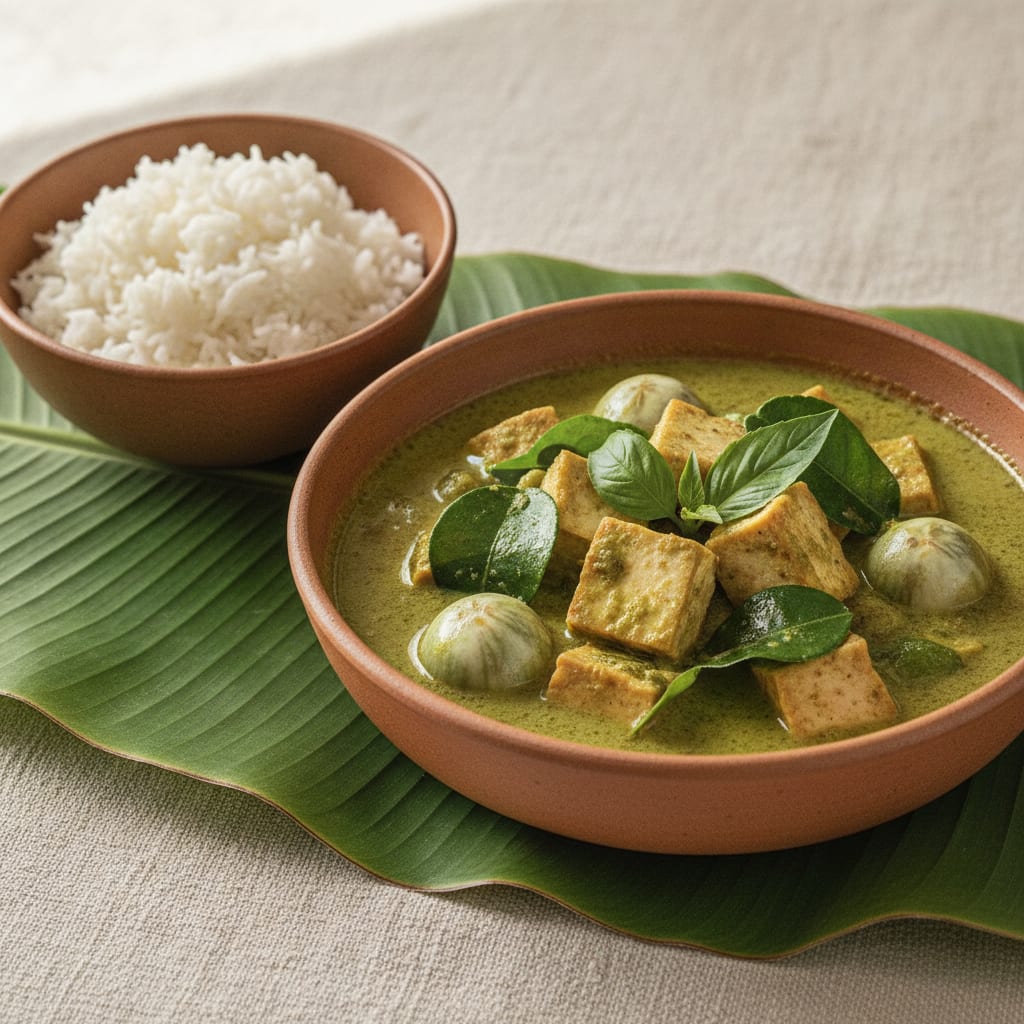
Thailand's green curry, two ways: a pounded green-chile paste, coconut cream cracked until the oil splits, eggplant and tofu, Thai basil and makrut lime.
- Prep
- 30 min
- Cook
- 30 min
- Total
- 1h
- Servings
- 4
- Difficulty
- Medium
Getting ready…
Ingredients
For 4 servings · 20 items
For the green curry paste (or use 4 tbsp good shop-bought)
For the curry
To finish
Method
6 steps · check as you go
- →
Serve
Serve the green curry in shallow bowls with the oily green sheen on top, plenty of jasmine rice alongside to catch the sauce, and the extra Thai basil, red chile, and lime at the table. The rice is not optional — green curry is a sauce dish, and the rice carries it. A cold beer or jasmine tea.
The story
The first thing to understand about green curry is that “green” is a colour, not a warning. The Thai name, kaeng khiao wan, gets translated as “sweet green curry,” and Western menus read sweet and green and quietly assume mild. It is not mild. The wan, the sweet, describes the soft creamy shade of green — that’s what Thais call that particular colour — and the green itself is green chiles, a lot of them, pounded into the paste, prik kaeng wan. Of the Thai curries, the green one is often the hottest. The name is a paint chip, not a heat rating. I’ve watched people order it expecting the gentle option and meet something with real fire behind the coconut.
I learned to make it properly in my Washington, D.C. kitchen over 2025, but I learned the crack — the move the whole dish turns on — watching a cook at a Thai kitchen who refused to let me stir the cream. “Wait,” she kept saying, holding my wrist back from the pan while the coconut cream bubbled and thickened and finally split, clear oil pooling green at the edges. “Now.” Only then did the paste go in, frying in that released oil until the kitchen smelled of chile and lime and galangal. I don’t have her name. I have the timing — the patience to let the cream crack before anything else happens.
This green curry has no shrimp paste and no fish sauce in it. It has a pounded paste of green chiles, lemongrass, galangal, makrut, and white miso where the shrimp paste was; cracked coconut cream; fried tofu and Thai eggplant; and makrut leaves and Thai basil thrown in off the heat at the end. The method is unchanged — the pound, the crack, the paste fried in the released oil, the late basil. It is not a “vegan green curry.” It is green curry, cracked the way green curry is cracked.
À la maison
The weeknight reading is the recipe above, and it asks one real thing of you: crack the cream and don’t rush it. Scoop the thick cream off the top of the can — don’t shake the can — and let it bubble until the oil splits out and pools clear at the edges. That released oil is what you fry the paste in, and it’s the difference between a deep, glossy curry and a pale, raw-tasting one. The other thing is the basil and makrut: they go in off the heat, at the very end, so their perfume survives. If you’re short on time, a good shop-bought green paste with a tablespoon of miso pounded in gets you most of the way — just still crack the cream and still fry the paste in the oil.
Au bistrot
The bistronomique reading is the same curry, split into a composed plate, the sauce read as the luxury it is.
Treat the cracked coconut cream as a sauce in its own right: after frying the paste and loosening with the milk, pass a ladleful through a fine sieve and reduce it to a glossy, spoon-coating green nappe with a visible oil sheen — that’s the sauce you’ll plate with. Fry the tofu into clean golden batons. Roast the Thai eggplant separately, cut-side down, until caramelized and just tender, so it reads as deliberate rather than stewed. Blister a few baby eggplant halves for char. Fry a few Thai basil leaves into crisp, translucent chips. Build a wide shallow bowl: a pool of the reduced green sauce, the tofu batons and roasted eggplant arranged off-centre, a fine julienne of makrut leaf and red chile across the top, the fried basil chips standing up, a single dot of coconut cream and a thread of chile oil. Mound the jasmine rice in a separate small bowl alongside — restraint on the plate, the rice within reach. Same heat, same makrut-and-basil top note, the cracked-oil sheen now a deliberate gloss.
Le dressage — Three-quarter, slightly above. A wide shallow bowl, a pool of glossy reduced green sauce with a visible oil sheen, tofu and caramelized eggplant arranged off-centre, makrut julienne and red chile across the top, crisp basil chips standing up. A small bowl of jasmine rice beside. Warm light to catch the oil sheen. The plate should say the curry refined to its sauce — heat and perfume, plated with restraint.
What the other recipes get wrong
Most Western green curry recipes online — I read the top ten in April 2026 — dump the paste straight into a can of coconut milk and simmer, skipping the crack entirely, and then boil the basil and makrut in from the start. Both flatten the dish. So I ran the test in my Washington kitchen over a week in April 2026, nine pots, the paste and aromatics held constant, two techniques moved: whether the cream was cracked and the paste fried in the released oil, and when the basil and makrut went in.
- Paste stirred into coconut milk, no crack; basil boiled from the start: pale, thin, raw-edged, with a flat coconut sweetness and almost no perfume by the time it was served — the basil had cooked to nothing and the chile read sharp rather than deep.
- Cream cracked, paste fried in the oil; basil boiled from the start: deep, round, glossy, the raw edge gone and the oil sheen on top — but the bright citrus-anise top note had still cooked off. The base was right; the perfume was lost.
- Cream cracked, paste fried in the oil; makrut and basil off the heat at the end: deep and glossy and alive on the nose — the citrus-anise lift of the makrut and basil sitting right on top of the rounded chile-coconut base. This was the dish.
The reasons are physical. When the coconut cream cracks, the oil breaks free of the emulsion as the water cooks off, and frying the paste in that hot released oil carries the fat-soluble flavor compounds out of the chiles, lemongrass, and galangal and cooks out their raw harshness — exactly what doesn’t happen when paste is simmered in watery milk. And the makrut and basil aromatics are volatile: a hard boil drives them off, so adding them off the heat and letting them steep keeps the perfume in the bowl. Crack the cream, fry the paste in the oil, and finish the herbs off the heat, and across all nine pots it stopped being a sweet coconut soup and started being green curry.
The line I draw
I will not skip the crack. Tipping curry paste into a can of coconut milk and calling it green curry is the single most common shortcut, and it produces a pale, flat, raw-tasting sauce that has the ingredients of a green curry and none of its depth. The whole architecture of a Thai curry rests on cracking the thick coconut cream until the oil splits out, then frying the paste in that released oil to bloom the aromatics and cook out the raw edge. That’s where the gloss comes from, where the rounded depth comes from, where the green of the oil comes from. It takes ten extra minutes and a little patience to wait for the split. Skip it to save the time and you’ve made a coconut soup with curry paste in it — not a green curry.
When this can fail
Three ways, all from my own kitchen between 2022 and 2026:
- The un-cracked, flat curry. Shook the can, dumped the paste in, simmered — and got a pale, watery, raw-tasting sauce with no gloss and no depth. Fix: don’t shake the can; scoop the thick cream off the top, crack it over medium heat until the oil pools clear at the edges, and fry the paste in that oil before any milk goes in.
- The perfume cooked off. Stirred the basil and makrut in early and let the whole thing boil for ten minutes; by serving it smelled of nothing. Fix: cut the heat first, then stir in torn makrut leaves and most of the basil, let them steep a minute, and garnish with the rest.
- The collapsed eggplant. Boiled the Thai eggplant hard to hurry it and it disintegrated into the sauce, taking its texture with it. Fix: keep the curry at a gentle simmer, add the eggplant first and watch it, and pull it the moment it’s just tender with a little bite.
FAQ
QWhy is Thai green curry called 'green' — is it the mild one?
No — green curry is often the hottest of the Thai curries, not the mildest. The Thai name, kaeng khiao wan, translates to 'sweet green curry,' but the 'sweet' (wan) refers to the soft, creamy shade of green itself, not to the taste. The green colour comes entirely from green chiles pounded into the paste. So the name describes a colour, not a heat level — and a proper green curry brings real chile heat behind the coconut richness.
QWhat does it mean to 'crack' the coconut cream?
Cracking is the defining technique of a Thai curry. You simmer the thick coconut cream — scooped unshaken from the top of the can — over medium heat until the water cooks off and the coconut oil separates and pools at the edges, an oily sheen breaking the surface. You then fry the curry paste in that hot released oil, which blooms the aromatics and cooks out the raw edge. Skip the crack and you're boiling paste in watery milk; the curry comes out flat and pale with none of the glossy oil sheen that signals it's done right.
QHow do you make green curry without fish sauce or shrimp paste?
The shrimp paste (kapi) in the curry paste and the fish sauce in the seasoning both supply funky, salty savor. Replace the shrimp paste with a tablespoon of white miso pounded into the paste, and the fish sauce with light soy or a vegetarian fish sauce. Both bring the salt and the fermented umami depth the originals carried. Keep everything else — the green chiles, lemongrass, galangal, makrut, coconut — and the curry tastes round and deep, not lean.
QWhat goes in green curry instead of meat?
Pan-fried firm tofu and Thai eggplant are the natural pair: the tofu, fried first so it holds and gives it a surface to drink the sauce, and Thai eggplant (small and round) or baby eggplant, simmered until just tender. Pea eggplant adds little bitter pops if you can find them. The eggplant goes in first to cook through; the fried tofu is folded in near the end so it stays intact and savory.
QWhen do I add the Thai basil and makrut lime leaves?
At the very end, off the heat. Both are aromatic and volatile — their bright citrus and anise perfume cooks off if you boil them. Tear the makrut leaves (discard the tough centre stem) and stir them in with most of the Thai basil once the heat is off, let them steep for a minute, then garnish with the rest. That late, gentle addition is what keeps the curry smelling fresh and alive.