A noodle by decree.
Pad thai.
Thailand's national stir-fry, two ways: soaked rice noodles, a tamarind-palm sugar-soy sauce, tofu two ways, garlic chives, bean sprouts, crushed peanuts, lime.
- Prep
- 30 min
- Cook
- 15 min
- Total
- 45 min
- Servings
- 4
- Difficulty
- Medium
Getting ready…
Ingredients
For 4 servings · 16 items
For the pad thai sauce
For the noodles and stir-fry
To finish
Method
7 steps · check as you go
- →
Serve
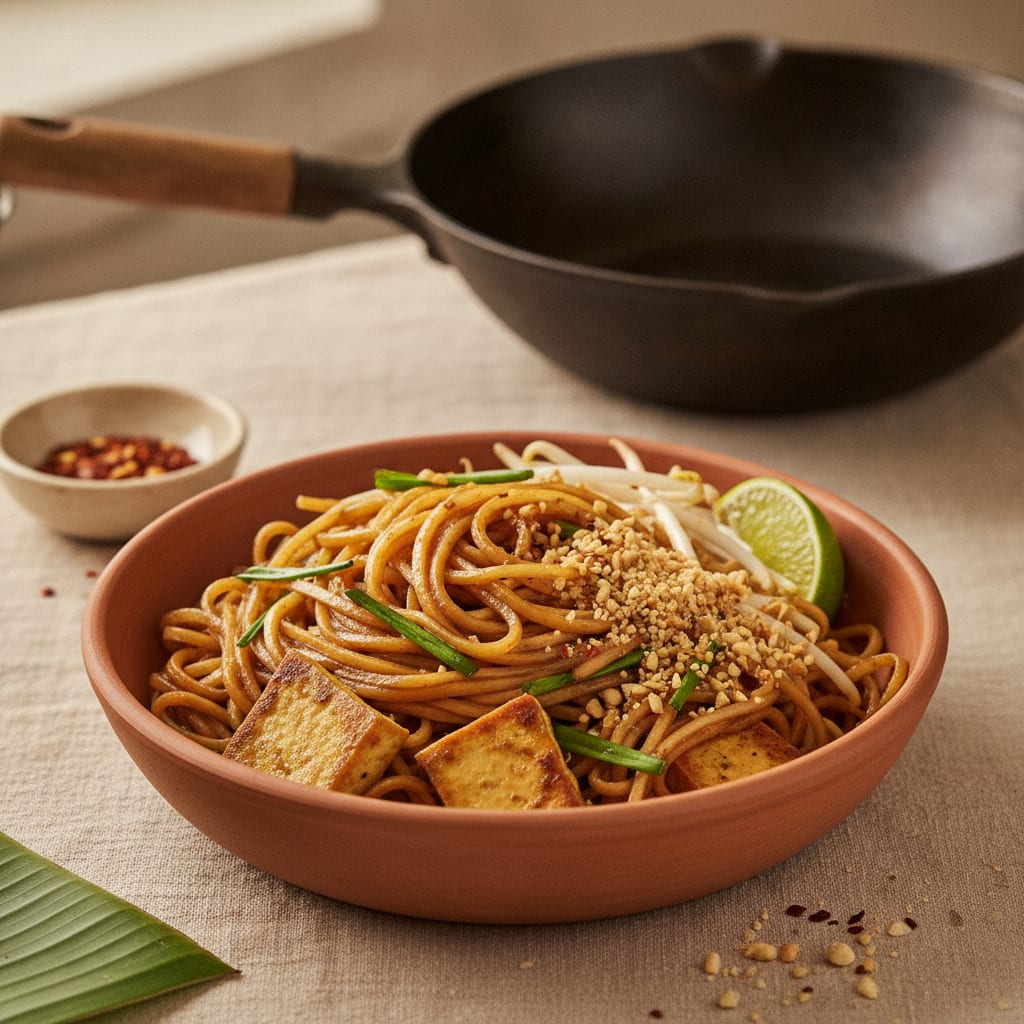
Pile the noodles high, crown with raw bean sprouts, crushed peanuts, a lime wedge, and chili flakes, and serve immediately while glossy and hot. Set out extra lime, chili flakes, sugar, and crushed peanuts so each person tunes their own plate — that final adjustment is part of how pad thai is eaten. A cold beer or iced tea.
The story
Pad thai was, in the most literal sense, an act of state. In the late 1930s and early 1940s, Prime Minister Plaek Phibunsongkhram — a man who looked at his own country and decided it was provincial and needed modernizing — promoted a rice-noodle stir-fry as the national dish of Thailand. It was nation-building on a plate: a unified Thai identity to set against the Chinese vendors he was pushing off the streets, and a practical answer to a wartime rice shortage, since a single bowl of rice could be milled into two bowls of noodles. The government handed out recipes and free noodle carts under a campaign called “Noodle is Your Lunch.” Most national dishes accrete over centuries. This one was, to a real degree, decreed.
I cooked my way to it in my Washington, D.C. kitchen across 2025, but I learned the balance from a cook at a Thai stall who let me watch her wok one lunch service and would not let me touch the tamarind. She’d taste the sauce off her finger, frown, add a pinch of palm sugar, taste again, and only then let it near the noodles. I don’t have her name — it was loud and fast and I was in the way. What I have is the lesson: the dish is decided in the sauce bowl, before the wok is even hot. Sour leading, sweet behind it, salt underneath. Get that and the rest is just heat and motion.
This pad thai has no fish sauce and no shrimp in it. It has a tamarind-and-palm-sugar sauce, soy and a pinch of seaweed where the fish sauce was, two tofus — one fried crisp, one pressed and chewy — garlic chives, bean sprouts, crushed peanuts, and lime. The method is unchanged: the warm soak, the balanced sauce, the screaming wok, the finish at the table. It is not a “vegan take” on pad thai. It is pad thai, balanced the way pad thai is balanced.
À la maison
The weeknight reading is the recipe above, and it lives or dies on two things you do before the wok is even hot: soak the noodles short, and balance the sauce in the bowl. Under-soak the noodles — pliable but still firm — because they finish cooking in the pan, and a noodle boiled soft will be paste by the time it’s plated. And taste the sauce cold, on a spoon, before anything goes in the wok: sour from tamarind, sweet from palm sugar, salt from soy, sour out front. Once those two are right, the stir-fry is ninety seconds of keeping everything moving over high heat. Finish at the table with raw sprouts, fresh lime, and chili so each plate gets its own last adjustment.
Au bistrot
The bistronomique reading is the same dish, the same sauce, plated tight instead of piled — pad thai as a composed course.
Cook the noodles exactly as at home, but pull them a touch firmer and twirl a neat nest per plate with a carving fork, so it stands tall and tidy rather than spreading. Sear the pressed tofu into clean golden batons and the firm tofu into crisp cubes, and arrange them deliberately rather than tossing them through. Reduce a little extra tamarind sauce to a glaze and brush it over the nest so it gleams. Make a peanut praline — peanuts caramelized and crushed to a coarse rubble — for a crunch that reads as intentional. Pickle a few bean sprouts briefly so they’re sharp and bright, and keep a few raw for crunch. Plate: the noodle nest off-centre, the tofu arranged around it, the garlic chives laid in a few clean lines, the peanut praline scattered, a single charred lime half for the squeeze, and a fine line of chili oil. Then a finishing touch of the raw sprouts on top, placed not piled. Same sour-sweet-salt balance, same crunch and lime — read once, cleanly, on a white plate.
Le dressage — Three-quarter, close. A tall tidy noodle nest off-centre on a white plate, tofu and garlic chives arranged around it, peanut praline scattered, a charred lime half, a line of chili oil. Side light to catch the gloss of the tamarind glaze. The plate should say the street cart, plated — the same dish, composed with restraint.
What the other recipes get wrong
Most Western pad thai recipes online — I read the top ten in March 2026 — reach for ketchup, or rice vinegar plus sugar, in place of tamarind, and boil the noodles soft. Both are shortcuts, and both change the dish. So I ran the test in my Washington kitchen over a week in March 2026, nine plates, the noodles and stir-fry held constant, three sauce bases compared head to head, plus a noodle-handling check.
- Ketchup + sugar + soy: gluey, candy-sweet, with a tomato tang that doesn’t belong. It’s what a lot of takeout tastes like, and it’s recognizably not pad thai — flat, one-note, sweet in the wrong key.
- Rice vinegar + sugar + soy: sharper and cleaner than the ketchup, but the sour is thin and acetic, a top-note that bites and vanishes with no body underneath.
- Tamarind + palm sugar + soy + a pinch of nori: deep, rounded, fruity sour with a long savory tail. Sour out front, sweet behind, salt underneath, and a faint marine note from the seaweed where the fish sauce used to be. This was the dish.
And on the noodles: the soaked-not-boiled batch finished springy and separate; the pre-boiled batch turned to paste and clumped in the wok, no matter how well the sauce was balanced. The reasons are concrete. Tamarind’s sourness comes with body and a touch of funk that vinegar’s clean acetic acid simply doesn’t have, and ketchup smuggles in tomato sweetness and a gluey texture that flatten the balance. The nori supplies a trace of the glutamate-rich marine umami fish sauce carried. And rice noodles are gluten-free, so they overcook into paste the instant they’re boiled — they have to hydrate slowly and finish in the wok. Move to tamarind and palm sugar, soak the noodles short, and across all nine plates it stopped being sweet takeout and started being pad thai.
The line I draw
I will not put ketchup in a pad thai. Tamarind is the sour soul of the dish — a deep, fruity, faintly funky sourness with real body — and the moment you swap it for ketchup you’ve traded that for tomato sweetness, a sharp acidic tang, and a gluey coat that sits on the noodles instead of soaking in. You get a sweet, red, sticky noodle that some people grew up calling pad thai, and I understand why; it’s just not the dish. Vinegar-and-sugar is closer but thin, a top-note sour with nothing under it. Use a wet tamarind block or a real concentrate, balance it against palm sugar and soy, and taste it cold before it ever hits the wok. The tamarind is the line. Cross it and you’re cooking something else.
When this can fail
Three ways, all from my own kitchen between 2022 and 2026:
- The paste of noodles. Boiled the rice noodles like spaghetti the first time, because that’s what you do with noodles. They went soft in the pot and dissolved into a clumped paste in the wok. Fix: soak in warm water until just pliable and still firm, drain, and let them finish cooking in the sauce in the pan. Under-soak on purpose.
- The flat, sweet sauce. Eyeballed the sauce straight into the wok without tasting and over-sugared it; the whole plate came out cloying, no sour to lift it. Fix: balance the sauce cold in a bowl first, on a spoon — sour from tamarind out front, then sweet, then salt — and adjust before any of it touches heat.
- The wilted everything. Threw the bean sprouts and garlic chives in early with the noodles; by the time it plated they’d collapsed into soft strings and the dish had no crunch left. Fix: fold sprouts and chives in off the heat at the very end, keep a handful raw for the top, and finish with lime and peanuts at the table.
FAQ
QWhat makes an authentic pad thai sauce without fish sauce?
Pad thai sauce is a balance of three things: sour from tamarind, sweet from palm sugar, and salty-savory from fish sauce. Keep the tamarind and palm sugar exactly as they are — they're the soul of the dish — and replace the fish sauce with light soy sauce plus a pinch of crumbled nori or seaweed for the marine umami fish sauce carried. The result hits sour, sweet, and salty at once, with sour leading. It tastes like pad thai because the tamarind-palm sugar-salt balance is pad thai.
QWhy use tamarind instead of ketchup in pad thai?
Tamarind is the authentic sour base of pad thai, and it's the line I won't cross. It gives a deep, fruity, slightly funky sourness with body, the backbone the whole dish balances on. Ketchup — used as a shortcut in many Western recipes — brings the wrong kind of sweet, a tomato tang, and a gluey texture, and the result is a different, flatter dish. Use a wet tamarind block or a good concentrate, and balance it with palm sugar and soy.
QShould I boil the rice noodles for pad thai?
No. Soak the dried flat rice noodles in warm — not boiling — water for 20 to 30 minutes until pliable but still firm, then drain. They finish cooking in the wok, in the sauce, which is why you under-soak them. Boiling them first turns the gluten-free noodles to paste, and they clump and break apart in the pan. The warm soak is the single most common thing home cooks get wrong.
QIs pad thai actually a traditional Thai dish?
It's a real Thai dish with a surprisingly recent, datable origin. In the late 1930s and early 1940s, Prime Minister Plaek Phibunsongkhram promoted it as part of a nationalist nation-building campaign — partly to forge a unified Thai identity, partly because a wartime rice shortage made noodles a practical alternative starch, since one bowl of rice could make two of rice noodles. The government distributed recipes and even free noodle carts under a 'Noodle is Your Lunch' campaign. So pad thai is genuinely Thai, and also genuinely a dish made national by decree.
QWhat stands in for the dried shrimp and egg?
Two moves. For the chewy, concentrated savory note that dried shrimp and pressed tofu give a classic pad thai, use dense five-spice or pressed tofu diced small alongside crisp fried tofu. For the egg, you can scramble a chickpea-flour batter into soft curds and fold it in like the egg, or simply lean on the two tofus and the crushed peanuts for richness. Salted preserved radish (chai po) adds the funky-sweet street-cart depth.