Cold, lumpy, gossamer.
Tempura.
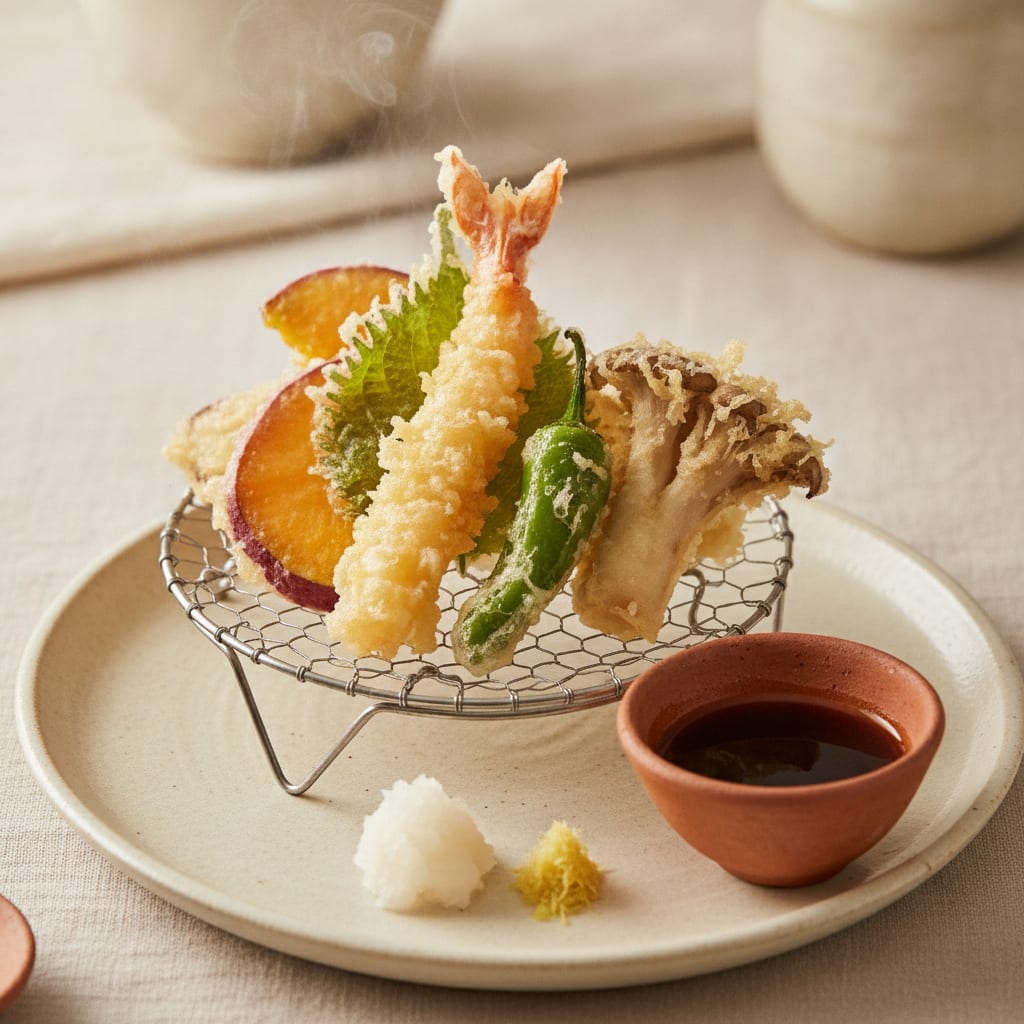
Lacy vegetable tempura, two ways: an ice-cold under-mixed low-gluten batter that fries gossamer-light, classic vegetables, a kombu-shiitake tentsuyu to dip.
- Prep
- 25 min
- Cook
- 20 min
- Total
- 45 min
- Servings
- 4
- Difficulty
- Medium
Getting ready…
Ingredients
For 4 servings · 15 items
For the vegetables
For the batter
For frying
For the tentsuyu (dipping sauce)
For the tentsuyu
To serve
Method
6 steps · check as you go
- →
Serve
Serve immediately, straight from the oil, on a rack or a paper-lined plate so the crust stays crisp. Set out the warm tentsuyu and let each person stir grated daikon and ginger into their own bowl. Dip lightly — a quick touch, not a soak — so the lace stays crisp. Eat in the order from lightest to richest: shiso and beans first, sweet potato and squash last.
The story
Tetsu did not make much tempura at Wakō — it was a ramen counter — but on New Year’s, in the first days of 2021, he made a great pile of it for the staff and the regulars, and he let me fry the vegetables beside him. I had made tempura before and thought I knew it. He watched me whisk the batter smooth and reached over and took the bowl away. “Dame,” he said. No good. He started again: flour and sparkling water both straight from the fridge, ice still floating in the jug, and he stirred it maybe five times with the tips of his chopsticks and stopped while it was still streaked with dry flour. It looked unfinished, wrong, lumpy. It fried into the lightest, lacy, see-through crust I had ever made. The mistake, he showed me, was caring too much about the mixing.
Tempura is Japanese now, but it arrived on a Portuguese ship. In the 16th century, Jesuit missionaries and Nanban traders reached Nagasaki and brought a Western habit of coating food in batter and frying it. The name most likely comes from tempora — Latin for “times,” the Ember Days and Lenten fasts when Catholics ate fish and vegetables instead of meat. Japan took a fasting fritter and spent four centuries refining it into something gossamer.
This tempura has no egg in the batter. It has low-protein flour, ice-cold sparkling water and a pinch of baking soda for lift, classic vegetables, and a kombu-shiitake tentsuyu to dip. It is not a “version” of tempura. It is tempura — cold, lumpy, gossamer, made with what is in my hands now.
À la maison
The weeknight reading is the recipe above, and Tetsu’s correction is the whole of it: keep everything ice-cold and mix the batter badly. Flour and sparkling water from the fridge, ice in the water, and only a few strokes with chopsticks — stop while it is still lumpy and streaked with dry flour. Use low-protein cake flour, fry only a few pieces at a time so the oil stays hot, and keep the tempura pale, never deep brown. Flick a little extra batter into the oil to build the lacy edges. Have the tentsuyu and grated daikon ready before you start, because tempura waits for no one — it is at its peak for about two minutes.
Au bistrot
The bistronomique reading treats tempura as a precise, course-by-course plate rather than a shared pile.
I fry to order and serve in a deliberate sequence, lightest to richest, each piece placed rather than heaped. The batter gets even more disciplined: cake flour and sparkling water held over ice, a few drops of toasted sesame oil through the frying oil for aroma, the pieces fried so pale they are almost white, the lace built up with flicked batter so each one wears a halo of crisp hana flowers. A single shiso leaf is battered on one side only and fried a few seconds, so the green shows through like stained glass. The tentsuyu I clarify and serve two ways: a small warm pour, and a cold oroshi version stiff with finely grated daikon and a thread of yuzu zest. A mound of momiji oroshi — daikon grated with a little chilli so it blushes — sits as one clean quenelle, and a few grains of matcha salt go alongside for the pieces meant to be eaten dry, without the dip. Each vegetable is plated alone, at the moment it leaves the oil, so the crust is never more than a minute old.
Mori-tsuke — Three-quarter, slightly above, hard side light to catch the lace and the see-through batter. Pale, almost white tempura placed on a slate or a folded paper stand, the shiso leaf glowing green through its batter. A small bowl of clear tentsuyu, a quenelle of pink momiji oroshi, a pinch of green matcha salt. Negative space. The plate should say gossamer, not abundance.
What the other recipes get wrong
Most tempura recipes online — I read the top ten in March 2026 — tell you to whisk the batter until smooth and use plain all-purpose flour, then wonder why the crust comes out thick and bready. They are building gluten on purpose. So I ran the test: nine batches over a week in March 2026, same vegetables, same oil at the same temperature, changing only the flour, the water temperature, and how much I mixed.
- Plain flour, room-temperature water, whisked smooth: thick, pale-brown, chewy — a doughnut coating, not tempura. It soaked oil and went heavy and soft within a minute.
- Plain flour, ice water, barely mixed: better, lighter, but still a touch bready at the thick spots where the higher-protein flour built gluten under the cold.
- Cake flour, ice-cold sparkling water, mixed five strokes and left lumpy: thin, blistered, see-through lace that shattered and stayed crisp. This was the plate, and it was not close.
The reason is gluten, and it is pure food science. Gluten is the elastic protein network that forms when wheat flour is hydrated and worked, and it forms faster when warm and over-mixed. Three moves suppress it. Low-protein cake flour, around 7% protein, simply has less of the proteins that build gluten. Ice-cold water slows the reaction that forms it. And minimal mixing — stopping while the batter is still lumpy and dry-streaked — gives it no time to develop. A little gluten is good: it cross-links into strands that let the crust crisp in flaky shards rather than a powder. Too much, and it fries thick and chewy. Across all nine, cold-plus-cake-flour-plus-lumpy won every time; warm-plus-plain-plus-smooth failed every time. The lumps are not sloppiness. They are the technique.
The line I draw
I will not whisk the batter smooth. Every instinct from every other kind of cooking says to mix until smooth, and in tempura that instinct ruins the dish. A smooth batter is a worked batter, and a worked batter has gluten, and gluten fries thick, chewy and heavy — the opposite of tempura. The batter must be ice-cold and mixed only a few strokes, left visibly lumpy with dry streaks of flour still showing. It looks unfinished. It looks like a mistake. It is exactly right. The moment you whisk it smooth to make it look like batter “should” look, you have made fritter coating, not tempura. Tetsu took the bowl out of my hands for whisking. He was right to.
When this can fail
Three ways, all from my own kitchen between 2022 and 2026:
- The heavy, bready crust. Whisked the batter smooth out of habit and used plain flour; the tempura fried thick, chewy and pale brown, soaking oil. Fix: low-protein cake flour, ice-cold sparkling water, and stop mixing while it is still lumpy with dry streaks — gluten is the enemy.
- The greasy, dense pieces. Crowded the pan and the oil temperature crashed; the batter soaked fat instead of crisping. Fix: fry only a few pieces at a time, keep the oil at 175–180°C, and wait for it to recover between batches.
- The batter that slid off. Dipped wet vegetables straight into the batter and it pooled, slid and spat in the oil, leaving bald patches. Fix: pat the vegetables completely dry and dust them lightly with flour first, so the slick batter has something to grip.
FAQ
QWhere does tempura come from?
Tempura is Japanese, but its frying technique came from Portugal. In the 16th century, Portuguese Jesuit missionaries and traders reached Nagasaki via the Nanban trade and brought a Western method of coating food in batter and deep-frying it. The name most likely comes from tempora — Latin for 'times,' used for the Ember Days and Lenten fasts when Catholics ate fish and vegetables instead of meat. The Japanese took the fasting fritter and refined it over centuries into the light, lacy tempura we know.
QWhy does tempura batter need to be ice cold?
Cold slows gluten formation. Gluten is the protein network that makes batter thick and chewy, and it develops faster when warm and worked. Ice-cold water — often sparkling, for extra lift — and minimal mixing keep the gluten from forming, so the batter fries into a thin, light, crisp lace instead of a dense, bready shell. Keep the flour and water in the fridge, use ice in the water, and mix only at the last second before frying.
QWhy should tempura batter be lumpy?
Lumps mean you stopped mixing before the gluten developed. Tempura batter is deliberately under-mixed — stirred just a few strokes with chopsticks until it is still lumpy with dry streaks of flour showing. If you whisk it smooth, you work the flour, gluten forms, and the batter fries heavy and chewy. A lumpy, barely-mixed batter is the sign of a light, crisp result. Mix it badly on purpose.
QCan you make tempura batter without egg?
Yes. Classic tempura batter is flour, egg and cold water, but the egg mainly adds a little colour, binding and lift. Ice-cold sparkling water carries the lift through its bubbles, and a pinch of baking soda adds a touch more rise and helps the batter set crisp. Use low-protein cake flour, keep everything ice-cold, and under-mix, and you get a lacy, gossamer crust with no egg at all.
QWhat flour is best for tempura?
Low-protein cake flour — around 7% protein. The lower the protein, the less gluten can form, and less gluten means a lighter, crispier crust. Plain all-purpose flour has more protein and fries heavier; if it is all you have, replace about a sixth of it with cornflour to dilute the gluten. Combined with ice-cold water and minimal mixing, low-protein flour gives the see-through, lacy crust that defines good tempura.