Crisp that survives the broth.
Agedashi Tofu.
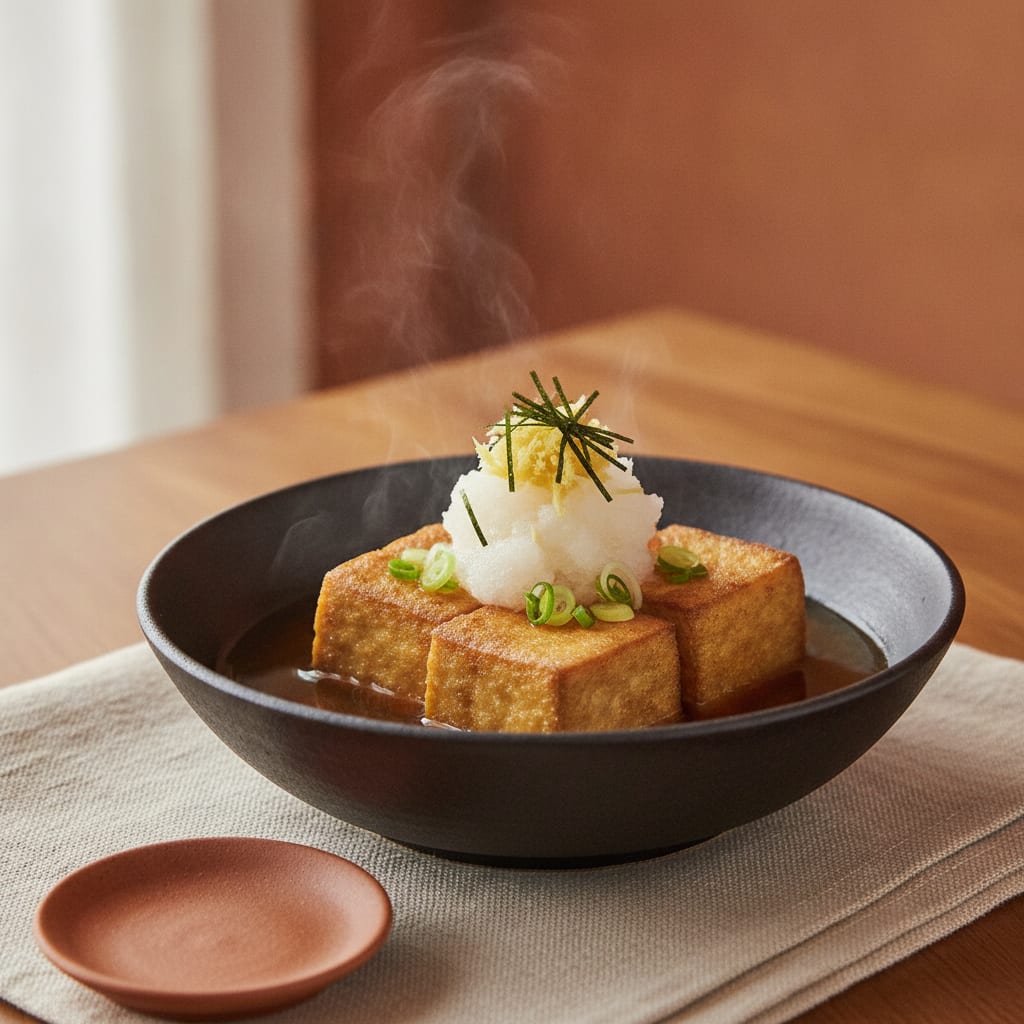
Deep-fried tofu in dashi, two ways: silken tofu in a potato-starch crust that survives the broth, a kombu-shiitake dashi, grated daikon and ginger to finish.
- Prep
- 20 min
- Cook
- 20 min
- Total
- 40 min
- Servings
- 4
- Difficulty
- Medium
Getting ready…
Ingredients
For 4 servings · 13 items
For the tofu
For the dashi broth (tsuyu)
To finish
Method
6 steps · check as you go
- →
Serve
Serve immediately, the moment the broth is poured, while the tops of the cubes are still crisp and the daikon mound is cool against the hot tofu. Eat with chopsticks and a renge spoon for the broth, breaking each cube so the soft interior meets the dashi. The grated daikon and ginger are not garnish — stir a little into the broth as you go to keep it bright.
The story
Agedashi tofu was the first thing Tetsu let me fry alone in Sapporo. It was early in my year there, the spring of 2020, and it was, he made clear with a flat hand and a shake of the head, a test of restraint, not skill. The frying is easy. The discipline is everything around it: dry the tofu until it squeaks, coat it the moment before it goes in, fry it pale and crisp, and — the part I kept getting wrong — pour the broth around the cubes, never over them. My first bowl I flooded, proud of the steaming dashi, and watched the crust go soft in front of me. Tetsu lifted a cube out of my drowned bowl, held it up dripping, and said one word I understood without translation: “Mottainai.” What a waste.
The dish wears its method as its name. Age — deep-fried. Dashi — the broth. Fried tofu in dashi, nothing hidden. It is old: traceable to the Edo period, and written down in the 1782 Tofu Hyakuchin, “A Hundred Delights of Tofu,” a book so popular it kicked off a small genre of tofu cookbooks. Two and a half centuries on, the dish is essentially unchanged — which tells you it was right the first time.
This agedashi has no bonito in its dashi. It has a kombu-and-shiitake broth, silken tofu in a potato-starch crust built to survive the broth, and a cool mound of grated daikon and ginger on top. It is not a “version” of agedashi tofu. It is agedashi tofu, made with what is in my hands now.
À la maison
The weeknight reading is the recipe above, and it lives or dies on two details Tetsu drilled into me. Use potato starch, not cornstarch, because it is the only coating that stays crisp sitting in broth. And pour the dashi around the cubes, only partway up, never over the top — that crisp-top, soaked-bottom contrast is the whole dish. Dry the tofu hard before you coat it, fry it pale gold and steady, and stand the hot cubes in the bowl before the broth goes in. The kombu-shiitake dashi does the rest: deep and savoury with nothing in it but kelp and mushroom.
Au bistrot
The bistronomique reading keeps the crisp-against-soft contrast sacred and composes it as a precise small plate.
I cut the tofu into two clean, tall rectangles per portion rather than rough cubes, press them firmly so they hold a sharp edge, and fry them to an even pale gold. The dashi I clarify and serve as a glossy, barely-set warm ankake — the seasoned tsuyu lightly thickened with a whisper of kuzu or potato starch so it clings and pools rather than running, brushed and spooned around the tofu instead of poured loose. The daikon becomes a fine momiji oroshi, grated with a little chilli so it blushes pink, set as one neat quenelle. A single batonnet of the fried tofu stands upright; the second lies beside it, broken to show the custardy interior against the crust. Grated ginger goes on as a small bright mound, a few threads of fresh yuzu zest, micro scallion, and a single fried nori shard standing in the sauce. Everything the home bowl has — crisp crust, soaked base, soft centre, savoury dashi, sharp daikon and ginger — set down with the stillness of a kaiseki course.
Mori-tsuke — Three-quarter, slightly above. A small dark bowl, the seasoned dashi pooled glossy and low. Two pale-gold tofu pieces, one standing, one broken to show the soft interior. A pink quenelle of grated daikon, a mound of ginger, a fried nori shard upright. Hard side light on the wet crust just above the sauce. Negative space. The plate should say contrast, not abundance.
What the other recipes get wrong
Most plant-based agedashi recipes online — I read the top ten in February 2026 — reach for cornstarch because it is the starch in the cupboard, and they flood the tofu with broth because the steaming bowl photographs well. Both choices kill the dish. So I ran the test: eight batches over a week in February 2026, same silken tofu, same kombu-shiitake dashi, changing only the coating starch and how the broth was added.
- Cornstarch coat, broth poured over: the crust dissolved into a slick gum within a minute, the upper coating sloughed off, and the tofu sat in a cloudy, starchy broth. No crust survived to the second bite.
- Plain flour coat: it fried into a soft, bready skin that went limp immediately in the dashi and tasted of fried dough, not the clean crust agedashi wants.
- Potato starch coat, broth poured around: the crust set glassy and stayed crisp on top while the base drank the dashi — crisp, soaked, soft, all in one cube. This was the bowl, and it was not close.
The reason is the starch granule. Potato starch has large granules and a high amylopectin-to-amylose ratio, which fry into a crust that holds its structure and stays crisp even when wet; cornstarch’s fine, amylose-heavier granules gelatinise and dissolve the instant they meet hot liquid, which is exactly why the coating just disappears in the broth. Flour brings gluten and makes a soft, bready coat. And pouring the broth around the cubes rather than over them keeps the upper crust dry and crisp while the submerged base soaks — the contrast that defines the dish. Across all eight, potato starch poured around won every time; cornstarch poured over failed every time.
The line I draw
I will not pour the broth over the top of the tofu. The flooded bowl looks generous and it ruins the dish — the moment the dashi covers the crust, the crisp top you fried so carefully goes soft, and you have a bowl of wet fried tofu instead of agedashi. Agedashi is a contrast: crisp crust above the broth line, savoury soaked crust below it, custardy tofu within. That contrast only exists if you pour the dashi around the cubes, partway up, and never over them. Drown it and you have thrown away the entire reason the dish exists. Tetsu held up my soggy cube and called it a waste. He was right.
When this can fail
Three ways, all from my own kitchen between 2022 and 2026:
- The dissolving crust. Reached for cornstarch instead of potato starch and the coating melted into the broth within a minute, leaving the tofu bald and the dashi cloudy. Fix: use potato starch (katakuriko) — its large granules are the only coating that stays crisp soaking in broth.
- The spitting fryer, the pasty coat. Coated the tofu while its faces were still wet from draining; the starch turned to paste, the cubes spat violently in the oil, and the crust never set crisp. Fix: press and pat the tofu bone-dry on every face before coating, and fry the moment it is dredged.
- The drowned bowl. Poured the hot dashi proudly over the cubes; the crisp tops went soft before the bowl reached the table. Fix: stand the cubes in the bowl and pour the broth around them, only partway up the sides, so the tops stay crisp.
FAQ
QHow do you keep agedashi tofu crispy in the broth?
Two moves. First, coat the tofu in potato starch (katakuriko), not cornstarch — potato starch has much larger granules and a high amylopectin ratio, so it fries into a crust that stays crisp when soaked, while cornstarch's fine granules dissolve and turn gummy the moment they hit liquid. Second, pour the broth around the cubes, only partway up, never over the top, so the upper crust stays crisp while the base drinks the dashi. The contrast of crisp top and soaked bottom is the dish.
QWhere does agedashi tofu come from?
Its exact origin is unclear, but it is generally traced to Japan's Edo period (1603–1868), and a version appears in the 1782 cookbook Tofu Hyakuchin — 'A Hundred Delights of Tofu' — a runaway bestseller devoted entirely to tofu dishes. The name is literal: age (deep-fried) plus dashi. Fried tofu, served in dashi. The dish has barely changed in two and a half centuries.
QCan you make agedashi tofu without bonito dashi?
Yes — a kombu and dried shiitake dashi makes a deeply savoury broth with no fish at all. Kombu brings glutamate and dried shiitake brings guanylate, and the two together register as far more savoury than either alone, giving the tsuyu the same round, meaty depth a katsuobushi dashi provides. Cold-steep both, simmer the shiitake gently, never boil the kombu, then season with soy, mirin and sake.
QWhat tofu is best for agedashi tofu?
Silken or soft tofu (kinugoshi) is traditional and gives the signature contrast — a custardy, almost liquid interior against the crisp fried crust. It is fragile, so drain and press it gently, pat every face bone-dry, and handle the cubes carefully into the oil. Firm tofu works and is more forgiving if you are nervous, but you lose some of the soft-against-crisp drama that defines agedashi.
QWhy is my agedashi tofu crust soggy?
Usually one of three things. You used cornstarch instead of potato starch, so the coating dissolved in the broth. You didn't dry the tofu before coating, so surface water turned the starch to paste before it could fry crisp. Or you poured the broth over the top of the cubes instead of around them, soaking the upper crust. Dry the tofu hard, coat in potato starch, fry hot, and pour the dashi only partway up the sides.