Crispy mushroom, creamy heat.
Spicy Garlic Ramen.
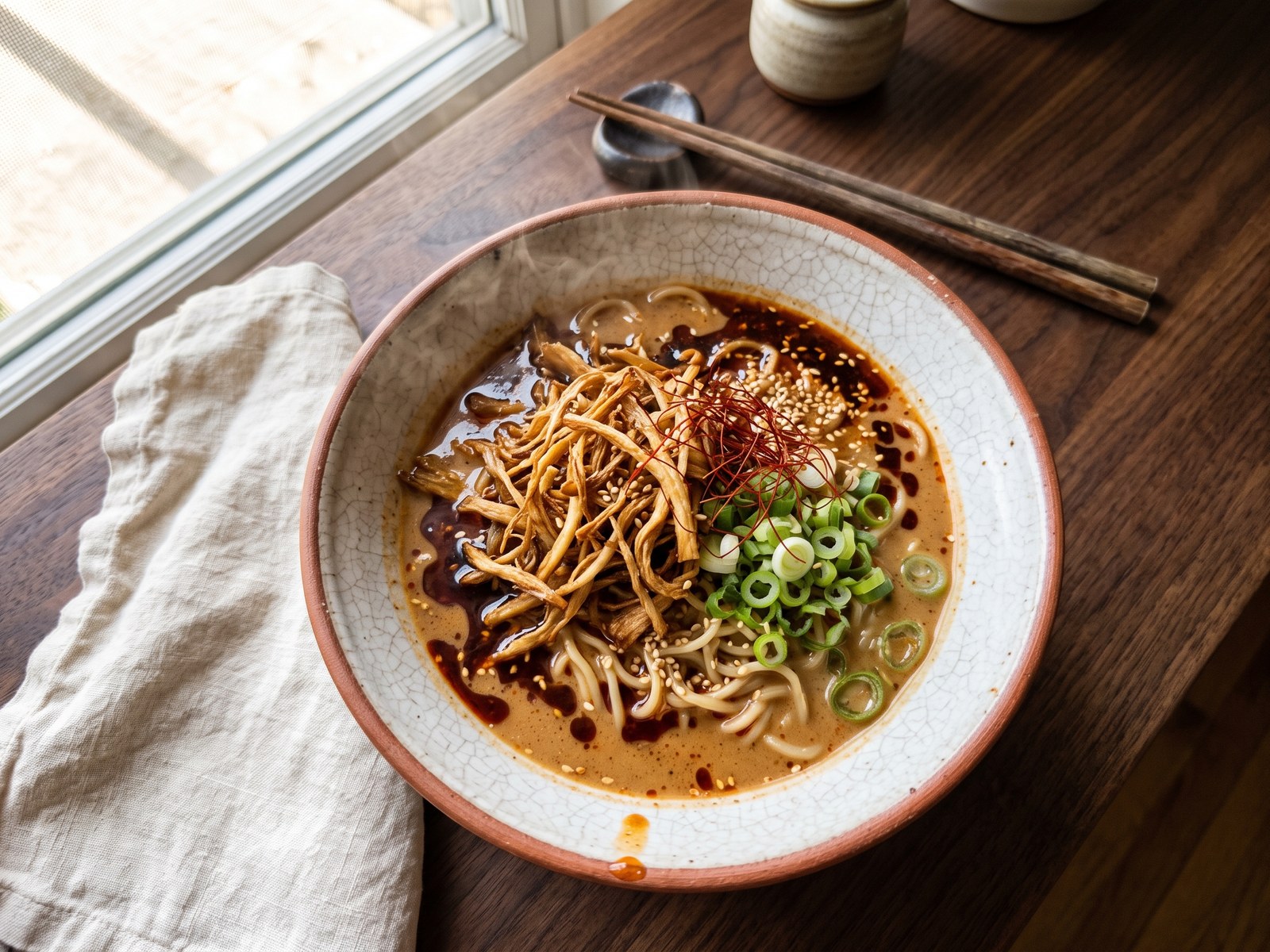
A 20-minute spicy garlic ramen: a creamy soy-milk chili broth and king oyster mushrooms forked into strands and oven-crisped until they pull like meat.
- Prep
- 10 min
- Cook
- 25 min
- Total
- 35 min
- Servings
- 2
- Difficulty
- Easy
Getting ready…
Ingredients
For 2 servings · 15 items
For the crispy king oyster mushrooms
For the broth
For the noodles and bowl
Method
6 steps · check as you go
- →
Serve
Serve scalding, the mushrooms still crisp on top. Eat the crunchy strands first, then let the rest sink and soften into the broth. A renge spoon for the soup, chopsticks for the noodles, and lean over the bowl. Cold beer or barley tea on the side. No bread.
The story
I found this bowl the way most people find Wil Yeung: a video, late, the title half-daring me — Restaurant Ramen at home! But Better?? That question mark did a lot of work. I clicked it expecting the usual instant-noodle upgrade and instead watched a man drag a fork down a king oyster mushroom, shred it into strands, and roast them until they crisped like something off a grill. The bowl that followed — a creamy, red-slicked broth built in under twenty minutes — looked like it had no business being that fast.
Wil Yeung is the cook behind Yeung Man Cooking, and his story is part of why his food looks the way it does. He was born in Hong Kong and emigrated to Canada as a boy, arriving with Cantonese and very little English. Before he was a chef on the internet he was an international photographer, a filmmaker, a violinist — and you can see all of it in the work: the framing, the patience, the sense that a plate is also a composition. He came to plant-based cooking and built a following teaching it the way a musician teaches a passage — slowly, clearly, with the belief that, in his words, learning to make food can change how you see things, especially when you share it with others. He wrote a whole vegan ramen cookbook on that conviction. This recipe is my version of one bowl from that world, cooked and tested in my own kitchen, with full credit to where it started.
It is not a “vegetable ramen.” It is restaurant ramen — the creamy body, the bloomed chili, the meaty topping — built from a mushroom, a carton of soy milk, and ten minutes of attention. The “but better” in Wil’s title is not bravado. The fork-shredded, oven-crisped mushroom genuinely does something a slice of pork belly can’t: it brings crunch into the bowl.
What the other recipes get wrong
Most quick-ramen recipes online — I worked through the top ten in June 2026 — treat the topping as an afterthought and the broth as a shortcut. Two things consistently fail.
First, the mushroom. I tested king oyster three ways over a week in June 2026, same oven, same seasoning: sliced into coins, cut into batons, and forked into strands. The coins browned on two faces and stayed leathery in the middle. The batons were better but dense. The forked strands — ragged, frayed, uneven — were the only ones that crisped all over and still pulled apart with that stringy, meaty give. The torn edges are the entire point; a knife makes them smooth and a smooth edge will not crisp. I also ran the tray two ways: crowded and spaced. Crowded, the strands steamed grey and never browned, because king oyster is around 90% water and that water has nowhere to go. Spaced in a single layer, they shrank by half and crisped. Same mushroom, same oven, opposite result.
Second, the soy milk. The instinct is to dump it in with the stock and bring the whole thing up to a boil. I did that, once, on purpose, to see — and watched it break into grainy flecks with a split, curdled surface. Soy milk proteins do not survive a hard boil. Added off the boil and held at a bare tremble, the same carton gives you a silky, clinging, faintly sweet body that reads as rich the way a long-simmered tonkotsu does. The technique is free. Skipping it costs you the whole texture.
The line I draw
I will not slice the mushroom to save thirty seconds. The fork is not a quirk of Wil’s video — it is the mechanism. Strands with torn edges crisp; clean slices stay limp. If you cut this mushroom with a knife you have made a different, lesser dish, and I would rather you spend the half-minute dragging a fork down its length. The crunch on top is what makes this restaurant ramen. Everything else in the bowl is soft.
When this can fail
Three ways, all from my own kitchen:
- The grey, limp mushroom. Crowded on the tray, or pulled too early. It steamed instead of roasting and never crisped. Fix: single layer with space between the strands, and trust the full 20 minutes — they should shrink by half and color at the edges before they come out.
- The split broth. Soy milk added to boiling stock, or the bowl brought back to a hard boil to “keep it hot.” It curdled into grain. Fix: drop to medium-low before the soy milk goes in, hold it just trembling, and serve straight away.
- The bloated, gluey noodles. Cooked in the broth, or cooked early and left sitting. They thickened the soup and turned soft. Fix: boil them in a separate pot, rinse off the surface starch under hot water, and add them at the last second.
The dinner
This is a fast bowl, and its speed is the argument for it: a weeknight ramen that tastes like a Friday-night one. Shred the mushroom, get it in the oven, and you have twenty hands-free minutes to build the broth — bloom the garlic and chili in oil, add stock, then soy milk off the boil, and it’s done before the mushrooms are. Cook the noodles last. Pile the crisp strands high and eat them while they still crackle, then let what’s left sink and soften into the creamy, spiced broth.
Credit where it’s owed: the bones of this bowl are Wil Yeung’s. The testing, the failures, and the opinions about the fork are mine.
FAQ
QHow do you make king oyster mushrooms crispy for ramen?
Shred them into strands with a fork rather than slicing, toss with a little oil, smoked paprika and umami powder, and bake in a single layer at 400°F (200°C) for about 20 minutes, tossing once. The torn, frayed edges crisp and curl where a clean slice would stay limp, and the single layer lets the mushroom's water escape so it browns instead of steaming. They shrink by about half and come out crisp at the edges, chewy in the middle.
QWhy is there soy milk in spicy garlic ramen?
Unsweetened soy milk gives the broth a creamy, tonkotsu-like body and pale color without any animal fat or hours of simmering bones. Its proteins and fat emulsify the chili oil and round out the heat, turning a thin spicy stock into a rich, clinging bowl in minutes. Use plain unsweetened soy milk only — sweetened or vanilla versions will ruin it — and never boil it hard, or it curdles.
QCan I make this ramen without king oyster mushrooms?
Yes. Shredded oyster mushrooms or torn maitake crisp up well the same way, though they bake faster — check at 12 to 15 minutes. Pressed and torn firm tofu, or thin-sliced shiitake, also work as the topping. King oyster is ideal because it shreds into long meaty strands, but any mushroom you can tear into ragged pieces and roast dry will give you the crisp-then-chewy texture this bowl is built around.
QHow do I keep the soy milk broth from curdling?
Add the soy milk only after the stock has boiled and you've dropped the heat to medium-low, then hold it at a bare simmer — never a rolling boil. Soy milk proteins separate into grainy flecks under hard heat. Stir gently, keep it just trembling for a couple of minutes, and serve straight away. If it does split slightly, a quick whisk usually brings it back together.
QWhat can I serve with spicy garlic ramen?
This is a one-bowl meal, so keep sides light and cool to balance the heat: a cucumber salad dressed with rice vinegar and sesame, quick-pickled vegetables, or a few cold edamame. Gyoza on the side make it a fuller dinner. Skip anything rich or fried — the creamy soy-milk broth is already doing that job. Cold beer or chilled barley tea cuts the spice best.