The pie that starts with squeezing.
Spanakopita.
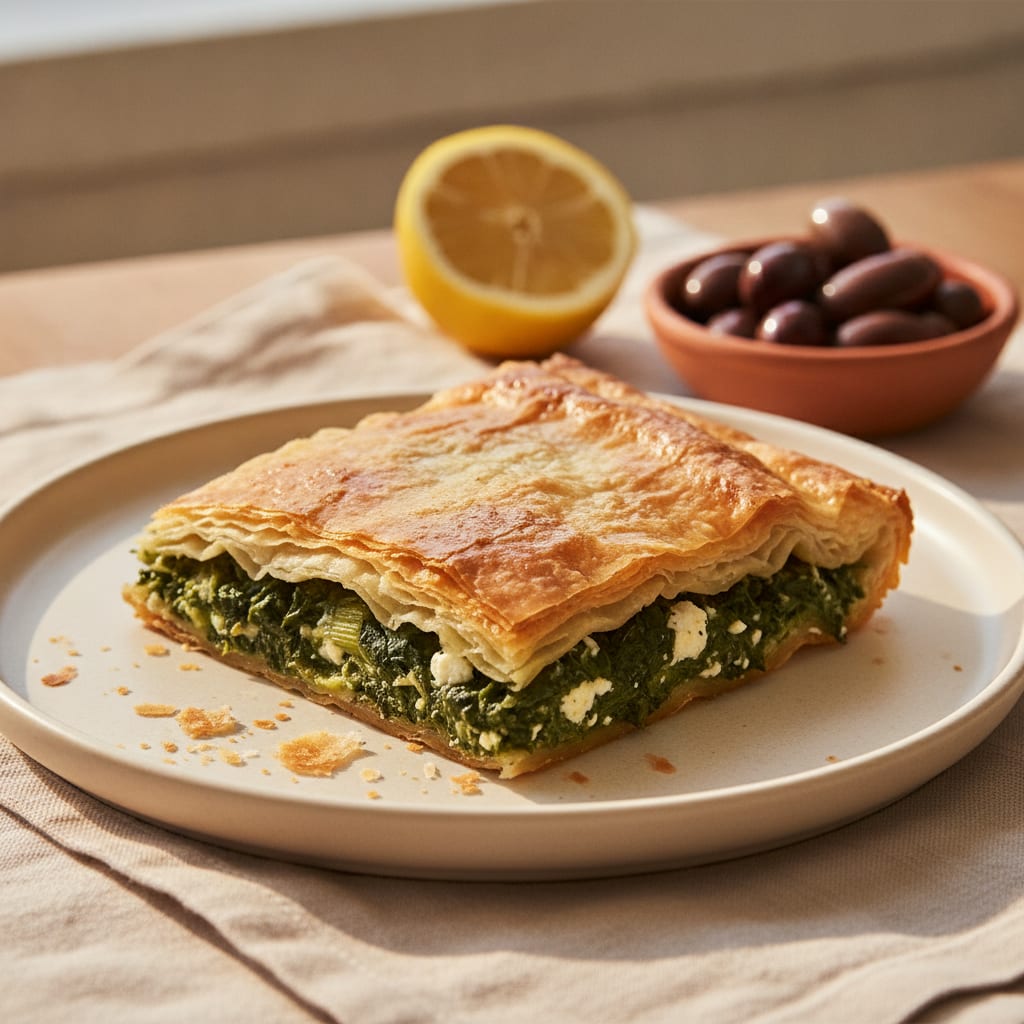
Greek spinach and herb pie, two ways: brittle olive-oil phyllo, spinach squeezed bone-dry, a tofu-and-cashew curd that breaks like feta.
- Prep
- 40 min
- Cook
- 45 min
- Total
- 1h 25min
- Servings
- 8
- Difficulty
- Medium
Getting ready…
Ingredients
For 8 servings · 19 items
For the filling
For the curd (the 'feta')
For assembly
Method
7 steps · check as you go
- →
Serve
Cut into squares along the scored lines and serve warm, not hot — spanakopita is better at the temperature of a kitchen than straight from the oven, which is how it's sold from bakery windows in Athens. A wedge of lemon, a few olives, nothing else. It is lunch, or it is the first thing on a meze table.
The story
Athens, March 2017. I spent six months that year working in a small taverna in Plaka, the old quarter under the Acropolis, for a woman named Eleni who ran the place the way a captain runs a ship. The spanakopita was not on the menu. It was what the staff ate, standing up, at four in the afternoon between services, cut from a tray Eleni baked most mornings and left on the pass under a cloth. The first time she handed me a square, she watched me eat it. The phyllo came apart in flakes down my shirt. The filling was so green and so sharp with dill it tasted like a field. She nodded once and went back to the books.
She taught me the squeeze before she taught me anything else. She took a fistful of salted, wilted spinach, wrapped it in a cloth, and wrung it over the sink until her forearms shook and a last few drops fell. “Stegnó,” she said. Dry. Then she opened the cloth and showed me the dense, dark mass inside. “If it is wet, you are making soup in pastry. Throw it away.” I have thrown away exactly one soggy spanakopita since, and I thought of her the whole time.
This spanakopita has no feta and no butter. It has a curd built from tofu, cashews, and miso, and phyllo brushed with olive oil the older Greek way. None of that is a workaround. The oldest Greek pies were wild greens — horta — and herbs folded into thin dough, with no cheese at all; the feta is a relative newcomer. And the Orthodox fasting calendar has always had a nistisimi spanakopita, made without dairy or egg for Lent and the August fast. This is not a vegan spanakopita. It is spanakopita, made the way it was made before the cheese arrived and the way it is still made for forty days every spring.
À la maison
The weeknight reading is the recipe above, and it lives or dies on one move: the squeeze. Salt the spinach, wait ten minutes, then wring it in a cloth until your arms hurt and almost nothing comes out. Everything after that is easy — soften the leeks, half-blend the curd so it stays lumpy, brush oil between every phyllo layer so they shatter instead of fusing. Score the top before it bakes so you can cut clean squares after. Eat it warm, not hot. It is better an hour out of the oven than straight from it, which is the most forgiving thing a pie can be.
Au bistrot
The bistronomique reading keeps the same filling and the same olive-oil phyllo, but stops making a tray and starts making individual pieces — and adds a sauce and a crunch to turn a slab of pie into a plated course.
Build small triangoli: brush a single phyllo sheet with oil, cut it into long strips, spoon filling at one end, and fold it corner to corner into a tight triangle, the way street-cart cooks in Psyrri fold them by the hundred. Brush the outside, scatter sesame, and bake until each one is a brittle, blistered parcel. While they bake, make two things. First, a thin lemon-and-dill emulsion — olive oil, lemon, a spoon of the curd, blended loose enough to pool. Second, a quick horta tangle: wilted wild greens or chard, dressed in lemon and oil, piled small. Plate one or two triangles leaning against the greens, the emulsion brushed in a single stroke beneath, a few toasted pine nuts and a dusting of sumac across the top for acid and red. The triangle should crack when the fork goes in and spill its dark green centre across the plate.
Le dressage — Overhead, tight. Two phyllo triangles leaning on a small nest of dressed wild greens, a single brushstroke of lemon-dill emulsion beneath, pine nuts and sumac scattered. Matte stone plate, hard side light to rake across the blistered phyllo. Negative space. The plate should say a bakery pie has been read as a restaurant course, not buried in one.
What the other recipes get wrong
Most spanakopita recipes online — I read the top ten in February 2026 — treat the spinach water as something you deal with after cooking, by draining. Draining is not enough. Water lives inside the leaf, and the only way out is osmosis and pressure. I ran the test over a week that February: nine pies, same filling, same phyllo, only the water-removal method changed.
- No salt, squeezed once: the filling went in damp, and the bottom three phyllo layers came out grey and soft, glued to the dish.
- Sautéed dry in a pan to evaporate the water: worked, but the spinach overcooked to a dull, stewed flavour and lost its green.
- Salted, rested 10 minutes, squeezed hard in a cloth: the filling went in dense and dry, the spinach kept its raw-bright colour, and the bottom phyllo baked as crisp as the top.
The salt is doing real work, not seasoning. Sprinkled on chopped leaves, it raises the salt concentration outside the cells above the concentration inside, and water moves out across the cell membranes to balance it — osmosis — pooling in the colander in ten minutes. You then squeeze out water that is already free, instead of fighting to crush it out of intact cells. Across all nine pies, the salted-then-squeezed batch lost roughly a third more liquid by weight than squeezing alone, and it was the only method that kept both a crisp base and a green, uncooked-tasting filling. The pan-dry method dries it too, but cooks the life out of it. Salt and a cloth: nothing else does both.
The line I draw
I will not use butter in spanakopita. Not for “richer browning,” not because a famous recipe says to. Butter-brushed phyllo belongs to a different pastry lineage — the Ottoman and Austro-Hungarian strudel tradition — and it changes what the pie is. Olive oil is the Greek fat, the nistisimo fat, the fat that lets the pie sit in a bakery window all afternoon and still taste right at room temperature. Brush spanakopita with butter and you get something that has to be eaten hot or it turns waxy and heavy on the tongue. Olive oil stays crisp and clean for hours. The dish is built around being eaten warm, slowly, hours later — and butter quietly breaks that.
When this can fail
Three ways, all from my own kitchen between 2022 and 2026:
- The soggy base. Rushed the squeeze, the filling went in wet, and the bottom layers came out pale and slick under a perfectly crisp top. There is no fixing it after baking. Fix: salt, wait ten minutes, then squeeze in batches until the cloth comes away nearly dry.
- The shattered, dried phyllo. Left the stack uncovered while I made the filling; by the time I built the pie the sheets cracked into shards I couldn’t lift. Fix: keep the unused phyllo under a damp (not wet) towel from the second you open the packet.
- The flat, bland filling. Skimped on the dill once because I only had a little, and the pie tasted of wet spinach and nothing else. Fix: dill is structural here, not a garnish — a full large bunch, plus the lemon zest, is what makes it taste of Greece instead of a green casserole.
FAQ
QHow do you make spanakopita without feta?
Build the curd from firm tofu and soaked cashews, blended halfway with white miso, lemon juice, nutritional yeast, and salt, then leave it lumpy. The miso supplies the fermented, salty-sour funk that defines feta; the lemon brings the acidity; the half-crumbled tofu gives the visible white curds that break in the bite the way feta does. Folded through dill-heavy spinach, it reads as feta because it does feta's job — sharp, salty pockets against the green.
QWhy is my spanakopita soggy?
Wet filling. Spinach holds an enormous amount of water, and if it goes into the pie wet, that water steams the bottom phyllo into a soggy mat. Salt the chopped spinach, leave it 10 minutes so osmosis draws the water out, then squeeze it bone-dry in a cloth in batches. Cook the leeks and onions down first to drive off their moisture too. A dry filling and oil brushed between every phyllo layer give you a crisp pie top and bottom.
QShould I use olive oil or butter for the phyllo?
Olive oil. It is the older, Greek way — butter-brushed phyllo is closer to the Ottoman and Central European pastry tradition. Olive oil gives a lighter, shatter-crisp layer and a savoury flavour that belongs with spinach and dill, and it browns cleanly at 180°C. It also means the pie stays good at room temperature, which is how spanakopita is actually eaten — from a bakery window, hours after baking, never piping hot.
QIs spanakopita traditionally vegan?
A fasting version is. The Greek Orthodox calendar has long fasting periods — Lent, the fortnight before the Dormition in August — when animal products are set aside, and a fasting spanakopita (nistisimi) made without feta or egg, bound only with greens, herbs, and olive oil, is genuine traditional cooking, not a modern adaptation. The pie predates the cheese in it: the oldest Greek pies were wild-greens-and-phyllo, the feta a later addition.
QCan I use frozen spinach for spanakopita?
Yes, and many Greek cooks do. Thaw it completely, then squeeze it hard in a cloth — frozen spinach holds even more water than fresh once thawed, so the squeeze matters more, not less. Use about 500 g frozen to replace 1 kg fresh. The one thing frozen spinach loses is a little texture, so lean harder on fresh dill and parsley to bring the filling back to life.