Big beans, slow oven.
Gigantes plaki.
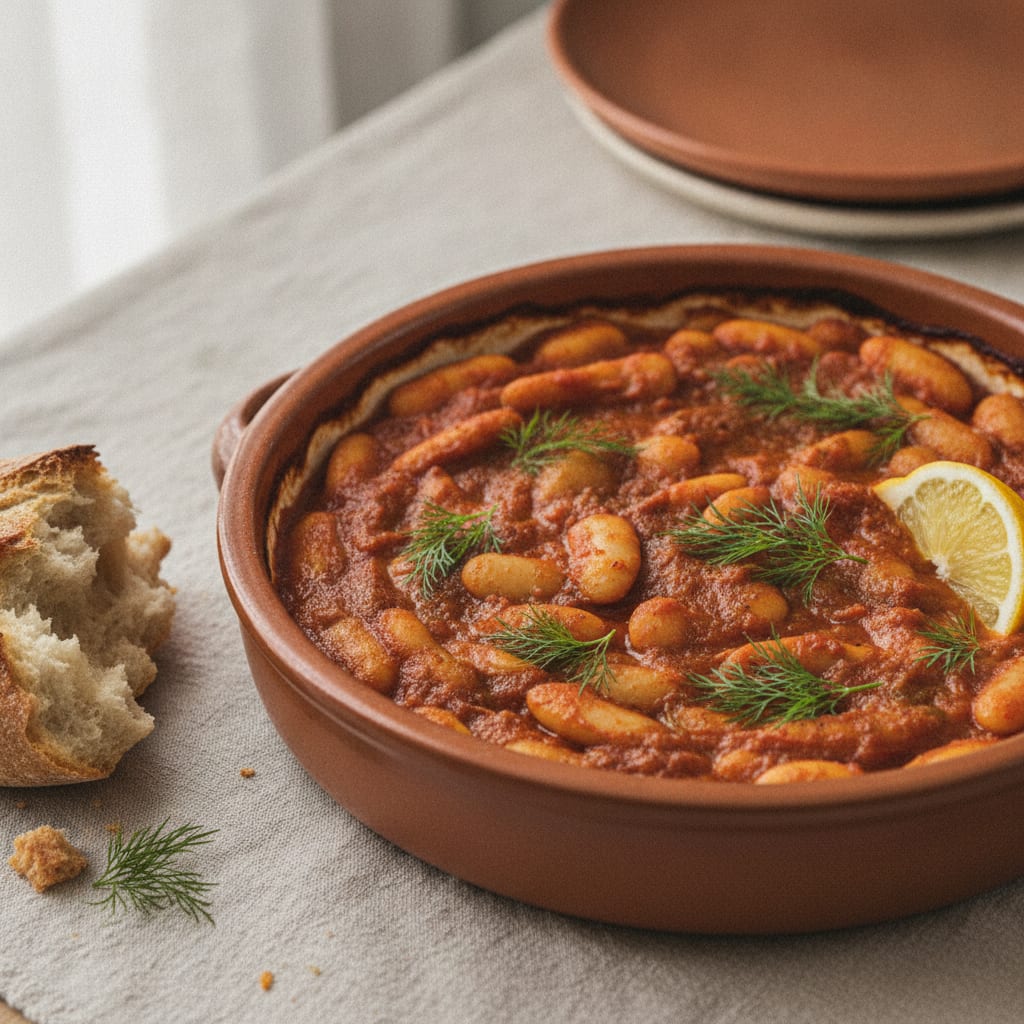
Greek giant baked butter beans in tomato, two ways: beans salted late so the skins stay whole, a deep oven-roasted sauce, dill and lemon at the end.
- Prep
- 20 min
- Cook
- 2h
- Total
- 2h 20min
- Servings
- 6
- Difficulty
- Easy
Getting ready…
Ingredients
For 6 servings · 16 items
For the beans
For the sauce
To finish
Method
6 steps · check as you go
- →
Serve
Serve warm or at room temperature, with the caramelised top intact, plenty of crusty bread to wipe the sauce, and a wedge of lemon. It's a meze when small, a main when generous. A slab of feta-style curd alongside is the classic Greek table. Good bread is not optional — the sauce is half the dish.
The story
Athens, October 2017. My last weeks at Eleni’s taverna in Plaka, the tourist season thinning, the evenings finally cool enough to want something baked. Gigantes came back onto the board — she’d taken it off in the heat — and a tray went into the oven most afternoons, the kitchen filling with the smell of tomato and onion cooking down slow. She served it warm, in shallow earthenware, the top of the beans gone dark and caught at the edges, a green fall of dill across it and bread to drag through the sauce.
She taught me the one rule that everyone gets wrong: no salt in the bean water. The first time I cooked them I salted the pot out of habit, the way you’d salt pasta water, and the beans came out with split, leathery skins floating off their bodies. Eleni took one look. “You salted them.” It wasn’t a question. She had me start again, no salt, and this time the skins stayed whole and the insides went to cream. Salt the sauce, never the boil — that was the law, and she could tell I’d broken it without tasting a thing.
Gigantes plaki has always been a fasting dish — beans, tomato, olive oil, herbs, written γίγαντες πλακί on taverna boards through Lent and eaten across the Orthodox fasting calendar with no animal product anywhere near it. The best beans, the ones Eleni mourned not being able to get in Athens, come from the cool mountain lakes of Prespa and Kastoria in the far northwest, prized enough to carry EU protected status. This is not a vegan version of anything. It’s a bean dish that was never built around meat — only around good beans, good oil, and a slow oven.
À la maison
The weeknight reading is the recipe above, and it comes down to two rules and a long oven. Rule one: soak the beans overnight, because giant beans cook unevenly otherwise. Rule two: never salt the cooking water — salt the sauce after the beans are tender, or you’ll split the skins. Then it’s a soft onion-carrot-celery base, the beans folded in gently to keep them whole, and a long, undisturbed bake with the lid off so the top caramelises. Don’t stir it in the oven. The dark, caught top is the best part, and stirring buries it. Dill, lemon, and raw oil go on at the end, and then it rests. Warm, not hot.
Au bistrot
The bistronomique reading keeps the same beans and the same slow-baked sauce, but pulls the components apart and rebuilds them on the plate, leaning into the contrast between the deep cooked sauce and bright raw finishes.
Cook the beans and the plaki sauce as before, but hold back a handful of the best, most intact beans before baking. Bake the rest down into a thick, dark, almost-jammy tomato base — reduced further than the home version, until it’s spoonable rather than saucy. Warm the reserved whole beans gently in a little olive oil so they stay plump and pale, a contrast to the dark base. Make a quick dill oil: blanched dill blitzed with olive oil and strained bright green. Build the plate: a swipe of the deep tomato base, the warm whole beans set on top in a loose line, a few thin slivers of raw red onion sharpened in lemon, a scatter of toasted breadcrumbs for crunch where bread used to be, and the dill oil drawn across in a thin green stroke. A grating of lemon zest at the table.
Le dressage — Overhead, tight. A swipe of dark, reduced tomato base, plump pale whole beans set in a loose line on top, a stroke of bright green dill oil across, toasted breadcrumbs and lemon-sharpened red onion scattered. Matte dark plate to throw the beans and green oil forward. The plate should say one humble baked-bean dish, read for its contrasts — dark and pale, deep and sharp, soft and crisp.
What the other recipes get wrong
Most gigantes recipes online — I read the top ten in April 2026 — tell you to salt the bean water “for flavour,” the way you would for pasta. With giant beans this is the single most common cause of a ruined batch. I ran the test over a week that April: eight pots of beans, same beans, same soak, same simmer, only the salt timing changed.
- Heavily salted cooking water from the start: skins split and peeled off, the insides stayed oddly firm, and a third of the beans burst before they were done.
- Lightly salted cooking water: better, but still more split skins than I wanted, and the texture uneven.
- No salt in the water, salted only in the sauce after cooking: whole, intact skins on nearly every bean, creamy through to the centre, properly seasoned.
This isn’t superstition, it’s the bean skin’s chemistry. The skin is held together largely by pectin, and in the presence of dissolved salts — sodium from added salt, plus calcium and magnesium from hard tap water — the pectin firms and the skin toughens and splits while the starchy interior is still cooking. Cook in plain (ideally soft) water and the skin stays supple, splits less, and the bean softens evenly; then season the cooked beans in the sauce, where the salt flavours without fighting the skin. Across all eight pots, the no-salt-in-the-water batches gave whole, creamy beans every time, and the salted ones never matched them. Salt the sauce. Never the boil.
The line I draw
I will not salt the water giant beans cook in. Not a pinch, not “just for taste.” The entire pleasure of gigantes is plump, intact beans with creamy centres and skins that hold — and salt in the cooking water firms and splits those skins before the inside is done, every time. I learned this from Eleni reading my split-skinned beans across the room and telling me exactly what I’d done wrong. Once you’ve cooked a pot of beans whole and another pot to leather side by side, you don’t break this rule again. Salt belongs in the sauce, where it seasons. In the boil, it’s just damage.
When this can fail
Three ways, all from my own kitchen between 2022 and 2026:
- The split skins. Salted the cooking water out of pasta-habit; the skins peeled off and floated, the beans burst. There’s no putting the skins back. Fix: no salt in the boil — season only once the beans are cooked, in the sauce.
- The beans that never softened. Used a bag of dried gigantes that had sat in the cupboard well over a year; they simmered for two hours and stayed chalky. Old beans don’t always come back. Fix: buy beans with turnover, soak overnight, and if they’re still hard after 90 minutes, accept the bag is too old and start fresh.
- The pale, stewed top. Covered the dish in the oven to “stop it drying out”; it came out wet and one-dimensional, with no caramelised crust. Fix: bake uncovered and don’t stir — the dark, caught top is the dish. Add bean liquid only if it threatens to dry before browning.
FAQ
QWhy do my giant beans split or stay tough?
Two separate problems, both about timing. Splitting and tough skins usually come from salting the cooking water — salt and hard-water minerals react with pectin in the bean skin, firming and splitting it before the inside softens. Salt the sauce instead, after the beans are cooked. Beans that stay tough no matter how long they boil are usually old; dried beans more than a year or two old may never fully soften. Soak overnight and buy from somewhere with turnover.
QWhat beans are gigantes, and what can I use instead?
Gigantes (gigantes elephantes, 'giant elephants') are very large white runner beans, and the prized ones carry EU protected status — Fasolia Gigantes Elefantes from the Prespa lakes and Kastoria in northwestern Greece, grown in a cool mountain microclimate that gives them a thin skin and creamy, meaty flesh. If you can't find them, large dried butter beans or lima beans are the closest stand-in. The dish works; the texture is just slightly less plush than true Prespa gigantes.
QIs gigantes plaki vegan?
Yes, and traditionally so. Gigantes plaki is a classic Lenten and fasting dish in Greece — beans, tomato, olive oil, herbs, no animal products — eaten through the Orthodox fasting calendar when it's often written γίγαντες πλακί on taverna boards. 'Plaki' is the baking-in-tomato method, not a meat preparation. This is original cooking, not an adaptation.
QCan I make gigantes plaki with canned beans?
You can, and it's a fair weeknight shortcut, but you lose two things: the creamy interior you get from cooking dried beans from scratch, and the bean cooking liquid that gives the sauce its body. If using canned, drain and rinse two large cans, skip straight to the sauce, and use a little vegetable stock in place of the bean liquid. Fold the beans in very gently — canned beans are softer and break more easily.
QWhy bake gigantes instead of just simmering on the stove?
The oven is the whole point of plaki. Uncovered dry heat caramelises the exposed tops of the beans and the edges of the sauce, building a browned, concentrated flavour you simply can't get on the stovetop, where everything stays wet and stewed. The signature of a good gigantes plaki is that dark, slightly caught top. Simmered on the hob it's a fine bean stew, but it isn't plaki.