The rise that fears the door.
Soufflé au fromage.
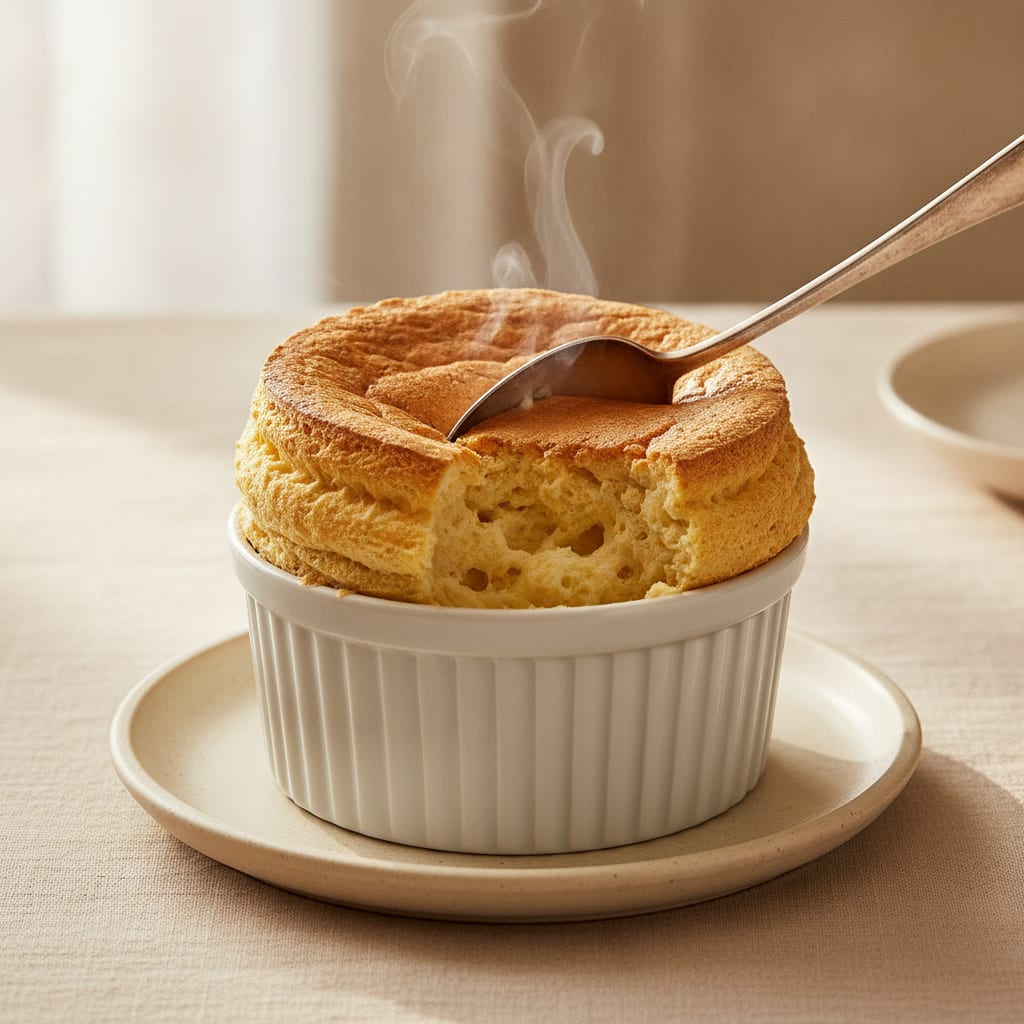
The cheese soufflé, two ways: a savoury chickpea-and-cashew base lifted on whipped aquafaba, baked tall in a buttered dish with the oven door kept shut.
- Prep
- 30 min
- Cook
- 30 min
- Total
- 1h
- Servings
- 4
- Difficulty
- Ambitious
Getting ready…
Ingredients
For 4 servings · 14 items
For the dishes
For the cheese base
For the rise
Method
7 steps · check as you go
- →
Serve
Serve the soufflés the instant they come out, while they stand tall and steaming — a soufflé is a thing you bring straight from oven to table. Crack the top with a spoon and eat from the airy centre. A simple green salad dressed sharp on the side cuts the richness. A cold, crisp white — a Chablis or a dry Riesling — is the classic pour.
The story
A cheese soufflé is the most theatrical thing in the French repertoire that uses almost nothing: a thick savoury base, a cloud of whipped foam, a hot oven, and nerve. The word is the past participle of souffler, to blow or puff, and that is exactly what happens — the dish blows itself up on trapped air and steam and then, the moment it cools, begins to let itself down. It came to prominence in the eighteenth century, once French cooks worked out that folding whipped whites into a flavoured base and baking it would lift the whole thing skyward. It has frightened home cooks ever since, mostly because of one rule everyone has heard and few understand: do not open the oven door.
I spent a long evening with the soufflé in November 2024, in Paris, in a tiny rented kitchen in the 11th near the rue Oberkampf, baking ramekin after ramekin to relearn the fold. A pastry cook I knew from the Le 110 de Taillevent stretch came by, watched me crack the door at the eight-minute mark to “check,” and caught my wrist. “On ne regarde pas,” she said — you don’t look. You trust it. She made me bake the next one blind, lit only by the oven lamp, and it rose a clean inch above the rim. The looking was the problem the whole time.
This soufflé has no egg in it. The lift comes from whipped aquafaba; the body of the base, normally the yolks, comes from blended chickpea and cashew; the cheese comes from nutritional yeast and miso. The method is unchanged — the thick seasoned base, the firm foam, the gentle fold, the thumb groove, the closed door. It is not a “vegan version” of a soufflé. It is a soufflé, baked with the door shut, the way I was made to.
À la maison
The weeknight reading is the recipe above, and it asks for nerve more than skill. Three moves carry it: whip the aquafaba to genuinely firm peaks — longer than you think, with cream of tartar — season the base boldly because the foam will dilute it, and fold gently so you keep the air. Then the hardest part, which is doing nothing: get them in the oven, set a timer, and leave the door shut. Don’t peek. Serve them the instant they’re out, tall and steaming, because a soufflé will not wait for a slow guest. Bring the soufflé to the table, not the table to the soufflé.
Au bistrot
The bistronomique reading is the same soufflé, baked twice, which sounds like a contradiction and is in fact the most forgiving restaurant trick there is.
Make a soufflé suissesse — the double-baked soufflé. Bake the soufflés as above in well-buttered ramekins, let them cool and deflate completely (yes, on purpose), then turn them out. Set each collapsed soufflé in a shallow gratin dish, pour a savoury cashew-cream sauce loosened with a little white wine and extra nutritional yeast around and over it, scatter the top with cashew parmesan, and bake again in a hot oven until the soufflé drinks the cream, puffs back up, and the top turns golden and bubbling. The second bake re-inflates it and the cream gives it a rich, set crust — and because it’s already fallen once, there’s no fragile window: it holds. Serve one per person in its dish, the puffed soufflé sitting in a pool of its own glossy sauce, a few chives and a turn of pepper on top. The diner gets the drama of the rise with none of the panic of the timing.
Le dressage — Three-quarter, warm and close. A single small gratin dish, the re-risen soufflé domed and golden, sitting in a shallow pool of pale cream sauce gone bubbling at the edges. Side light to catch the gloss and the browned top. A scatter of fine chives, a single grind of pepper. The plate should say the soufflé that can wait — all of the theatre, held steady.
What the other recipes get wrong
Most eggless soufflé recipes online — I read the top ten in March 2026 — either rely on a thickener-and-baking-powder cake batter that never truly rises, or whip the aquafaba too softly and fold too hard, and the result is a dense, damp custard that looks nothing like a soufflé. The lift is the whole dish, and the lift is the foam. I ran the test over a week in March 2026, four batches, same cheese base, same oven, only the rise changed:
- Baking powder, no whipped foam: it puffed a little, then baked into a savoury cake — dense, even, no airy structure at all.
- Aquafaba whipped to soft peaks, folded fast: a brief rise that collapsed before it set; the centre was wet and heavy.
- Aquafaba to firm peaks, then over-folded smooth: I knocked the air out chasing a streak-free batter, and it baked low and tight.
- Aquafaba to firm peaks, cream of tartar, folded just until no streaks, door kept shut: it rose a clean inch above the rim, domed, golden, airy inside. This was a soufflé.
The reason is the physics of foam. A soufflé rises because a protein foam traps air, and in the oven that air plus the steam from the base expand and lift everything until the proteins coagulate and lock the scaffold in place. With eggs, the white’s proteins do this; aquafaba — around 1.5% protein, mostly albumins and globulins, with saponins that aid foaming — whips to several times its volume and forms the same air-trapping film, though it needs longer whisking and cream of tartar to hold firm peaks. The base’s chickpea and cashew protein then set around the air on baking, the way yolk-enriched base does. And the door: the rise is fragile until those proteins set, so opening the oven in the first ten minutes drops the temperature, the air contracts, and the half-risen soufflé sinks. Firm foam, gentle fold, closed door: every batch that obeyed all three climbed.
The line I draw
I will not open the oven door while a soufflé is rising. Not at the eight-minute mark, not “just to check,” not because I can’t see through the glass. The rise is a fragile thing held up by expanding air inside a foam that has not yet set, and a blast of cool air at the wrong moment makes that air contract and the whole soufflé fall — and a fallen soufflé does not come back in the same bake. The discipline is to trust the timer and the oven lamp and keep your hands off the handle until it’s tall, domed, and golden. The pastry cook in the 11th was right: on ne regarde pas. You don’t look. You wait, and then you run it to the table.
When this can fail
Three ways, all from my own kitchen between 2022 and 2026:
- The flat soufflé. I under-whipped the aquafaba to soft, slumping peaks because it was taking forever, and the foam couldn’t hold the air — it baked into a dense pancake. Fix: whip to genuinely firm, glossy peaks that stand when you lift the whisk, even if it takes eight minutes, with a clean bowl and cream of tartar.
- The collapse. I opened the door early to rotate the tray; the cold air hit and the soufflés sank in front of me. Fix: keep the door shut for the first ten minutes at least, and don’t open it until they’re risen and set.
- The bland centre. I seasoned the base for how it tasted in the pot, forgetting the foam would dilute it, and the baked soufflé came out flat and underseasoned. Fix: season the base assertively — it should taste slightly too strong before the foam goes in.
FAQ
QCan you make a cheese soufflé without eggs?
Yes. A soufflé rises because a foam traps air and steam that expand in the oven, and that foam doesn't have to be egg white. Aquafaba — chickpea cooking water — whips to firm peaks and gives the same lift; whipped longer than egg white, it holds the air just as well. The base, normally enriched with yolks, is built from blended chickpea and cashew for body and protein, with nutritional yeast and miso for the cheese flavour. It rises and reads as a soufflé because it follows the soufflé's structure.
QWhy did my soufflé collapse?
Three common causes. The aquafaba was under-whipped, so the foam couldn't hold the air. The folding was too rough and knocked the air out. Or the oven door was opened too early — the sudden temperature drop deflates a soufflé whose protein scaffold hasn't set yet, which matters most in the first 10 minutes. Whip to firm peaks, fold gently, keep the door shut, and serve the moment it's out, because every soufflé begins to settle within a minute of leaving the oven.
QWhy can't you open the oven while a soufflé bakes?
Because the rise depends on trapped air and steam expanding inside a foam, and that structure is fragile until the proteins set. Opening the door early lets in cool air and disrupts the heat, so the air contracts and the half-risen soufflé sinks before its walls have firmed. The first ten minutes matter most. Once it's tall, domed, and golden it's far sturdier, but you still serve it straight away.
QHow does aquafaba replace egg whites in a soufflé?
Aquafaba is about 1.5% protein — mostly albumins and globulins — plus saponins that help it foam, and when whipped it unfolds and forms a film around air bubbles, the same way egg white does. It whips to several times its volume, though it needs longer whisking and a stabiliser like cream of tartar to hold firm peaks. In a soufflé it provides the entire lift; the body and richness the yolks would add come from blended chickpea and cashew in the base.
QWhat dish do I bake a soufflé in?
Straight-sided ramekins or a soufflé dish, buttered with upward strokes and dusted with nutritional yeast or fine breadcrumbs so the rising mixture has a grippy surface to climb. Straight sides let it rise true; sloped or smooth-greased walls make it catch and rise crooked. Run a thumb around the inside rim before baking — the 'top hat' groove — so it lifts straight up rather than mushrooming over the edge.