The braise that fears brown.
Blanquette.
The ivory braise, two ways: celeriac and king oyster poached in a white velouté, finished with a lemon-and-cream liaison that must never see brown.
- Prep
- 25 min
- Cook
- 45 min
- Total
- 1h 10min
- Servings
- 4
- Difficulty
- Medium
Getting ready…
Ingredients
For 4 servings · 23 items
For the braise
For the white velouté
For the liaison
For the garnish
To serve
Method
8 steps · check as you go
- →
Serve
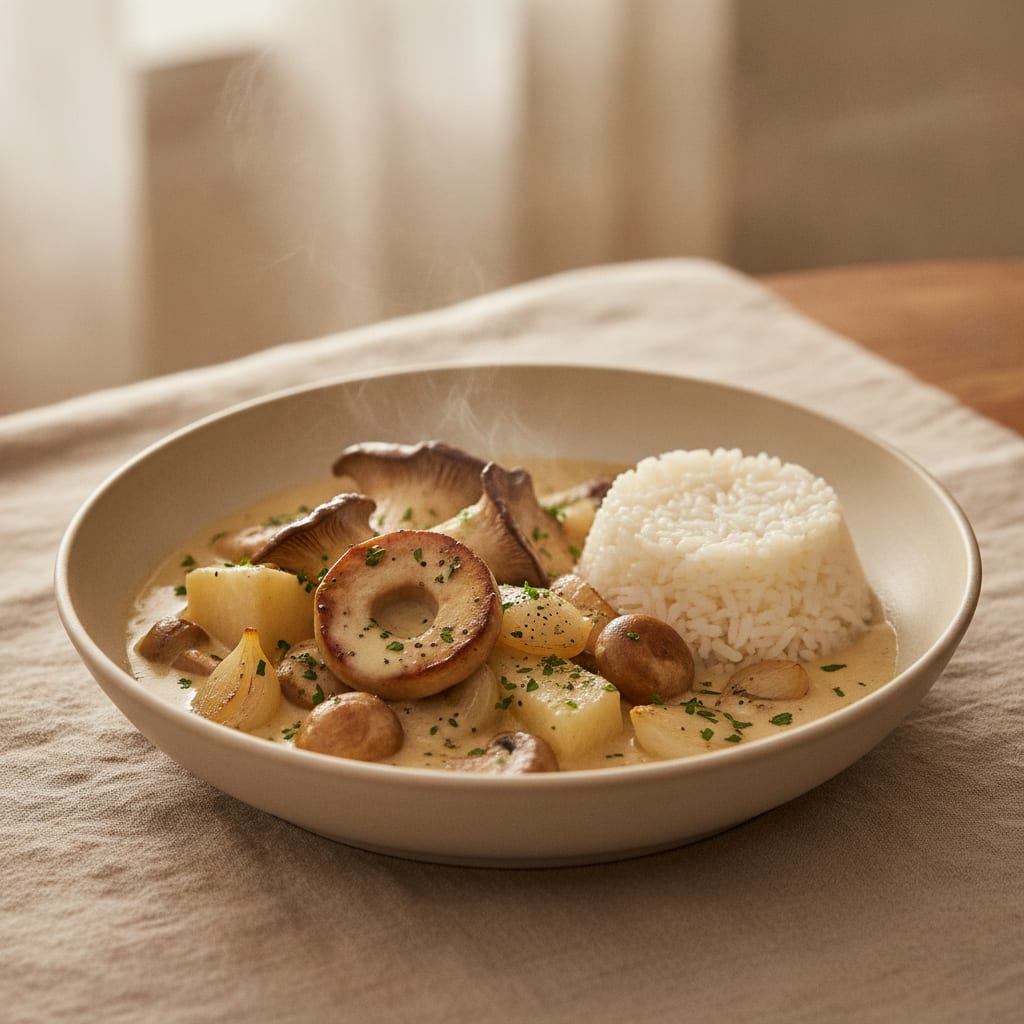
Spoon the blanquette into warm shallow bowls over a mound of plain white rice — the Parisian default — or alongside steamed potatoes. Finish each bowl with parsley, a turn of white pepper, and a last few drops of lemon at the table. A cold glass of dry white, an Aligoté or a Chablis, is the right pour for an ivory braise.
The story
A blanquette is the white braise — the one French dish built on the refusal to brown anything. The name comes straight from blanc, white, and that is the entire discipline: no fond, no colour, no Maillard, just a clear poach finished into an ivory sauce. The first recipe to carry the name appears in Vincent La Chapelle’s Le Cuisinier moderne in 1735, made then from leftover roast and reworked into something pale; by 1752 the supplement to the Dictionnaire de Trévoux could call it “a very common dish among the bourgeois when they are only with the family.” It became the polite opposite of the peasant brown stew — and stayed there.
I learned to keep it white in Paris, in the first stretch I spent there between 2010 and 2014, in a kitchen where the chef de partie on the garde-manger would stop me with a hand on the wrist if my roux so much as thought about turning blond. “Pas de couleur,” he’d say — no colour — and tip the pan to the window so the light caught the sauce. If it read cream, it passed. If it read beige, I started the roux again. I thought he was fussy. He was teaching me the one rule the dish has.
This blanquette has no veal in it. It has celeriac for the body and king oyster mushroom for the chew, poached à blanc; a white roux that never colours; and a liaison of blended cashew and lemon doing the work of the egg yolk and cream. The method is the dish: poach, don’t sear; roux blond-stopped; liaison off the heat. It is not a “vegetable version” of a blanquette. It is a blanquette, held to the same white discipline as the one I was taught at the window.
À la maison
The weeknight reading is the recipe above, and it asks one thing of you: keep your hands off the colour. Don’t sear the celeriac, don’t let the roux go blond, glaze the onions and mushrooms in butter and water rather than browning them. The only moment that needs care is the finish — pull the sauce off the heat, let it stop bubbling, then whisk the cashew liaison in and don’t boil it again. Serve it over plain white rice. That bowl of pale braise over white rice is exactly how it is eaten in Paris, and it is most of why a plate of vegetables feels like a blanquette.
Au bistrot
The bistronomique reading is the same braise, taken apart and recomposed so the white reads as a choice, not an accident.
Treat the celeriac two ways on one plate. Poach the prettiest pieces as above and keep them ivory. Then take a second wedge of celeriac, poach it soft, and blend it with a little of the velouté and a knob of butter into a smooth, glossy purée — a pomme of celeriac that anchors the plate without a single brown edge. Sear nothing of the celeriac; instead, take just one king oyster, poach it, then sweat its cut faces in foaming butter over low heat only until barely golden — the one permitted whisper of colour, for contrast — and slice it on the bias. Glaze the pearl onions à blanc until they shine like glass. Build a wide, shallow bowl: a swipe of celeriac purée, three ivory celeriac pieces and the sliced king oyster arranged off-centre, the glazed onions and a few button mushrooms tucked between, the white velouté spooned around rather than over, so the sauce frames the elements. A few drops of brown-butter-coloured mushroom oil and a single leaf of chervil. Then a last squeeze of lemon at the pass to wake the whole pale composition up.
Le dressage — Overhead, soft and low-contrast. Wide ivory bowl, ivory sauce, ivory vegetables — a study in white with one bias-cut mushroom for shape and a single green leaf for life. Side light to find the gloss on the glaze. Negative space, sauce framing not flooding. The plate should say discipline — that white is the hardest colour to plate well, and here it was earned.
What the other recipes get wrong
Most blanquette recipes — I read the top ten in February 2026 — get the colour right and the finish wrong. They tell you to thicken with a roux and stop there, or to dump cream straight into a boiling sauce, and the result is either a floury, flat ivory paste or a split, grainy one. The liaison is the part everyone flattens. I ran the test over a week in February 2026, four batches, same poach, same white roux, only the finish changed:
- Roux only, no liaison: thick and pale but dull and pasty, with a raw-flour edge that never fully cleared. White, but lifeless.
- Oat cream stirred into a simmering sauce: it looked right for thirty seconds, then the boil broke it into a faintly grainy surface and cooked the brightness out.
- Cashew liaison stirred in while still simmering: silky for a moment, then the heat dulled the lemon and the sauce lost its lift.
- Cashew-and-lemon liaison whisked in off the heat, below 80°C: silky, ivory, bright, with a faint tang on the finish that kept the richness from cloying. This was the dish.
The reason is chemistry and not preference. A classic blanquette is finished with a liaison of egg yolk and cream, and egg yolk proteins set — scramble — above roughly 65°C (150°F), which is exactly why the technique has always demanded you pull the pot off the heat first. The cashew version won’t curdle, but the lemon’s volatile brightness cooks off the same way under a hard simmer, and a boiling emulsion separates whether the fat is dairy or nut. Finish below a simmer, off the flame, every time, and the sauce stays bright, glossy, and white.
The line I draw
I will not let a blanquette brown. Not a seared edge on the celeriac “for flavour,” not a blond roux “for nuttiness,” not a hard reheat that catches the bottom. The entire identity of the dish is the absence of the Maillard reaction — blanc is in the name — and the second something colours, you have made a different, browner stew that happens to have the same vegetables in it. A blanquette that has gone beige is not a rustic blanquette. It is a failed one. The chef at the window was right to make me start the roux again.
When this can fail
Three ways, all from my own kitchen between 2022 and 2026:
- The scrambled liaison. Early on I whisked a yolk-style liaison into a sauce still at a simmer and watched it seize into pale threads. There is no whisking it back smooth. Fix: pull the sauce off the heat, let it stop bubbling and drop below 80°C, then add the liaison and never boil it again.
- The greyed sauce. I let the poaching liquid rip at a hard boil to save time; it went cloudy, and the finished velouté came out a dingy grey rather than ivory. Fix: poach at a bare simmer the whole way, keep the liquid clear, and the sauce stays white.
- The rubbery king oyster. I poached the mushrooms too long while I fussed with the sauce, and they turned squeaky and tight. Fix: pull them at 8 minutes, poached gently, and fold them back in only to warm through at the end.
FAQ
QCan you make a real blanquette without veal?
Yes, because a blanquette is defined by its method, not its meat: it is a white braise where nothing is ever browned, finished with a cream-and-acid liaison. The name comes from blanc, French for white. Celeriac gives the meaty, sliceable body and king oyster mushroom gives the dense chew that reads as the simmered veal, both poached à blanc so the sauce stays ivory. A blended-cashew liaison with lemon replaces the egg-yolk-and-cream finish. It eats as a blanquette because it follows every blanquette rule — above all, no colour anywhere.
QWhy is blanquette white and never browned?
The whole identity of the dish is its pale, ivory sauce, which only exists if you avoid the Maillard reaction at every step. You poach rather than sear, you cook the roux blond-stopping it before it colours, and you glaze the garnish à blanc in butter and water. The moment anything browns you have tinted the sauce and pulled the dish toward a brown stew. White is not a garnish here; it is the definition.
QHow do you keep the liaison from splitting?
Temperature. A classic egg-yolk liaison curdles above about 65°C (150°F), so you always pull the sauce off the heat and let it drop below a simmer before whisking the liaison in, then never boil it again. A blended-cashew liaison is more forgiving and won't scramble, but boiling it hard after it goes in can still break the emulsion and dull the lemon. Finish off the flame, warm gently, and stop.
QWhat can I use instead of egg yolk and cream in blanquette?
Raw cashews soaked in hot water for 30 minutes, then blended with water, lemon juice, and a little nutritional yeast, give you the silk, the pale colour, and the faint tang of a yolk-and-cream liaison in one pour. Whisk it into the velouté off the heat. Silken tofu blended with lemon is a lighter alternative; a splash of oat cream loosened with lemon works in a pinch but gives less body.
QWhat do you serve with blanquette?
The Parisian default is plain white rice, which soaks up the ivory sauce, or steamed waxy potatoes. Keep the sides quiet — the dish is rich and pale, so anything loud or browned fights it. A handful of parsley and a last squeeze of lemon at the table is all the lift it needs. A dry white wine, an Aligoté or a Chablis, is the classic pour.