Cheeky chickpea.
Milanesa.
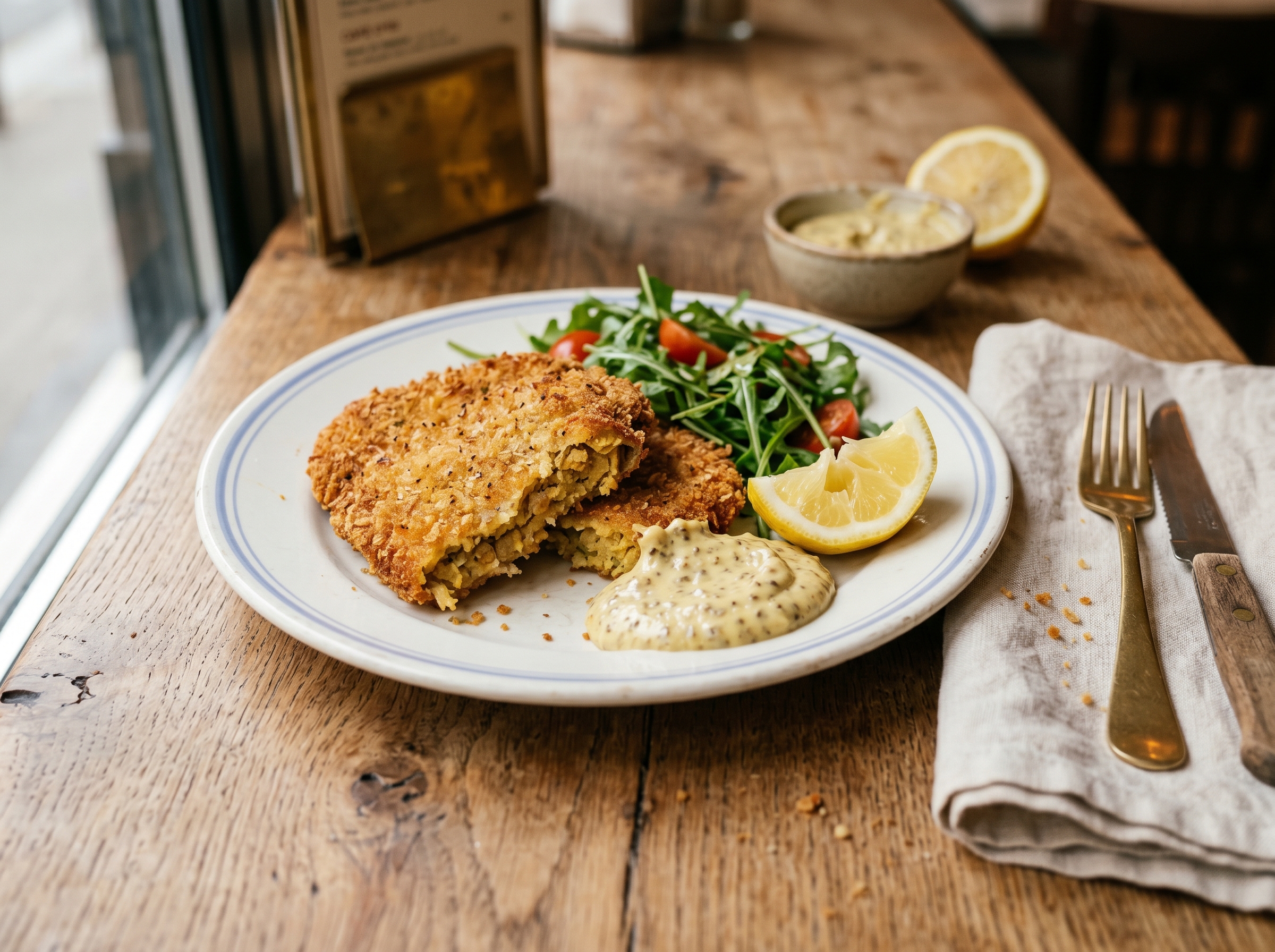
Crispy breaded cutlets, Argentine style — chickpeas inside, panko crust, mustard-caper aioli, and the lemon wedge that doesn't negotiate.
- Prep
- 20 min
- Cook
- 25 min
- Total
- 45 min
- Servings
- 4
- Difficulty
- Medium
Getting ready…
Ingredients
For 4 servings · 24 items
For the cutlets
For the breading
For the aioli
To serve
Method
8 steps · check as you go
- →
Serve
Plate one cutlet per person. Spoon a dollop of aioli to one side. Tuck a lemon wedge in. Eat hot, the cutlet should crackle when you cut it. The Argentine move is to squeeze the lemon over the whole thing the moment before the first bite.
The story
A milanesa is a thin breaded cutlet, fried until the crust shatters. The dish came to Argentina in the 19th century with Italian immigrants — a translation of the Milanese veal cotoletta into the cattle country that would, eventually, take it as its own. The first one I ate was in November 2019, in a corner bodegón on Calle Estados Unidos in San Telmo, around the corner from the leather workshop where I was supposed to be picking up a belt. The waiter — a man in his sixties with the patience of someone who had served the same dish ten thousand times — set down a cutlet the size of the plate, a wedge of lemon, and a bottle of bone-dry house red. He said nothing. Said nothing in the way that means: this is the dish. There is nothing else to say.
I have been making milanesas at home ever since. For years they were veal, and then they were chicken, and then they were chickpeas, and then I stopped noticing the change. The technique never moved. The dish never moved. What changed was what was in my hands.
The chickpea version is not a “vegan milanesa.” It is a milanesa. The proof is in how it eats: that same shattering crust, that same lemon-squeeze moment, that same bone-dry red. The chickpeas — pulsed coarse, not smooth — give you a cutlet with internal texture, with bits that hold their shape under the bread. The potato binds. The aquafaba lets the panko stick the way an egg would. The dijon in the wash carries flavor into the crust. None of this is invented. It is the same dish, made with what is in the kitchen.
The mustard-caper aioli is not strictly traditional — most porteños would shrug and ask why you bothered when a good lemon will do. It’s there because I cook for myself now, and I like the way capers cut into the rich crust. If you want the purist plate, skip the aioli. The lemon will not negotiate.
What the other recipes get wrong
Most plant-based milanesa recipes online — I checked the top ten in March 2026 — solve the binder problem with chia egg or flax egg. I tested both, in twelve batches over a Saturday and Sunday in February. Chia gave a slimy interior that never set, even with longer rest. Flax gave a beany aftertaste that fought with the panko. Aquafaba alone gave a thin crust that flaked off the second cutlet onto the plate.
The combination that worked, every time, across all twelve batches: aquafaba in the wash, chickpea flour as the in-mash binder, dijon in the wash, panko toasted before breading. Each piece does something the others can’t. Drop any one and the cutlet starts to split. I have the photos of the failures — twelve cutlets in various states of falling apart — pinned above my station as a reminder.
The line I draw
I will not bake a milanesa. I have tried. Three times. The pan-fried version is the dish. The baked version is something else — a chickpea cutlet, a fritter, a thing on bread. The shattering crust is the dish, and you only get it from oil at 350°F. If you cannot fry, this is not the recipe for you. I would rather you cook something else honestly than do this dishonestly.
When this can fail
Three ways, all from my own kitchen between 2022 and 2026:
- The wet mash. Chickpeas straight from the can, undrained, undried. The cutlet split on the flip, the panko slid off in sheets, the oil spat. Fix: pat the chickpeas with a clean towel until they squeak between your fingers.
- The cold oil. Tested with a panko crumb that floated and stayed pale. The cutlet absorbed the oil instead of frying in it — finished grey, oily, sad. Fix: wait the extra minute. A crumb should brown in 25 seconds.
- The over-pulsed mash. Once into hummus, it is hummus. The cutlet had no internal texture, the bite was uniform, the crust had nothing to grip. Fix: pulse five times. Stop. Look. If you see fragments of chickpea, you’re done.
The dinner
A few notes on technique before you start. The chickpeas must be very dry — wet chickpeas mean a wet mash, which means a cutlet that splits in the oil. Pat them with a clean kitchen towel until they squeak. The breading is a relay: flour first, then the aquafaba wash, then the panko. The aquafaba is the loadbearing piece — the dijon and the salt do the real work. The oil temperature is the difference between gold and grey. 350°F (175°C). Test it with a single crumb if you don’t have a thermometer. Fry briefly. Salt immediately. Eat hot.
This is dinner. The whole dinner. Made with the technique I learned in France, refracted through the country that taught me what a milanesa is for.
FAQ
QWhat is the best plant-based version of milanesa?
A chickpea milanesa, breaded the proper Argentine way. The chickpeas are pulsed into a coarse paste with a Yukon gold potato as binder, formed into thin cutlets, then triple-breaded using aquafaba (the brine from the chickpea can) as the egg replacement. Pan-fried in neutral oil until golden, the texture is crispy outside and tender inside. Mustard-caper cashew aioli and a lemon wedge finish the plate.
QHow do you make milanesa crispy without eggs?
Use aquafaba — the liquid from a can of chickpeas — whisked with a tablespoon of dijon mustard until foamy. The proteins in aquafaba mimic the binding action of beaten egg. Triple-bread the cutlet in seasoned flour, then aquafaba, then toasted panko. Pan-fry at 350°F (175°C) for 90 seconds per side. Toasting the panko first guarantees the deep golden color even with a short cook.
QCan I bake the chickpea milanesa instead of frying it?
Yes, with a compromise. Brush the breaded cutlets generously with oil on both sides. Place on a parchment-lined sheet pan and bake at 425°F (220°C) for 12 minutes per side. The texture will be crisp but slightly less shattering than pan-fried. For a closer-to-fried result, use an air fryer at 400°F (200°C) for 8 minutes per side.
QWhat can I serve with chickpea milanesa?
Argentine tradition is a green salad — escarole or arugula with olive oil and a sharp vinegar — and crusty bread. For a fuller plate, a side of crispy smashed potatoes with parsley and garlic. The milanesa is rich enough that the sides should be light: nothing creamy, nothing else fried. A glass of cold Malbec is the obvious local pairing.
QHow do I store and reheat leftover milanesa?
Store cooled cutlets in a single layer in an airtight container in the fridge for up to three days. To reheat, place on a wire rack over a sheet pan and warm in a 375°F (190°C) oven for 8-10 minutes — never the microwave, which turns the crust to soft cardboard. The aioli holds in the fridge for five days; whisk in a teaspoon of cold water if it tightens up.