The pastry that crossed Asia.
Samosa.
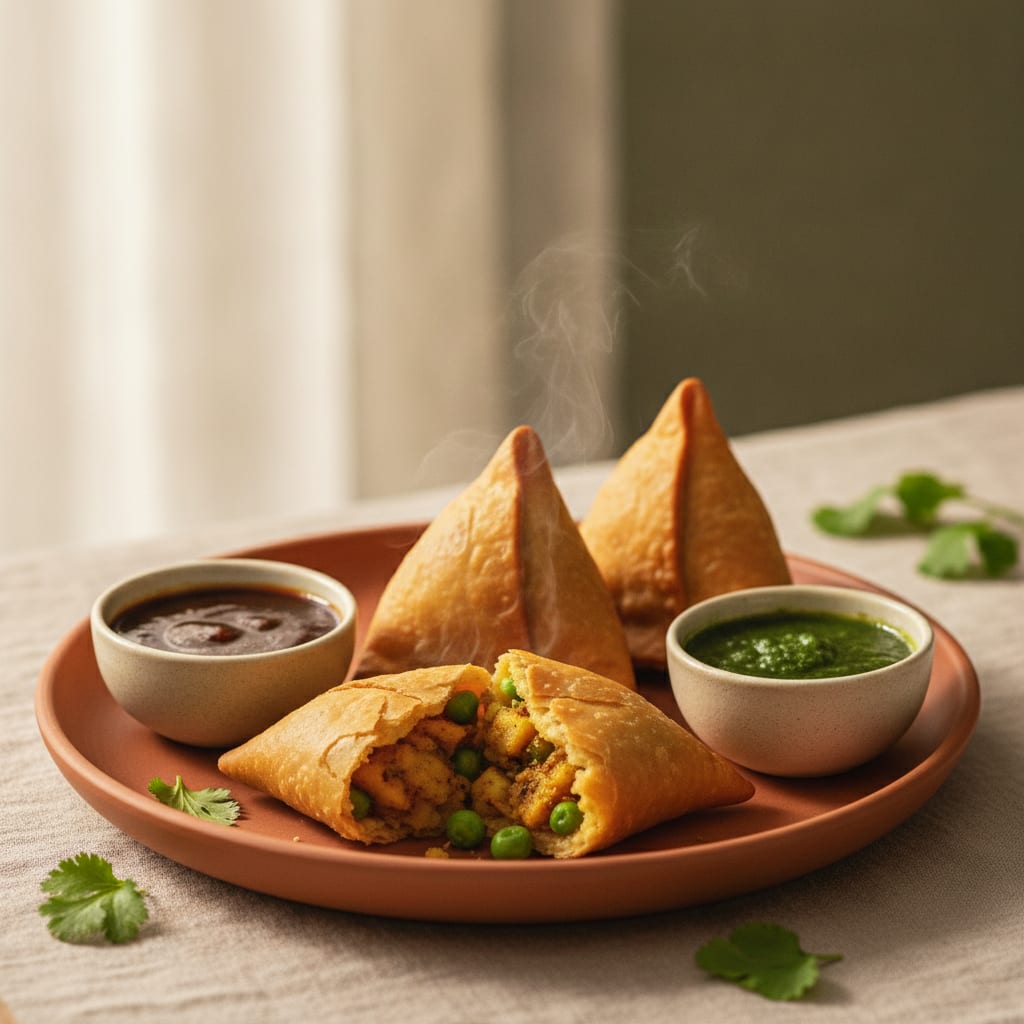
Punjabi potato-and-pea samosas: a flaky ajwain maida pastry, fried low then high for a blister-free crust, around a cumin-spiced filling with whole coriander.
- Prep
- 40 min
- Cook
- 30 min
- Total
- 1h 10min
- Servings
- 4
- Difficulty
- Medium
Getting ready…
Ingredients
For 4 servings · 16 items
For the pastry
For the filling
For frying
To serve
Method
7 steps · check as you go
- →
Serve
Serve the samosas hot and upright, two or three per plate, with a bowl of dark sweet-sour tamarind chutney and a bowl of bright green coriander-mint chutney. Crack one open at the table so the spiced steam escapes. A cup of strong masala chai alongside is the only correct pairing in the afternoon; a cold beer in the evening.
The story
I learned to fold a proper samosa in the autumn of 2023, in the back of a Brick Lane café in East London where I was spending a season cooking and the head cook, an aunty from Lahore everyone called Bibi, ran the snack station with terrifying efficiency. October, the windows fogged, the fryer going, a tray of folded cones standing in formation waiting their turn. The first batch I fried came out blistered and bubbled all over the surface like bubble wrap, and Bibi looked at them, then at me, the way you look at someone who has done something both wrong and slightly funny. “You burned them alive,” she said. “You put them in a fire. A samosa is not put in a fire. A samosa is brought up slowly, then crisped.” She turned the heat down to almost nothing, slid in the next tray, and walked away to make tea while they cooked. Twelve lazy minutes later she came back, cranked the heat, and finished them gold in two. Smooth as glass. Not a blister.
The samosa is a great traveller, and not originally Indian at all. It descends from the Central Asian and Persian sambosa — a stuffed pastry recorded across the medieval Islamic world before the tenth century, named by the Persian historian Beyhaqi, carried east by traders. By around 1300 the Delhi poet Amir Khusrau was writing of nobles eating samosas of meat and ghee; the traveller Ibn Battuta ate a minced-meat sambusak at the Tughluq court. The potato — the filling we now think of as the soul of the thing — only arrived after Columbus, centuries later.
This samosa has no meat in it, and the one most people in Britain eat never did: it’s the Punjabi potato-and-pea version, a flaky ajwain crust around cumin-spiced potato. It is not a “vegetable samosa” as some lesser thing. It is the samosa most of the world means — Bibi’s samosa, brought up slowly and crisped at the end.
À la maison
The weeknight reading is the recipe above, and the two things that separate a good homemade samosa from a sad one both live outside the spice tin. First, the dough: rub the fat into the flour properly — a few real minutes, until it clumps like damp sand — and keep it stiff. That’s the flake. Second, the fry: low first, then high. Resist every instinct to crank the oil for speed. Bring them up gently at a lazy heat until the crust is firm and pale, then turn it up to colour and crisp. Folding the cone takes a couple of tries to get a tight seam; after the third one your hands learn it. Cool the filling fully before it goes in — warm filling is half the reason crusts split.
Au bistrot
The bistronomique reading keeps the flaky ajwain pastry and the spiced potato but trades the handful-snack for a precise plated starter.
Make the samosas small and exact — neat little cones, or fold them into crisp parcels — and fry them the same two-stage way so the crust stays smooth and pale-gold. Pass the potato filling finer, almost a spiced mash, and tuck a single softened pea-and-mint dot in the centre of each so the cross-section reads clean. Turn the two chutneys into plate elements rather than dipping bowls: a glossy tamarind gastrique reduced sticky and dark, dotted and dragged into a teardrop, and a vivid coriander-mint oil in fine green dashes. Add a cool counterpoint — a small quenelle of whipped coconut yogurt with toasted cumin — and a few pickled red onion threads for sharpness and colour. Set three small samosas leaning together off-centre, the tamarind teardrop and green dashes around them, the yogurt quenelle to one side, pickled onion and a single fried curry leaf on top. Crack one open as it goes out so the steam shows.
Le dressage — Three-quarter, low light raking across to read the crisp ridges of the crust. Matte dark plate. Three small golden samosas leaning together, one cracked to show the filling, a dark tamarind teardrop, bright green oil dashes, a pale cumin-yogurt quenelle, a tangle of pink pickled onion. The plate should say street snack, plated with respect — humble food given the geometry of a restaurant course.
What the other recipes get wrong
Most samosa recipes online — I read the top ten in November 2025 — tell you to fry at “medium-hot oil” in one go, and then wonder in the comments why the crust comes out bubbled and oily. The blister isn’t bad luck; it’s the wrong fry. I ran the test over three afternoons in November 2025 — same dough, same filling, same shaped cones — and changed only how they were fried:
- Hot oil, one stage (~180°C the whole way): erupted into blisters within seconds, browned outside while the inner dough stayed raw, and drank oil through the cracked surface. Greasy, bubbled, hard.
- Medium oil, one stage (~160°C): better, but still bubbled in patches and the crust was uneven — some smooth, some blistered — because the surface was setting faster than the dough cooked through.
- Low then high (~135°C for 12 minutes, then ~180°C for 2): smooth, even, pale crust that fried up glassy and crisp, fully cooked through, with no blisters and almost no oil absorbed. Bibi’s samosa.
The reason is heat and rate, not luck. When dough hits very hot oil, its surface starch gelatinises and sets almost instantly while the water just beneath flashes to steam; that trapped steam pushes up against an already-rigid skin and erupts it into blisters — the same mechanism that bubbles a too-hot puri. Fry low first, and the dough heats through gradually: water escapes gently, the gluten and starch set evenly, and the crust stays smooth. Only once the whole pastry is cooked and firm do you raise the heat — now the high temperature only browns and crisps an already-stable surface, no eruption possible. The well-rubbed fat helps too: shortened dough has weaker, more even gluten that resists violent bubbling. Across all three afternoons, the smooth crust came only from the two-temperature fry, in that order.
The line I draw
I will not drop a samosa into hot oil to save time. The entire look and bite of a proper Punjabi samosa — the smooth, blister-free, layered crust — depends on bringing it up slowly first, at a lazy 130–140°C, until the dough is cooked through and set, and only then cranking the heat to colour it. Fry it hot from the start and you get a samosa that’s bubbled like bubble wrap, browned on the outside, raw and doughy within, and greasy from the oil that flooded the split surface. That is not a faster samosa; it’s a failed one. Bibi turned the heat down to make the best samosas in East London, and walked away to make tea while they cooked. The patience is the recipe.
When this can fail
Three ways, all from my own kitchen between 2022 and 2026:
- The blistered crust. Cranked the oil hot to get through a big batch faster; every samosa came out bubbled and oily, gold outside and gummy within. Fix: fry low and slow first (130–140°C, ten to fifteen minutes) until firm and pale, then raise to 180°C only to colour and crisp. Two stages, in order, no shortcuts.
- The split seam. Filled the cones hot and overstuffed them; three burst open in the fryer and bled potato into the oil. Fix: cool the filling completely, fill only three-quarters full, and seal the seam firmly with a wet edge, pressing and fluting it shut. Stand each one up to check it holds before it goes near the oil.
- The hard, dense crust. Made the dough too soft and skipped properly rubbing in the fat; the samosas fried up tough and bready instead of flaky. Fix: rub the oil into the flour a full three to four minutes until it clumps like damp sand, keep the dough genuinely stiff, and rest it before rolling. The flake is built before the water ever goes in.
FAQ
QWhere does the samosa actually come from?
Not originally from India. The samosa descends from the Central Asian and Persian sambosa/sanbusak — a stuffed pastry recorded in the Middle East before the 10th century and mentioned by the Persian historian Abolfazl Beyhaqi (995–1077). It reached the Indian subcontinent with Central Asian traders around the 13th–14th centuries. The Delhi Sultanate poet Amir Khusrau (1253–1325) described nobles eating samosas of meat and ghee around 1300, and the traveller Ibn Battuta recorded a 'sambusak' of minced meat and nuts served at the court of Muhammad bin Tughluq. The potato filling is a much later, post-Columbian Indian development.
QWhy are my samosas bubbly and not smooth?
Two usual causes. First, the oil was too hot when you dropped them in — a violent fry erupts the surface into blisters before the dough sets. Fry low first (130–140°C / ~285°F) until the crust is firm and pale, then raise the heat to finish. Second, the dough was too soft or under-rested, or the fat wasn't rubbed in enough, so the gluten and fat couldn't set a smooth crust. A stiff, well-rested dough fried in two stages comes out glassy and smooth.
QWhat does ajwain do in samosa dough?
Ajwain (carom seed) is the signature aroma of samosa pastry — a sharp, thyme-like, slightly bitter note that you register the instant you bite a good samosa. It's traditionally added both for that flavour and because it's thought to aid the digestion of the rich fried pastry. Skip it and the crust tastes plainly of fried flour; it's the one spice in the dough and it isn't optional.
QHow do I make the crust flaky?
Rub the fat (the moin) thoroughly into the flour — a full 3 to 4 minutes, until a squeezed fistful holds together like damp sand — before you add any water. That fat coats the flour and shortens it, so the fried crust breaks in crisp layers instead of going hard. Then keep the dough stiff, rest it, roll it thin but not paper-thin, and fry in two stages. Soft dough and rushed mixing give a hard or bubbly crust.
QCan samosas be baked or air-fried instead of deep-fried?
Yes, though they won't be quite the same. Brush them with oil and bake at around 200°C (390°F) or air-fry until golden, turning once. You lose some of the all-over shatter that deep-frying gives, and the crust is a little drier, but a well-made flaky ajwain dough still bakes up crisp and good. The filling is already cooked, so you're only baking the pastry through and colouring it.