Cold sets the secret.
Croquetas.
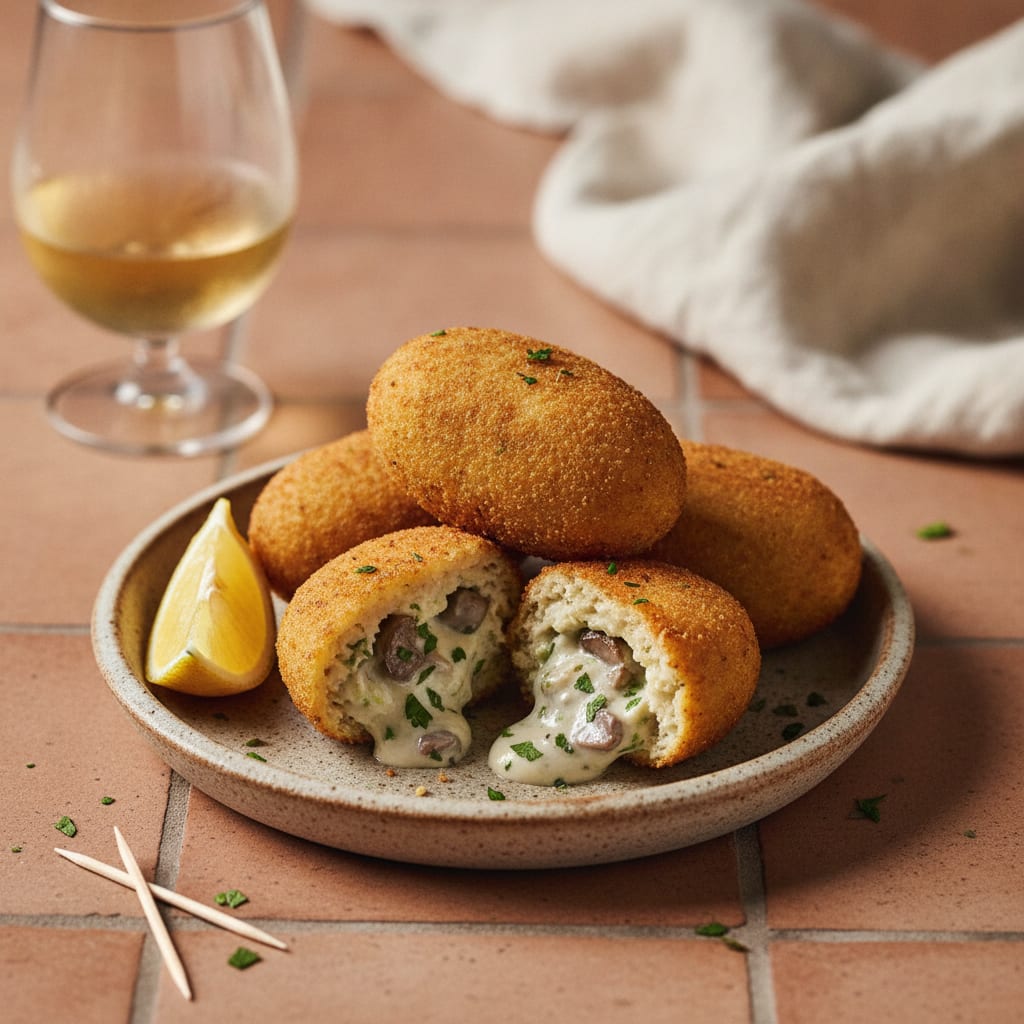
Spanish croquettes, two ways: a thick mushroom-and-jamón béchamel chilled until sliceable, shaped, double-breaded, and fried to a shattering golden shell.
- Prep
- 40 min
- Cook
- 20 min
- Total
- 4h
- Servings
- 4
- Difficulty
- Medium
Getting ready…
Ingredients
For 4 servings · 15 items
For the filling
For the béchamel
For breading and frying
Method
6 steps · check as you go
- →
Serve
Serve hot, straight from the fryer, piled on a small plate with a lemon wedge and toothpicks, and a glass of cold fino or manzanilla sherry. The centre should be molten and the shell shattering — eat them within a few minutes while that contrast holds. They are a tapa, a starter, or a part of a spread; in Spain a plate of croquetas appears on almost every bar counter, and they are eaten with the fingers.
The story
Croquetas are the most quietly French thing on a Spanish bar counter, and almost nobody who eats them knows it. The croquette is a French invention, built on béchamel — the white sauce credited to the kitchen of the Marquis de Béchameil in the 17th century — and it has a remarkably precise birthday in its modern form: on 18 January 1817, the chef Antonin Carême served croquettes à la royale at a banquet for the Prince Regent, the future George IV, and Grand Duke Nicholas of Russia. They crossed into Spain with French influence in the 19th century, and then something happened that rarely happens: the borrower outdid the lender. Spain turned an occasional French garnish into a national obsession, a thing on every bar counter, built on thick béchamel and yesterday’s leftovers.
I learned to make them the summer I spent at La Riuà in 2018, cooking arroces in the lanes of El Carmen in Valencia. Croquetas were the staff-meal economy machine — whatever was left from service went into the béchamel — and the cook who ran them, an old hand named Paco, treated the béchamel’s thickness as a moral matter. “Tiene que poder cortarse,” he’d say, dragging a spoon through the cold tray. It has to be sliceable. The first time I tried to bread a filling that hadn’t chilled long enough, three of them burst in the oil into pale clouds, and he just pointed at the clock without a word.
These croquetas have no meat in them, but they keep everything that makes a croqueta a croqueta: the thick béchamel, the cold set, the double crumb, the shattering shell over a molten heart. Mushrooms cooked dark and dry with smoked paprika and soy stand in for the cured, savoury jamón note. It is not a “vegan version.” It is croquetas, the way Paco made them from the week’s leftovers, sliceable when cold and golden when fried.
À la maison
The weeknight reading is the recipe above, though “weeknight” is generous — croquetas are easy but not quick, because the cold set cannot be hurried. The two moves that matter are both about firmness. Make the béchamel genuinely thick — thicker than feels right, a mass that pulls away from the pan in one piece — and then chill it hard, at least three hours and ideally overnight, until it is cold and sliceable. Everything after that is just careful breading and hot oil. Make the filling a day ahead and the rest takes twenty minutes; rush the chill and they will burst.
Au bistrot
The bistronomique reading keeps the same sliceable béchamel and simply refines its flavour and its shape. Push the mushroom base further: caramelise the mushrooms until properly dark, deglaze with a splash of dry sherry, and fold in a little finely chopped rehydrated porcini and a grating of dried mushroom for a deeper, more cured intensity. Strain the béchamel through a sieve before chilling for a flawlessly smooth interior. Shape the croquetas small and uniform — neat bonbons the size of a large olive, so the molten-to-shell ratio is at its most luxurious — and double-bread them in fine panko for the most even, shattering crust.
Plate them as a precise course, not a heap: three or five croquetas in a row or a small pyramid on a warm plate, each one identical. Set a small swipe of something sharp beneath — a saffron alioli, a black-garlic purée, or a smoked-mushroom ketchup — and balance the richness with a single bright note: a few pickled mushrooms, a dot of parsley oil, a sliver of lemon. The first one cut open at the table so the steam and the molten centre show. The same humble leftover croqueta, served as the deliberate, plated tapa it can be.
El emplatado — Three-quarter, close, warm light. Three or five identical golden croquetas in a tight row on a pale plate, one cut open to show the molten flecked centre. A clean swipe of dark purée beneath, a dot of green oil, a lemon sliver. Steam if you can catch it. The plate should say humble thing, exact execution — the bar staple given a quiet polish.
What the other recipes get wrong
Most croqueta recipes online — I read the top ten in April 2026 — go wrong in the same two places: a béchamel that is too loose, and a single coat of breadcrumbs. I ran the test over two days in April 2026: nine batches, the same filling, comparing béchamel thickness, chill time, and single versus double breading, frying them all at the same 180°C.
- Loose béchamel, short chill, single coat: a disaster — soft fillings that smeared when shaped and split open in the oil, leaking pale béchamel into the fat. Maybe a third survived intact.
- Thick béchamel, overnight chill, single coat: the filling held and shaped cleanly, but the thin single crumb cracked here and there and a few still wept at the seams.
- Thick béchamel, overnight chill, double coat: smooth, sealed, golden, every one intact with a molten centre and a shell that audibly shattered. Not one burst.
The reason is structure and water. A croqueta is an emulsion of fat, starch, and liquid held in a shell, and it works only if both the filling and the shell are built right. The high flour-to-liquid béchamel sets firm when cold because the starch granules, swollen with gelatinisation, lock into a sliceable gel as they cool — exactly the same staling chemistry that firms up cold bread, here put to work. That firmness is what lets the filling be shaped without bursting. The double breading then builds a thick, continuous barrier — two layers of batter-glued crumb — so that when the croqueta hits 180°C oil, the shell vitrifies and crisps before the heat can fully liquefy and pressurise the centre. Loose filling or thin shell, and the steam inside finds a weak point and blows it open. Thick, cold, and double-coated: the three together are the whole craft.
The line I draw
I will not bread a filling that has not fully chilled. It is the most tempting corner to cut — the béchamel is made, it looks firm enough after an hour, and you want to eat. But warm or under-chilled béchamel is paste: it smears when you shape it, cracks when you bread it, and bursts the moment it meets hot oil, leaking its centre into the fryer in pale clouds. The cold set is not a resting step you can shorten; it is the chemistry that turns sauce into something sliceable. Three hours minimum, overnight if you can. Paco pointed at the clock for a reason.
When this can fail
Three ways, all from my own kitchen between 2022 and 2026:
- The burst croqueta. Breaded a filling after only an hour in the fridge because I was impatient; half of them split open in the oil and leaked. Fix: make the béchamel genuinely thick and chill it at least three hours, ideally overnight, until cold and sliceable before you shape.
- The sliding crumb. Single-coated them and skipped chilling the breaded croquetas; the coating slid off in sheets in the oil, leaving bald patches. Fix: double-bread — flour, batter, crumb, batter, crumb — and chill the breaded croquetas 20 minutes so the coat sets before frying.
- The greasy, pale shell. Crowded the pan and let the oil drop below temperature; the croquetas soaked oil and came out flabby instead of crisp. Fix: keep the oil at a steady 180°C and fry only a few at a time, lifting them onto a rack the moment they’re deep golden.
FAQ
QAre croquetas Spanish or French?
Both, in lineage. The croquette is French by origin — built on béchamel, the sauce credited to the household of the Marquis de Béchameil in the 17th century — and the chef Antonin Carême served 'croquettes à la royale' at a banquet for the Prince Regent and the Grand Duke of Russia on 18 January 1817. They arrived in Spain with French influence in the 19th century, and Spain made them its own: where the French dish stayed occasional, the Spanish croqueta became a national obsession, a fixture of every bar, built on leftovers and thick béchamel. French in birth, Spanish in perfection.
QWhy do you have to chill croqueta béchamel before frying?
Because warm béchamel is an unshapeable paste. Croqueta filling is a deliberately very thick béchamel — a high ratio of flour and fat to liquid — and chilling it for several hours sets the starch and fat into something firm enough to slice, roll, and bread. Shape it warm and it will smear, crack, and burst open the moment it hits the hot oil. The long cold set, ideally overnight, is the single most important step and the one most home cooks rush.
QHow do you make croquetas without egg?
Replace the beaten-egg wash with a thin batter of plant milk whisked with a little flour or chickpea flour — it glues the breadcrumbs to the croqueta just as egg does. Bread them the same way: flour first, then the batter, then breadcrumbs, and for a proper shattering shell do it twice. The béchamel itself is easily made with vegan butter or olive oil and unsweetened soy or oat milk. See our guide to breading without eggs for the full method.
QWhy do my croquetas burst open when frying?
Almost always one of three things: the béchamel was too loose, the filling wasn't chilled firm enough, or the breading had cracks or a single thin coat. Make the béchamel genuinely thick, chill it for at least three hours, shape smooth ovals with no cracks, and double-bread them for a sealed armour. Then fry hot and fast at 180°C (355°F) so the shell sets before the centre fully melts. Don't crowd the pan or the oil cools and they split.
QCan I make croquetas ahead and freeze them?
Yes, and they're ideal for it. Shape and double-bread them, then freeze on a tray until solid and transfer to a bag — they keep three months. Fry them straight from frozen at a slightly lower 170°C (340°F) for a minute or two longer so the centre heats through before the shell over-browns. The filling can also be made and chilled up to two days ahead before shaping. Making them ahead actually helps, since the cold filling fries more reliably.