Thicker than gazpacho.
Salmorejo.
Córdoba's thick cold tomato-and-bread cream, two ways: a glossy emulsion of tomato, bread and olive oil, finished with black-salt tofu and smoky jamón crumbs.
- Prep
- 20 min
- Cook
- 0 min
- Total
- 20 min
- Servings
- 4
- Difficulty
- Easy
Getting ready…
Ingredients
For 4 servings · 10 items
For the salmorejo
For the topping
Method
6 steps · check as you go
- →
Serve
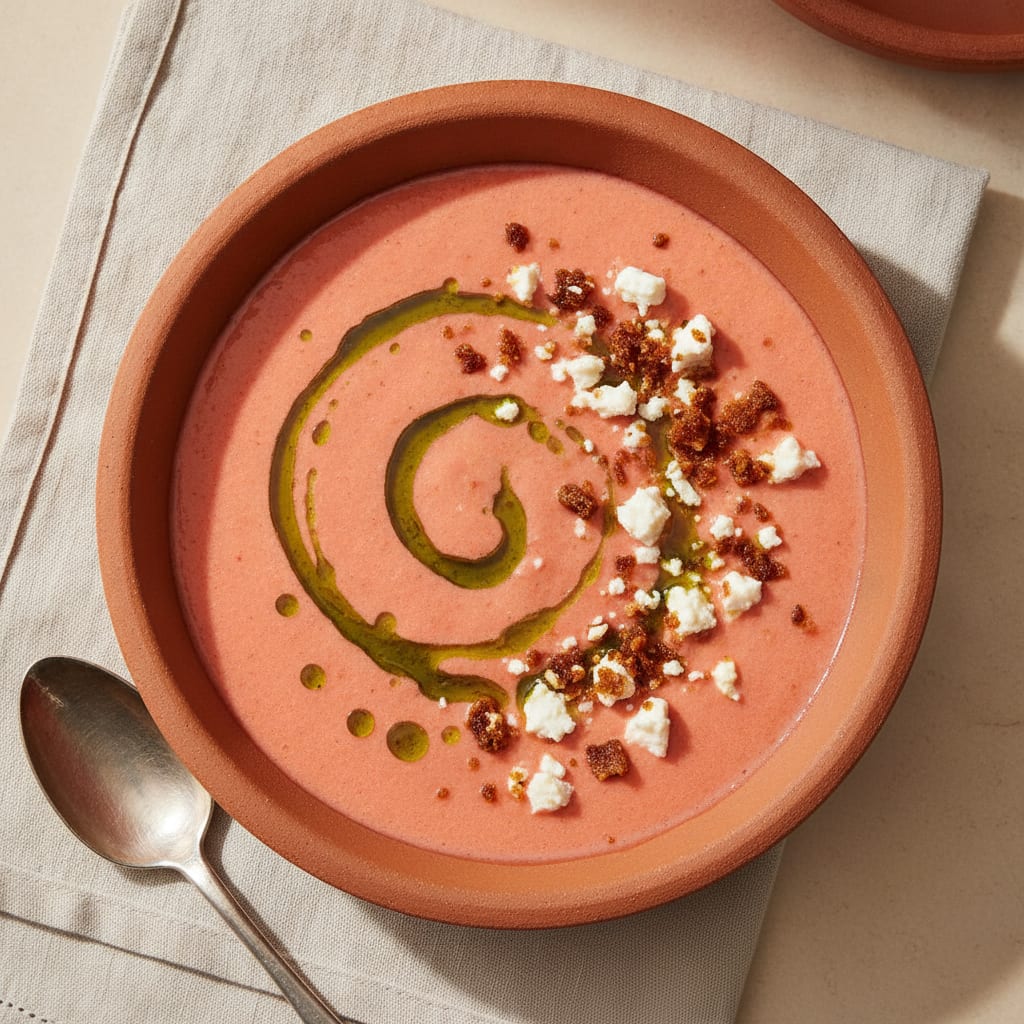
Serve in shallow bowls, cold and thick enough that the toppings sit on the surface rather than sink. Crown with the black-salt tofu, the smoky crumbs, and a bold spiral of extra-virgin olive oil. A few drops more vinegar at the table is welcome. In Córdoba it is lunch on a hot day, eaten with bread and a cold glass of fino sherry.
The story
Salmorejo is the dish people order thinking they ordered gazpacho, and then go quiet over, because it is not gazpacho at all. It is thicker, paler, richer — a cold cream of tomato, bread, garlic and a great deal of olive oil, from Córdoba, where it has been working-class lunch for well over a century. Its lineage is long: the Romans left Andalusia the moretum, a pounded paste of bread and oil; the Moors refined a garlic-and-bread mazamorra; and only after the Columbian Exchange brought tomatoes did Córdoba, sometime in the eighteenth or nineteenth century, commit to the red version we know. Two thousand years of pounding bread and oil into a cream, and tomato is the newcomer.
I learned the difference the hard way in the summer of 2018, cooking arroces at La Riuà in the lanes of El Carmen in Valencia. A cook from Córdoba made a vat of salmorejo for the staff on the hottest days and watched, arms folded, while I called it gazpacho. “Gazpacho se bebe. Salmorejo se come,” she said. Gazpacho you drink; salmorejo you eat. She poured the oil into the blender in a thin thread, slowly, the way you build a mayonnaise, and the tomato turned from red juice to thick coral cream in front of me. That thread of oil was the whole lesson.
This salmorejo has no egg and no jamón in it, and it doesn’t need them to be salmorejo. The cream is the same — ripe tomato, stale bread, garlic, a flood of olive oil emulsified in. On top, black-salt tofu for the soft egg crumble, smoked almonds for the salty jamón hit. The method does not move: the bread soaked in tomato, the long blend, the slow thread of oil, the cold rest. It is not a “vegan version” of salmorejo. It is salmorejo, the way the cook from Córdoba made it, made with what is in my hands.
À la maison
The weeknight reading is the recipe above, and it asks for almost nothing but ripe tomatoes and a blender that runs long enough. The two moves that matter: blend the tomato and bread truly smooth before the oil goes in, and then add that oil slowly, in a thread, with the machine running, so it emulsifies into a thick cream instead of sitting on top as a slick. Use stale bread, not fresh. Chill it properly cold. Go easy on the raw garlic — it grows louder by the hour. The toppings go on at the table, never before.
Au bistrot
The bistronomique reading keeps the cream exactly and turns the toppings into a composed plate. Pass the chilled salmorejo through a fine sieve twice so it is flawless and glossy, and pour it as the base of a shallow bowl — a clean, even pool of coral. Then build small, deliberate components to sit on it. Press and cube the black-salt tofu into neat dice and sear two faces gold, so it reads as a soft egg with edges. Make the jamón element properly: thin slices of king oyster mushroom or coconut, cured briefly in soy, maple and smoked pimentón, then crisped in a low oven until they shatter like the best edge of cured ham. Fry a few cubes of the bread you’d otherwise blend into croutons.
Plate it cold and architectural: the smooth salmorejo poured to fill the bowl, then three seared tofu dice, a shard of the crisp “jamón,” a scatter of croutons, and a few leaves of micro basil set off-centre, not in a ring. Finish with a single confident spiral of the greenest olive oil you have and a few grains of flaky salt. Pour the salmorejo at the table over a small mound of the toppings if you want theatre — the cream rises around them like a tide. The dish is still the cold cream; everything on top exists to give it texture and a salty, smoky lift.
El emplatado — Straight overhead, shallow wide bowl, the coral cream filling the frame. Three gold-edged tofu dice, one dark shard of crisp jamón, croutons and micro basil off-centre, a green spiral of oil. Cold, summer-bright light, a few oil droplets caught on the surface. The plate should say Córdoba in August — cool, rich, unhurried.
What the other recipes get wrong
Most salmorejo recipes online — I read the top ten in June 2026 — treat it as gazpacho with extra bread: everything in the blender at once, a quick whizz, oil poured straight in. The result is a thin, separated tomato soup with a film of oil on top. I ran the test over three hot days in June 2026: nine batches, same tomatoes, same bread, comparing how and when the oil went in.
- All-in, fast blend: thin and watery, the oil floating in a slick, the colour staying red rather than turning pink. A rough gazpacho, not salmorejo.
- Oil poured in at the end, fast: better body but it broke as it chilled, weeping oil at the edges of the bowl by the time it reached the table.
- Oil streamed in slowly, blender running, then chilled: thick, opaque, coral-pink, holding a spoon-trail, stable for days. The real thing.
The reason is emulsion, and the bread is the key to it. Salmorejo is, in food-science terms, an oil-in-water emulsion stabilised by the starch and fibre the blended bread releases — the same family as mayonnaise, where yolk lecithin does the stabilising. When you stream the oil in slowly with the blender running, you break it into tiny droplets that the bread starch coats and suspends, and the mixture turns thick, pale and opaque. Dump the oil in at once and the droplets are too big to stay suspended; they coalesce and float. The high bread-to-liquid ratio isn’t just for thickness — it’s what makes the emulsion possible at all, which is exactly why Córdoba’s cooks use so much more bread than a gazpacho ever would. Across all nine batches, only the slow thread gave the stable cream.
The line I draw
I will not water down a salmorejo to make it pourable. The whole identity of the dish is its thickness — a cold cream so dense the spoon leaves a trail and the toppings sit on the surface rather than sink. The moment you thin it with water or stock to make it “easier to eat,” you have made gazpacho’s poor cousin: a watery tomato soup with bread in it. Salmorejo you eat with a spoon, standing the toppings up on top. If you want something you can drink, make gazpacho — make it honestly — and leave the salmorejo thick.
When this can fail
Three ways, all from my own kitchen between 2022 and 2026:
- The broken slick. Poured all the oil in at once at the end; it floated as a film and the salmorejo underneath stayed thin and red. Fix: blend the base smooth first, then stream the oil in slowly with the machine running so it emulsifies, and finish with 30 seconds more blending.
- The garlic bomb. Used a whole fat clove, served it the next day, and the raw garlic had grown so loud it was all you tasted. Fix: start with half a small clove; you can always blend in more, but you cannot pull it back out.
- The pale, watery batch. Bland supermarket tomatoes out of season gave a thin, sour cream no amount of salt could save. Fix: this is a dish for ripe summer tomatoes only — out of season, lean on the best vine tomatoes you can find and a spoon of sun-dried tomato to deepen the colour and flavour.
FAQ
QWhat is the difference between salmorejo and gazpacho?
They are different techniques, not just different recipes. Gazpacho is a soup — tomato, cucumber, pepper, garlic and bread blended thin and drinkable. Salmorejo is an emulsion: tomato and a much higher proportion of bread blended with a stream of olive oil into a thick, opaque, mayonnaise-like cream, with no cucumber or pepper. Salmorejo comes from Córdoba and is thicker, paler, and richer, traditionally topped with chopped egg and jamón rather than served as a thin chilled soup.
QWhy is my salmorejo thin instead of thick and creamy?
Usually the oil wasn't emulsified. Blend the tomato and bread smooth first, then add the olive oil slowly with the blender running so it emulsifies into the base — like making mayonnaise — rather than pouring it in all at once. Use enough bread (roughly 150 g per kilo of tomato) and enough oil (about one part oil to two parts tomato). A short blend or a fast oil pour leaves you with watery soup and a slick on top instead of a thick cream.
QWhat bread should I use for salmorejo?
Stale, day-old rustic white bread with the crusts removed — a country loaf or a baguette past its best. Stale bread soaks up the tomato juice and blends to a smooth, structural cream; fresh bread turns gluey. Let it soak in the tomato itself rather than water so you keep all the flavour. The bread is what gives salmorejo its body and is the reason it emulsifies the oil so well.
QWhat goes on top of salmorejo traditionally?
Chopped hard-boiled egg, diced jamón serrano, and a drizzle of good olive oil. The salty, savoury toppings are the contrast to the cool, sweet cream beneath. For a plant version, crumble pressed tofu seasoned with kala namak (black salt) for the eggy note, and use smoked almonds or coconut bacon for the smoky, salty jamón hit. The olive oil spiral is non-negotiable either way.
QHow long does salmorejo keep?
It holds 2 to 3 days covered in the fridge and the flavour deepens overnight, though the raw garlic grows stronger, so go easy on it at the start. The emulsion can separate slightly as it sits — just whisk or briefly re-blend it before serving and check the seasoning, since cold dulls salt. Add the toppings fresh at the table, not in advance, so they stay crisp and distinct against the cream.