Cooked until the sauce becomes oil.
Rendang.
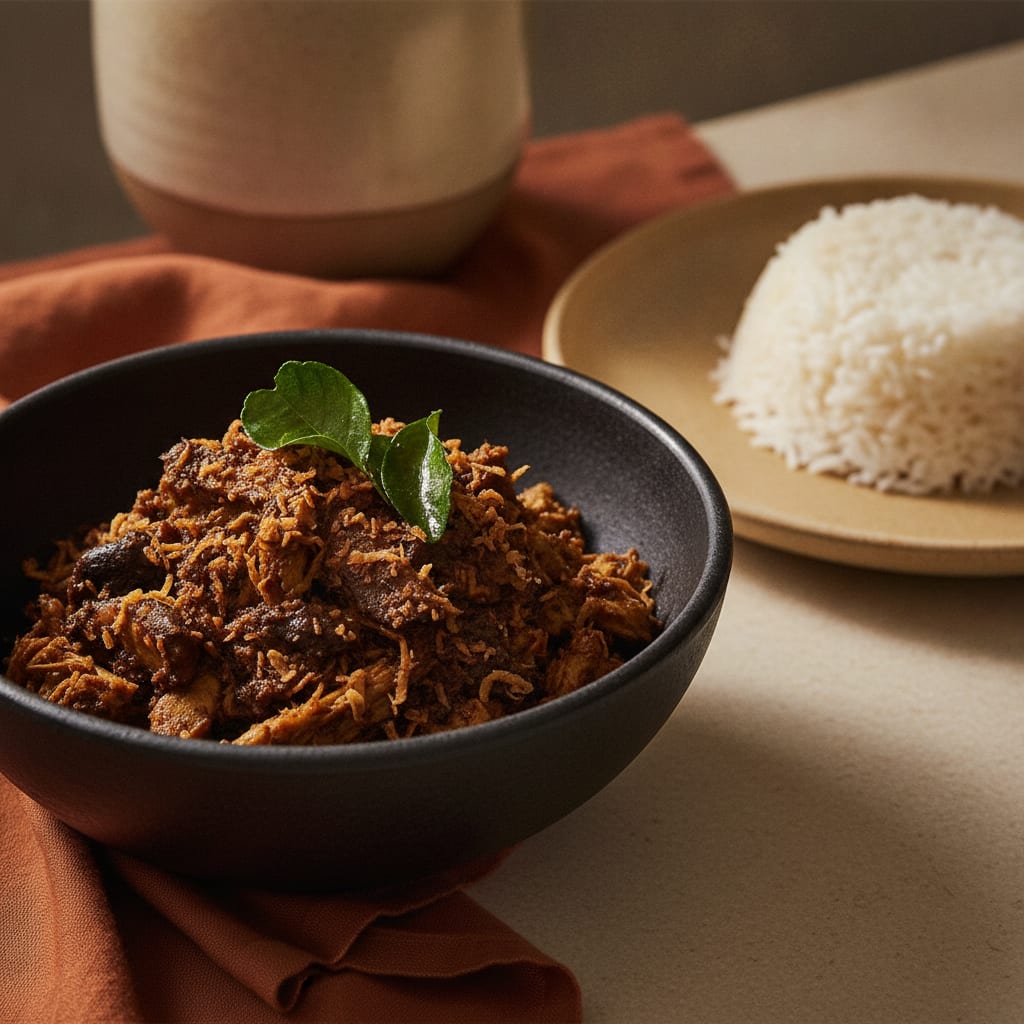
The Minangkabau dry coconut braise, two ways: jackfruit and king oyster cooked for hours through gulai and kalio until the coconut milk reduces to dark oil.
- Prep
- 40 min
- Cook
- 3h 30min
- Total
- 4h 10min
- Servings
- 6
- Difficulty
- Ambitious
Getting ready…
Ingredients
For 6 servings · 20 items
For the kerisik (toasted coconut)
For the spice paste (bumbu)
For the braise
Method
7 steps · check as you go
- →
Serve
Serve warm, not hot, with plenty of steamed jasmine or coconut rice — rendang is intense and dry, and the rice is essential to it, not a side. A simple cucumber or a fresh sambal cuts the richness. Rendang famously improves over days as the spices marry, and because the coconut milk has fully reduced away it keeps far longer than a wet curry; it holds a week in the fridge and freezes well. Reheat gently with a splash of water if it has gone too stiff.
The story
I learned to make rendang properly over a long Saturday in March 2025, in my D.C. kitchen, from a friend’s mother who had grown up in Padang, in West Sumatra, and who came over with a paper bag of dried chilies and a look I recognized from another kitchen on another continent — the look of someone braced to watch a foreigner get her grandmother’s dish wrong. Her name was Ibu Yanti, and she did not cook it for me. She sat at my counter with a glass of iced tea and watched me cook it, the way Madeleine had watched me make cassoulet in the Languedoc three years before. She let me run the whole thing. When the sauce thickened to caramel and the oil started to bead at the edges, after the first hour and a half, I reached to turn off the heat. She put her hand up. “Not yet,” she said. “That is kalio. People stop there. Keep going.” So I kept going. Another hour, stirring, the sauce darkening past brown toward black, the oil rising and the spice frying onto the jackfruit until the whole pot was dry and glistening and smelled of toasted coconut and clove. She took a bite around hour four. She chewed slowly. She said, “Ya. Sekarang rendang.” Now it is rendang.
Rendang comes from the Minangkabau of West Sumatra, and it is older and stranger than its reputation as “the world’s best dish” suggests. It was cooked for ceremonies and for merantau — the moment a young person leaves home to make their way — because a dish reduced completely dry, all its water cooked off and its spices acting as preservatives, could survive a journey in a tropical climate without refrigeration. The dryness is the dish. It moves through three stages: gulai, the loose coconut curry; kalio, the thickened brown gravy where most cooks stop; and rendang, the dry, near-black end where the coconut milk has reduced entirely into fragrant oil.
This rendang has no beef in it. It has shredded young jackfruit and seared king oyster mushroom where the beef would be, and white miso where any fermented fish or shrimp element would be. The long spice paste is unchanged. The kerisik is unchanged. The hours-long reduction through gulai and kalio to true, dry rendang is unchanged. It is not a “plant-based version” of rendang. It is rendang, made with what is in my hands now.
A few notes before you begin.
This is a long cook. Make it on a Saturday. It is not hard — most of it is stirring and waiting — but it is not fast, and there is no honest shortcut. The whole dish is the reduction.
The kerisik is worth the ten minutes. Toast the coconut slowly, low and patient, until it is deep golden and smells of nuts, then pound it warm so the oils release. Rushed over high heat it scorches and turns bitter and you have to start again.
Sear the jackfruit and mushrooms first. The browning builds the Maillard base that carries through the hours ahead. King oyster, torn into thick chunks, holds a dense chew that survives four hours of cooking where a softer mushroom would dissolve to nothing.
Do not stop at kalio. This is the whole lesson Ibu Yanti taught me. When the sauce thickens to a brown, clinging gravy and the oil starts to bead at the edges, you are at the halfway point, not the end. Most recipes online stop here and call it rendang. Keep going. Another hour, stirring more and more as it dries, until the coconut milk has vanished into oil and the spice has fried onto the solids and the whole thing is dark, dry, and glistening.
Stir constantly at the end. Once the sauce has reduced to oil and paste, it catches and scorches in seconds if you walk away. The last hour wants your attention. Put on records. Refill the cook’s iced tea.
This is a dish for a long, slow day, like cassoulet — the kind of cook that asks for patience and rewards it. Make it the weekend you want the apartment to smell of toasted coconut and clove for hours. Make extra; it is better on day two and day three, after the spices have fully married.
Ibu Yanti and I still text. She sends me photos of her own rendang, always darker than mine. I am still chasing that last shade of black.
À la maison
The weeknight reading is — honestly — not a weeknight dish, and I won’t pretend otherwise. The recipe above is the home version, but home in the sense of a long Saturday at the stove, not a Tuesday after work. What makes it achievable is that it asks for patience, not skill: toast the coconut, pound the paste, sear the jackfruit, then cook the coconut milk down through its three stages, stirring more and more as it thickens. The only real decision is when to stop, and the answer is: later than you think. When you believe it is done, it is kalio. Keep going until it is dry and dark. Make it a day ahead — it genuinely improves — and you turn a four-hour cook into a ten-minute reheat.
Au bistrot
The bistronomique reading takes the same dry braise and plates it as a single, intense, composed bite — the rendang treated as a concentrate rather than a stew.
Cook the rendang all the way to dry, then split it: press half into a neat quenelle or a small pressed disc using a ring mould, dense and dark, and keep the other half loose. Make a smooth coconut purée as a counterpoint — simmer coconut milk with a single lime leaf and a thread of salt, blend it silky, and stripe it under the rendang as a cool, pale brushstroke against the near-black braise. Fry a few makrut lime leaves and curry leaves crisp in hot oil for a brittle, fragrant garnish. Toast a little extra kerisik to a fine crumb and use it as a savory soil scattered across the plate. Add a sharp note: a quick acar — quick-pickled cucumber and shallot in rice vinegar — in a small, precise mound to cut the richness. Build a dark plate: the pressed rendang disc off-centre, the coconut purée dragged beneath it, the kerisik soil, the crisp leaves standing up, the acar to one side. Where the home bowl is generous and rustic, the bistrot plate is one concentrated read of a dish that took four hours — restraint around intensity.
Le dressage — Three-quarter, slightly above, deep shadows. Dark plate, a pressed near-black rendang disc off-centre, a pale coconut brushstroke dragged beneath. Toasted-coconut soil, crisp lime leaves standing up, a small mound of bright acar. Low warm light catching the oil-sheen on the braise. Negative space. The plate should say four hours reduced to one intense bite — heat, depth, and a sharp clean cut.
What the other recipes get wrong
Most rendang recipes online — I read the top ten in March 2026 — stop at kalio and call it rendang. They cook the coconut milk down for an hour, the sauce thickens to a brown gravy, and they plate it wet and glossy and label it the finished dish. It is not. I ran the test over three Saturdays in March 2026, same paste, same kerisik, same jackfruit and king oyster, same low heat. Only the end point changed.
- Stopped at gulai (45 minutes): a loose, pleasant coconut curry. Bright, soupy, the spices still raw-edged. A perfectly good gulai — but it tasted of coconut and chili, not of the deep, roasted thing rendang is meant to be.
- Stopped at kalio (90 minutes): thickened, browned, the oil just beginning to surface. This is where most recipes stop. It was good — rich, clinging — but the flavor was still on the surface, the coconut still tasting of coconut, the depth not yet built.
- Cooked to true rendang (3+ hours, dry and near-black): the coconut milk fully reduced into oil, the spice paste fried and caramelized onto the jackfruit and mushroom. Dry, dark, intense, with a roasted depth that the kalio simply did not have. This was a different dish.
The reason is the Maillard reaction, and it needs time and low water to happen. As long as the pot is full of coconut milk, the temperature is capped near boiling and the contents stay wet — too wet for meaningful browning. Only when the water has reduced away and the milk separates into oil does the temperature of the solids climb past the point where sugars and proteins start reacting in earnest, generating the hundreds of brown, savory, roasted flavor compounds that define rendang. Kalio is the dish before that browning has fully happened; rendang is the dish after. The extra hour and a half is not stubbornness — it is the chemistry of getting the water out so the browning can begin. Every Saturday, across all three, the fully reduced version tasted like rendang and the kalio tasted like a very good curry that had stopped early.
The line I draw
I will not stop at kalio. Not because the sauce already looks rich, not because three hours is a long time and the pot already smells good at ninety minutes. Kalio is a real and delicious thing — but it is not rendang, and calling it rendang is the single most common way the dish is gotten wrong. True rendang is dry: the coconut milk reduced completely into oil, the spice fried and caramelized onto the solids, the color gone past brown toward black. That last hour and a half, stirring an increasingly dry and oily pot to keep it from scorching, is where rendang becomes rendang. Ibu Yanti put her hand up when I reached for the burner at kalio. She was right. Keep going.
When this can fail
Three ways, all from my own kitchen between 2022 and 2026:
- The kalio mistaken for rendang. Stopped at ninety minutes because the sauce was thick and brown and I was tired; served a rich gravy that was good but tasted of coconut, not of the deep roasted thing it should have been. Fix: keep cooking, stirring, until the coconut milk has fully reduced to dark oil and the dish is dry and near-black. Later than you think.
- The scorched final stage. Walked away during the last half hour to answer a message; the now-oily, near-dry paste caught on the bottom and turned acrid, and the bitterness threaded through the whole pot. Fix: once it reaches the dry, oily stage, stir almost constantly and lower the heat — the end of the cook needs your full attention.
- The bitter kerisik. Toasted the coconut over high heat to save time; it went from pale to burnt in under a minute and tasted acrid, and the whole batch carried the char. Fix: toast the coconut low and slow, stirring constantly, and pull it the moment it is deep golden and smells nutty — not a shade darker.
FAQ
QWhat is the difference between rendang and kalio?
They are the same dish caught at different stages of the same long cook. Rendang moves through three stages: gulai, where it simmers in coconut milk like a loose curry; kalio, where the sauce has thickened to a brown, clinging gravy and the oil begins to surface; and finally rendang, where the coconut milk has fully reduced and separated into dark oil, and the dish is dry, almost black, with the spice paste caramelized onto the solids. Kalio is wet and caramel-colored; true rendang is dry and near-black. Many recipes stop at kalio and call it rendang — the difference is another hour of patient reduction.
QWhy does rendang take so many hours to cook?
Because the entire point is to reduce three cans of coconut milk all the way down until the milk separates into oil and the spice paste fries and caramelizes onto the solids. That slow reduction is what drives the Maillard reaction — sugars and proteins browning into hundreds of new flavor compounds — and what gives rendang its dark color, its concentrated depth, and historically its keeping quality. Rush it over high heat and the coconut scorches and the flavors never develop; the dish demands low heat and several hours. There is no fast version that tastes like rendang.
QWhere does rendang come from?
Rendang originates with the Minangkabau people of West Sumatra, Indonesia, where it was traditionally cooked for ceremonies, weddings, and Hari Raya, and prepared for merantau — the Minang custom of young people leaving home to seek their fortune. Because the dish is cooked until completely dry, with antimicrobial spices and no remaining water, it could survive long journeys in a hot, tropical climate without refrigeration. The dryness that defines true rendang is not an aesthetic choice; it is what made the dish travel and keep.
QWhat can I use instead of beef in rendang?
Rendang is defined by its long spice paste, its kerisik, and the hours-long reduction of coconut milk through gulai and kalio to a dry, near-black braise — not by the beef. Young green jackfruit, shredded, takes on the spice and gives a pulled, fibrous texture; king oyster mushroom, torn into chunks and seared first, holds a dense, meaty chew through the long cook where softer mushrooms would dissolve. Build the savory base on white miso for fermented depth. The dish reads as rendang because it follows rendang's method, all the way to dry.
QWhat is kerisik and do I need it?
Kerisik is grated coconut toasted dark and pounded to an oily paste. It adds a deep, nutty, roasted flavor and helps the sauce thicken and darken, and it is especially central to Malaysian-style rendang, which leans on kerisik to build body in a shorter cook. In a long Sumatran-style braise like this one, where the coconut milk is reduced for hours, kerisik adds an extra layer of toasted depth near the end. It is worth the ten minutes: toast the coconut slowly until deep golden, then pound it while warm so its oils release into a paste.