The curry the spice road left behind.
Massaman Curry.
Thailand's Persian-rooted curry, two ways: warm dry spices toasted into a paste, coconut milk, potatoes and peanuts, with jackfruit and tofu where the meat once was.
- Prep
- 30 min
- Cook
- 50 min
- Total
- 1h 20min
- Servings
- 4
- Difficulty
- Medium
Getting ready…
Ingredients
For 4 servings · 23 items
For the spice paste
For the curry
To serve
Method
7 steps · check as you go
- →
Serve
Spoon over jasmine rice — massaman is a sauce-forward curry and the rice is the point of it, not a side. Top with crisp fried shallots and torn cilantro, and a few extra peanuts for crunch. A scatter of sliced red chili for those who want more heat. Like all braises, it is even better the next day, once the spices have fully married; it holds 4 days in the fridge and freezes well.
The story
I cooked massaman through a cold stretch of February 2025 in my D.C. kitchen, after a long afternoon at the spice stalls of the Eden Center over in Falls Church, just across the river in Virginia, where a vendor I’d been buying from for years pressed a fat green cardamom pod into my palm and told me to smell it raw, then to imagine it toasted. “This is the one,” he said. “Not the chili. This.” He meant the cardamom was the soul of the curry — the warm, resinous, almost perfumed note that no green or red Thai curry has. I went home and toasted a whole pan of dry spices until the kitchen smelled like a different country, and understood what he meant.
Massaman is the Thai curry that came overland. The story most tellings agree on dates it to the 17th century and the Persian Muslim traders who reached the Siamese court at Ayutthaya; the name is a Thai rendering of “Mussulman,” meaning Muslim. With them came the spice-route pantry — cardamom, cinnamon, clove, star anise, cumin — warm dry spices almost never seen in other Thai curries. That, plus potatoes and peanuts, is why massaman tastes like a curry from somewhere else that found a home in Thailand.
This massaman has no beef in it. It has shredded young jackfruit and pan-fried tofu where the meat would be, and white miso where the shrimp paste would be. The toasted spice paste is unchanged, the cracked-coconut fry is unchanged, the potatoes and peanuts and the sweet-sour-salt balance are unchanged. It is not a “plant-based version” of massaman. It is massaman, made with what is in my hands now.
À la maison
The weeknight reading is the recipe above, and two moves carry it. First, toast and grind the dry spices — this is non-negotiable, the cardamom and cinnamon and clove are the whole identity of the dish, and they have to be woken in a hot dry pan. Second, don’t shake the coconut cans: spoon off the thick cream, crack it in the pot until the oil splits, and fry the paste in that oil until it’s dark and glossy. That fry is where the depth comes from. After that it’s a gentle braise — potatoes and jackfruit in, tofu and peanuts late, balance the tamarind, sugar, and soy at the end. Make it a day ahead if you can; it deepens overnight.
Au bistrot
The bistronomique reading keeps the same spiced braise but separates its elements and composes them, the sauce reduced and the components arranged rather than stewed together.
Reduce the strained sauce hard, separately, until it is glossy and coats a spoon — a true nappe. Cook the potatoes apart: peel them into smooth turned ovals, simmer them in a ladle of the sauce until tender so they take its color without breaking, then glaze them in a pan. Braise the jackfruit in sauce until it pulls into soft strands, then press it into a small disc. Sear the tofu hard so it has a deep golden crust. Candy the peanuts: toss the roasted nuts in a thread of palm sugar caramel with a pinch of salt until they lacquer and crackle. Build a wide shallow bowl: the pressed jackfruit off-centre, the glazed turned potatoes and the seared tofu arranged around it, the reduced sauce spooned and dragged into a brushstroke beneath, the candied peanuts scattered with intent, a single curl of fried shallot and a cardamom-oil dot. Where the home bowl is a comforting stew, the bistrot plate is the same flavors read as distinct, deliberate components.
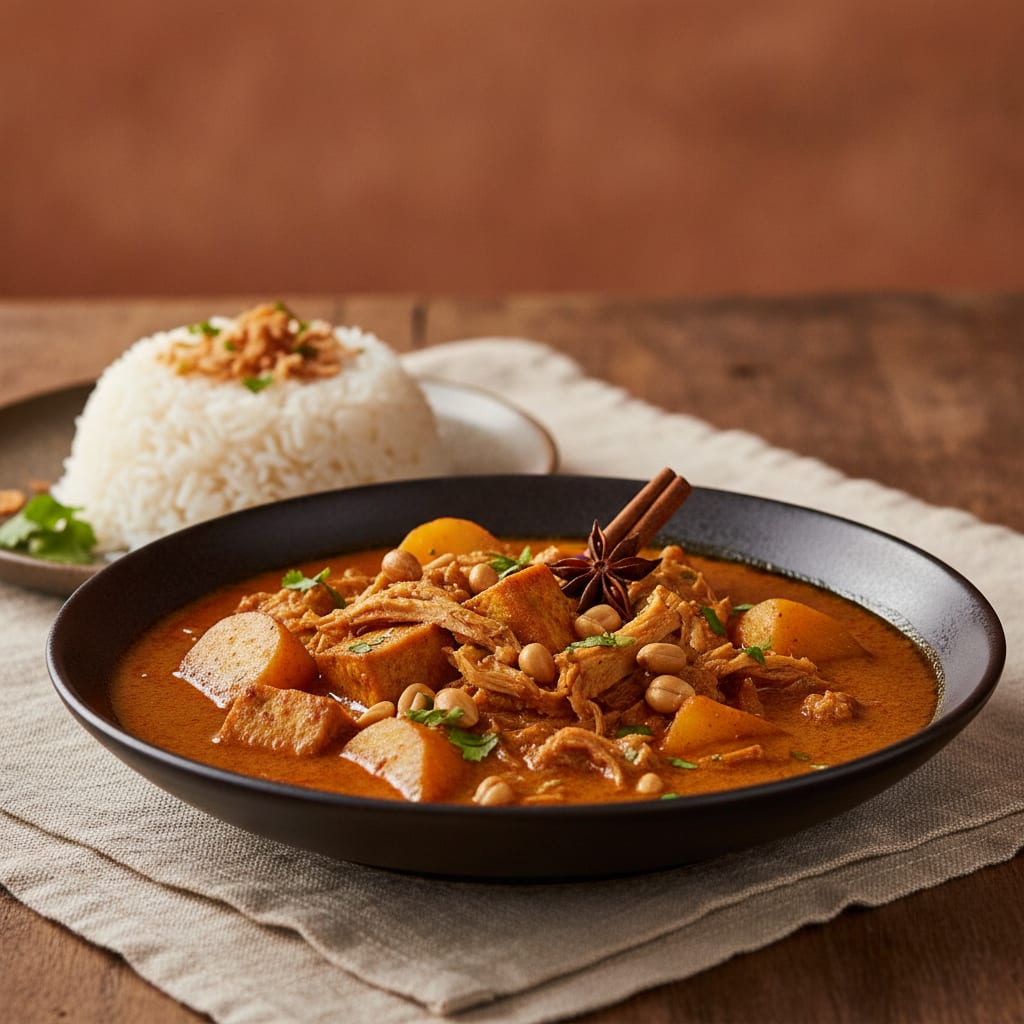
Le dressage — Three-quarter, slightly above. Wide dark bowl, a glossy russet brushstroke of reduced sauce, turned potatoes and seared tofu arranged off-centre, candied peanuts scattered. A cinnamon stick and a curl of fried shallot. Steam, warm light, negative space. The plate should say a spice-road braise composed with restraint — sweet, sour, savory held apart and then together.
What the other recipes get wrong
Most massaman recipes written for home cooks — I read the top ten in February 2026 — reach for a jar of curry paste and ground spices from the back of the cupboard, and skip the toasting entirely. The toasting is the dish. I ran the test over a week in February 2026, four pots, same coconut, same jackfruit, same braise — only the spice treatment changed.
- Pre-ground spices, straight from the jar, no toasting: dusty and flat. The warm spices read as old and tired, with a faintly stale, papery edge under the coconut. It tasted vaguely of curry, not of massaman.
- Store-bought massaman paste, simmered in liquid: louder but one-dimensional, with that flat, slightly bitter jarred-paste tone and no aromatic lift. The cardamom was nowhere.
- Whole spices toasted, ground, but not fried in coconut oil: much better and fragrant up front, but the paste tasted faintly raw — a sharp shallot-and-garlic edge that never resolved.
- Whole spices toasted, ground, paste fried in cracked coconut cream: round, deep, glossy, the cardamom and cinnamon blooming over a savory base. This was a different category of curry.
The reason is volatility and heat, twice over. The aromatic compounds in cardamom, cinnamon, clove, and cumin are bound up as volatile oils that need heat to release; toasting in a dry pan at moderate heat drives them out without burning them, which is why toasted spices smell of the whole spice and pre-ground powder smells of cardboard. Then frying the ground paste in cracked coconut oil blooms those same oils a second time in fat — fat carries aroma where water can’t — while the heat cooks off the raw alliums. Skip the toast and there’s nothing to bloom; skip the fry and the aromatics never fully release and the alliums stay sharp. Every pot, across the week, the toasted-and-fried version tasted like massaman and the others tasted like coconut stew with spice in it.
The line I draw
I will not build massaman from pre-ground spice powder. Not to save ten minutes, not because the jar is right there. The warm dry spices — cardamom above all — are the entire reason massaman exists as a separate curry, the Persian fingerprint on a Thai dish, and pre-ground powder that has sat in a cupboard has already lost most of its volatile oils to the air. You toast whole spices in a dry pan, you grind them fresh, you bloom them in the cracked coconut oil. The vendor at Eden Center put the raw pod in my hand for a reason. A massaman without that toasted-cardamom soul is just a sweet coconut stew wearing the name.
When this can fail
Three ways, all from my own kitchen between 2022 and 2026:
- The dusty, flat curry. Used pre-ground spices from the back of the cupboard because I didn’t feel like toasting; the whole pot tasted stale and papery under the coconut, with no aromatic lift. Fix: toast whole spices in a dry pan until fragrant and a shade darker, then grind them fresh.
- The split, greasy sauce. Boiled the coconut milk hard for too long trying to thicken it; the fat separated out into an oily slick that wouldn’t come back together. Fix: keep it at a gentle simmer once the liquid coconut goes in, and let the potatoes thicken it instead of the heat.
- The collapsed peanuts. Threw the peanuts in at the start with the potatoes; by the end they’d gone soft and pasty and lost their roasted crunch entirely. Fix: add the peanuts in the last five minutes, just to warm and barely soften, so they keep their bite.
FAQ
QWhy does massaman taste so different from other Thai curries?
Because it isn't entirely Thai in origin. Massaman is widely traced to the 17th century, when Persian Muslim traders reached the Siamese court at Ayutthaya — the name itself comes from a Thai rendering of 'Mussulman,' meaning Muslim. Those traders brought the warm, dry spices of the overland spice route: cardamom, cinnamon, clove, star anise, cumin. Those spices are almost unheard of in green or red Thai curry, which lean on fresh herbs and chili heat. The result is mellow, sweet, and aromatic rather than fiery — a Thai curry built on a Persian-Indian spice rack.
QWhy does massaman have potatoes and peanuts when other Thai curries don't?
Potatoes and peanuts are part of massaman's signature and a tell of its overland, Persian-and-Indian-influenced lineage rather than the coastal, herb-driven character of most Thai curry. The potatoes soak up the spiced coconut sauce and thicken it as their starch leaches out; the roasted peanuts add crunch, richness, and a nutty depth that rounds the whole dish. Few other Thai curries use either, which is part of what makes massaman read as a curry from somewhere else that settled in Thailand.
QWhat can I use instead of beef or chicken in massaman?
Massaman is defined by its spiced coconut braise, its sweet-sour-salt balance, and its potatoes and peanuts — not by the meat. Young green jackfruit, shredded, drinks up the sauce and gives a pulled, tender texture; seitan chunks give more of a dense, meaty chew if you prefer. Pan-fried firm tofu adds a second texture and protein. Build the savory base on white miso in place of the shrimp paste and a kombu-shiitake or light soy seasoning, and the curry carries the same depth. The dish reads as massaman because it follows massaman's rules.
QDo I have to toast and grind whole spices?
It is the single biggest quality step, so yes if you can. Toasting whole coriander, cumin, cardamom, cinnamon, clove, and star anise in a dry pan wakes their volatile aromatic oils; ground straight from raw or from old pre-ground powder, they taste dusty and flat. The warm dry spices are the entire identity of massaman, so getting them fragrant matters more here than in almost any other curry. If you must use pre-ground, buy them fresh and still bloom them in the cracked coconut oil with the paste.
QWhy do you fry the curry paste in coconut cream first?
Thai curries build their depth by frying the paste in fat before adding liquid. If you don't shake the coconut can, the thick cream sits on top; heated in a wide pot, it bubbles and 'cracks,' the oil separating out. Frying the paste in that hot coconut oil for several minutes toasts the spices a second time, drives off the raw shallot and garlic, and turns the paste dark, glossy, and deeply fragrant. Skip this and simmer the paste in liquid instead, and the curry tastes raw, thin, and one-note.