Cook each one alone.
Pisto.
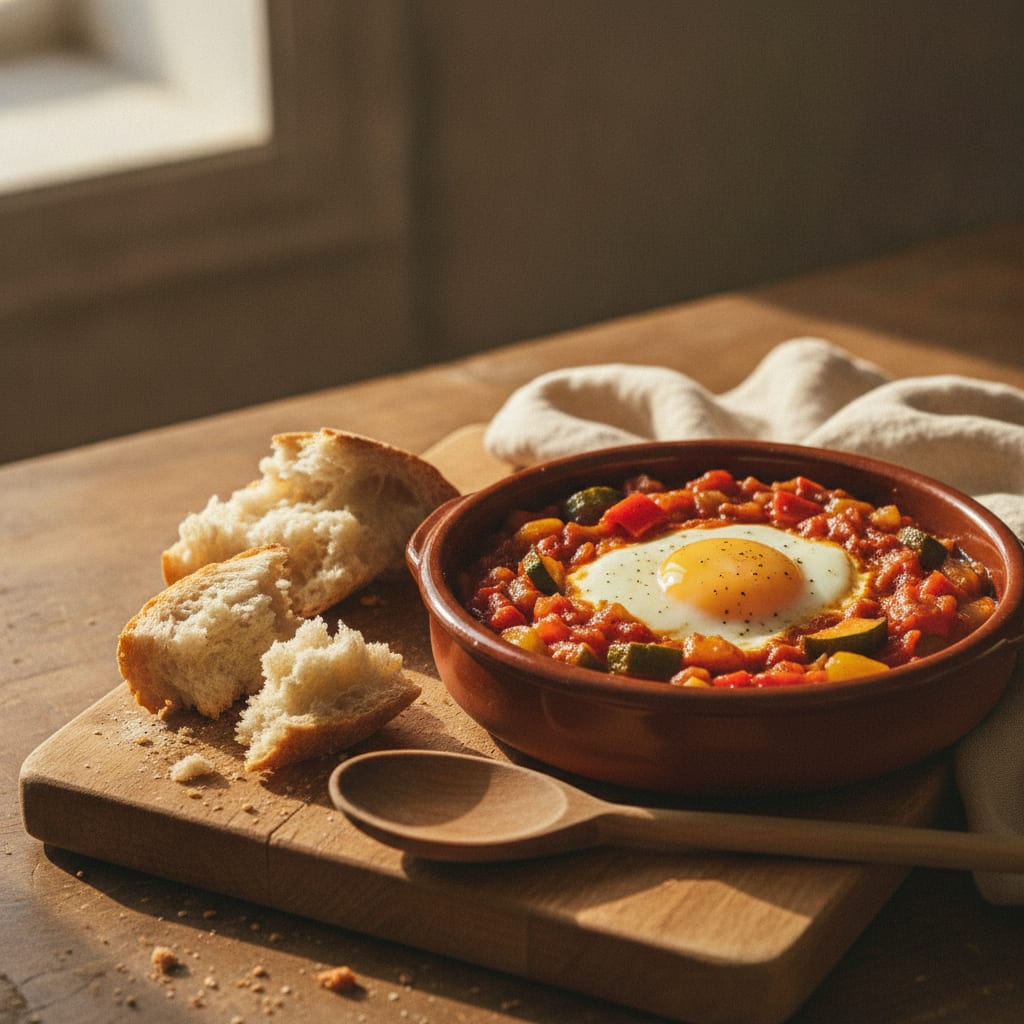
La Mancha's tomato-and-pepper stew, two ways: each vegetable cooked apart and folded together, jammy and slow, finished the old way under a soft-set egg.
- Prep
- 20 min
- Cook
- 55 min
- Total
- 1h 15min
- Servings
- 4
- Difficulty
- Easy
Getting ready…
Ingredients
For 4 servings · 13 items
For the pisto
To finish (the old way)
To serve
Method
7 steps · check as you go
- →
Serve
Serve warm or at room temperature, in a shallow cazuela, with plenty of bread to mop the oil-rich tomato. The soft egg on top is the Manchego tradition; leave it off and the pisto stands alone as a vegetable dish, a side, or the filling for a coca or a sandwich. A glass of chilled Manchego white or a light red is the regional pour.
The story
Pisto is La Mancha’s answer to the question every Mediterranean kitchen eventually asks: what do you do with a glut of summer vegetables and good olive oil? The answer here is tomato, pepper, courgette, and onion, each cooked alone and then folded into one glossy, jammy whole. The name comes from the Latin pistus — crushed, ground — but the dish itself is older than its Castilian name. It descends from alboronía, the Mozarabic vegetable stew of Al-Andalus, and in its earliest form it had neither tomato nor pepper at all: those arrived from the Americas and were folded into a dish that already existed, the way the New World was folded into the Old.
I learned to make it the summer I spent at La Riuà in 2018, cooking arroces in the lanes of El Carmen in Valencia. Pisto wasn’t a Valencian dish, strictly — it belongs to the Manchego plains inland — but one of the cooks, a Manchego woman whose name I never properly caught, made a vat of it for the staff meal most weeks and was fierce about one thing: each vegetable went into the pan alone. “Cada uno por separado,” she’d say, lining up four bowls. Each one on its own. The first time I tried to save a pan and cook them together she looked at the grey, weeping mess and said nothing, which was worse than if she had.
This pisto has no meat in it, and the classic version never did — the egg on top is optional and the dish is whole without it. Grated tomato reduced to a jam, peppers and courgette and onion each given their own heat, married at the end. It is not a “vegetable version” of anything. It is pisto, the way the Manchego cook made it, cooked one vegetable at a time.
À la maison
The weeknight reading is the recipe above, and it asks for one discipline and one piece of patience. The discipline is cooking each vegetable separately — four short fries instead of one long stew — which feels fussy until you taste the difference between vegetables with their own character and vegetables boiled into a common mush. The patience is the tomato: let it reduce to a genuinely thick, jammy base before the vegetables go back, because a watery tomato is the whole difference between pisto and soup. Make it ahead if you can; it is better on day two, and you can crack a fresh egg into it when you reheat.
Au bistrot
The bistronomique reading keeps the cook-each-alone rule but composes the plate instead of spooning it. Cook the vegetables as before, but cut them with more precision — neat, even dice — and hold each one slightly firmer, so on the plate they read as distinct jewels in the tomato, not a homogenous stew. Reduce the grated tomato further, almost to a paste, then loosen a portion of it with a little stock and olive oil and blend it into a smooth, glossy coulis to pool beneath. Spoon the diced vegetables into a low ring mould to set a clean disc of pisto, then lift the ring away.
For the egg, go further than the soft-set classic: slow-cook an egg at 63°C for 45 minutes so the yolk turns to a custard, or skip the egg and crown the disc instead with a quenelle of saffron alioli for the same richness without it. Brush the tomato coulis across the plate in a single arc, set the disc of pisto on it, slip the soft egg or the alioli on top, and finish with a few drops of the greenest olive oil, a dusting of pimentón, and a single fried sage or basil leaf. A peasant glut, read one careful spoonful at a time.
El emplatado — Three-quarter, close. A clean disc of jewelled pisto on a wide pale plate, a single arc of glossy red coulis beneath, the soft egg or a quenelle of saffron alioli on top catching the light. Greenest oil in droplets, pimentón dust, one fried leaf. The plate should say the same vegetables, given their own dignity — order where the family dish is generous chaos.
What the other recipes get wrong
Most pisto recipes online — I read the top ten in February 2026 — tell you to soften everything in one pan together to save time and washing-up. I ran the test over a week in February 2026: six batches, identical vegetables and tomato, only the cooking method changed, comparing all-in-one against cook-each-alone against a halfway version where I cooked the onion and peppers together but the courgette apart.
- Everything in one pan: grey, weeping, uniform. The courgette flooded the pan with water and steamed the rest; nothing held its shape and the whole thing tasted of one flat vegetable note. It was edible. It was not pisto.
- Halfway (onion and peppers together, courgette apart): better — the courgette stayed intact — but the peppers, cooked alongside the onion, never got the hard, blistering fry that gives them their savoury edge.
- Each vegetable alone: distinct, bright, every vegetable tasting of itself inside the jammy tomato. This was the staff-meal pisto, every time.
The reason is water and heat. Courgette is over ninety per cent water, and water is the enemy of frying — once it floods a pan the temperature drops below the point where anything browns, and you are steaming, not frying. Cook the courgette alone and hot, and that water flashes off before it can drown its neighbours. Peppers, denser and tougher, want a longer fry at a steady heat to soften their cell walls and blister their skins; onions want low and slow to convert their sharpness to sweetness. Three vegetables, three different requirements, one pan that can only do one thing at a time. The Manchego cook’s four bowls weren’t fussiness. They were the recipe.
The line I draw
I will not cook the vegetables together to save a pan. The single fact that separates pisto from every grey vegetable stew is that each vegetable is cooked alone, at its own heat, for its own time, and folded together only at the end. The moment you tip them all into one pan, the courgette weeps, the temperature collapses, everything steams, and you have made a uniform mush that happens to contain the right ingredients. It will be fine. It will not be pisto. The extra ten minutes and the extra bowl are not optional; they are the dish.
When this can fail
Three ways, all from my own kitchen between 2022 and 2026:
- The watery pisto. Folded the vegetables into a tomato base that had not reduced enough, and served a loose, soupy plate that bread couldn’t mop. Fix: reduce the tomato to a genuinely thick, jammy sauce — when a spoon dragged across the pan leaves a trail — before the vegetables go back in.
- The bitter pimentón. Stirred the paprika into the hot pan over full heat and let it cook; it scorched and turned the whole tomato base acrid. Fix: pull the pan off the flame, stir the pimentón in for ten seconds only, then add the tomato straight away.
- The collapsed courgette. Cooked the courgette low and slow like the onion; it wept, went grey, and dissolved into the tomato. Fix: fry courgette alone, hot and fast, just to colour the edges — it should still hold its cube when it goes back in.
FAQ
QWhat is the difference between pisto and ratatouille?
They look alike, but the technique and the base diverge. Pisto manchego is built on a thick, reduced tomato sauce that the other cooked vegetables are folded into, and it is classically finished with a soft egg on top. The vegetables — onion, green and red pepper, courgette — are each cooked separately, then married. Ratatouille leans on aubergine and herbes de Provence and is often layered or stewed without a dominant tomato base. Pisto's deeper roots are Andalusian: it descends from the Mozarabic alboronía, and tomatoes and peppers only entered it after they arrived from the Americas.
QWhy cook each vegetable separately for pisto?
Because each one wants a different heat and time. Peppers need a long, hot fry to soften and blister; courgette is mostly water and needs a quick, fierce colour before it floods the pan; onion wants a low, slow cook to go sweet. Throw them in together and they steam each other into a grey, watery mush. Cooking them apart and folding them together at the end is the rule that separates real pisto from a vegetable boil.
QDo you have to put egg on pisto?
No. The soft egg on top is the traditional Manchego finish — the yolk loosens into the tomato and enriches it — but pisto is a complete dish without it. Left plain it works as a main with bread, a side for almost anything, or a filling for a sandwich, a coca, or empanadas. The egg is a topping, not the foundation, which is why the dish holds up without it.
QCan I use tinned tomatoes for pisto?
Yes, and out of tomato season you should. Good tinned tomatoes, crushed, beat pale, woody winter tomatoes every time. If you have ripe summer tomatoes, grate them on a box grater and discard the skins for the cleanest pulp. Either way, reduce the tomato to a thick, jammy base before folding the other vegetables back in — that reduction is what gives pisto its body.
QHow long does pisto keep?
Pisto keeps 4 to 5 days in the fridge and arguably tastes better on day two, once the flavours have settled. It also freezes well for up to three months. Reheat it gently, and add the egg only when you serve — cook a fresh soft egg into the reheated pisto rather than storing it with the egg already in.