The bowl is the broth.
Phở.
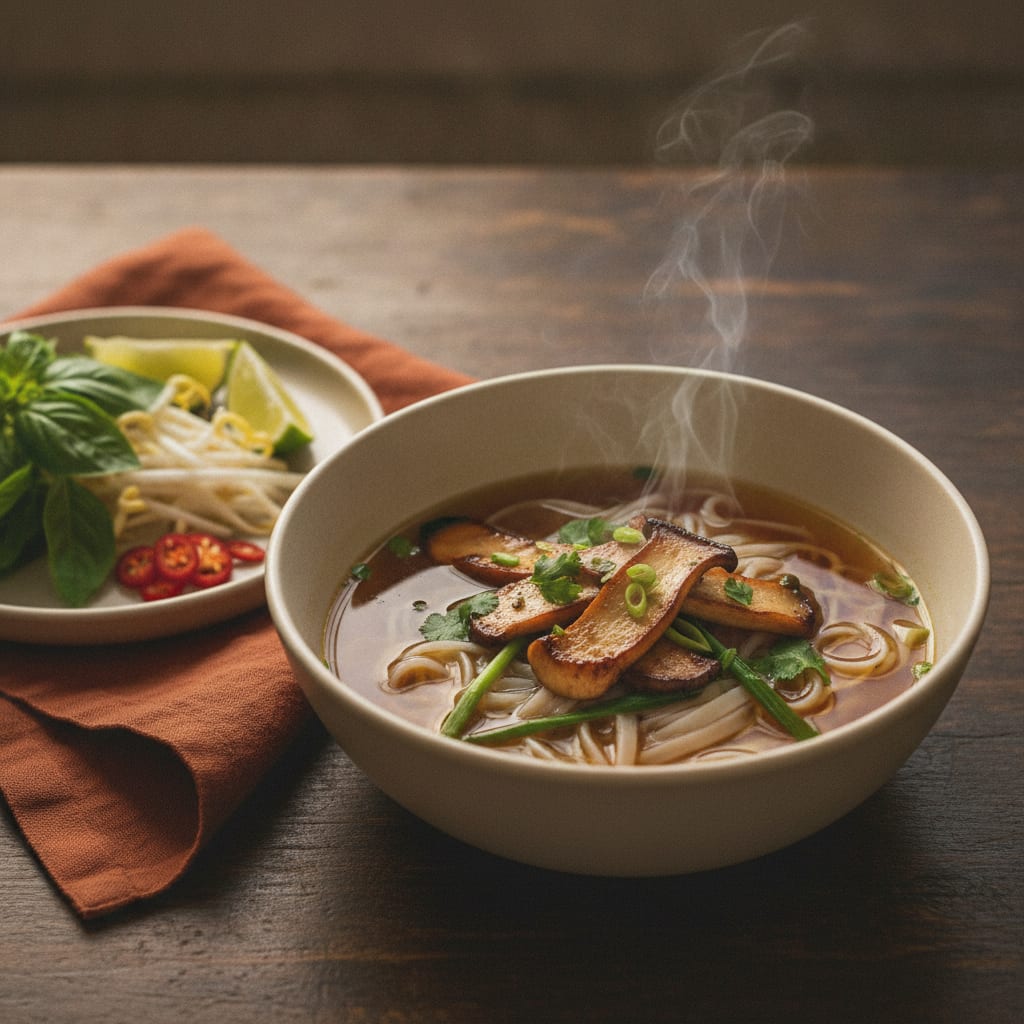
Vietnam's clear aromatic noodle soup, two ways: a charred-onion-and-ginger broth bodied with kombu and shiitake, toasted spice, rice noodles, herbs.
- Prep
- 30 min
- Cook
- 2h 30min
- Total
- 3h
- Servings
- 4
- Difficulty
- Ambitious
Getting ready…
Ingredients
For 4 servings · 22 items
For the broth
For the bowls
To serve (the herb plate)
Method
8 steps · check as you go
- →
Serve
Ladle near-boiling broth over the noodles and seared toppings at the very last moment, and carry the herb plate — Thai basil, bean sprouts, lime, sliced chili — to the table with hoisin and sriracha so each person tears herbs and squeezes lime into their own bowl. Eat immediately, with chopsticks and a deep spoon. A cold lager or jasmine tea is the pour.
The story
Phở is an argument about fire. Not the heat under the pot — the word itself. Stand in any phở house and someone will tell you the name comes from the French feu, fire, carried in on the back of pot-au-feu, the beef stew French colonists brought to Vietnam around the turn of the twentieth century. Someone else will tell you it comes from the Cantonese fen, flat rice noodle. What the food historians mostly agree on is narrower and more honest: the dish emerged in the north, in Nam Định and Hanoi, in the early twentieth century, probably a composite of a Cantonese beef-noodle dish, a Vietnamese buffalo soup, and yes, the French pot in the fire. I make pot-au-feu. I make phở. I will not pretend to know which word won.
I learned to keep the broth clear in my own kitchen in Washington, D.C., across a long stretch of 2025 — and I learned what it was supposed to taste like at the Eden Center out in Falls Church, at a counter where an older woman ran a pot of phở broth that never once came to a boil while I watched. I never got her name; she had a queue and no English for me and I had no Vietnamese for her. What I got was the gesture: the way she held the ladle flat across the surface and lifted the grey foam off in one slow sweep, the broth underneath staying clear as tea. The whole bowl is in that one motion.
This phở has no beef in it. It has onion and ginger charred black over the flame, star anise and cinnamon and clove and coriander toasted until they shout, a body built on cold-soaked kombu and dried shiitake, and king oyster mushroom seared and sliced where the thin beef would go. The method is unchanged — the char, the toast, the tremble, the skim, the soak-not-boil noodle, the assembly at the table. It is not a “vegetable version” of phở. It is phở, built the way phở is built.
À la maison
The weeknight reading is the recipe above, and it asks two things of you: char the aromatics like you mean it, and hold the tremble. The char is the backbone; pale onion gives pale broth. The tremble is the clarity; a boil clouds in minutes everything the char and the spice built. Everything else is forgiving. Make the broth a day ahead if you can — it deepens overnight and any sediment settles so you can decant it even clearer. Soak the noodles, don’t boil them. Ladle the broth near-boiling so it warms the bowl in one pour, then let everyone finish their own with basil, lime, and chili. That table-side finish is most of what makes a bowl feel like phở.
Au bistrot
The bistronomique reading is the same broth taken to true clarity and the bowl composed instead of heaped.
Clarify the strained broth into a near-consommé: whisk 3 tablespoons of aquafaba into the cold broth, bring it slowly to a tremble without stirring, and let the foam set into a raft that traps the fine particles; ladle the brilliant liquid out through a cloth-lined sieve. Now the broth is glass, and the spice reads as a perfume rather than a colour. Cut the king oyster into neat bias coins, sear them hard, and brush them with a reduction of the broth so they gloss. Blanch a few squares of bok choy or gai lan for a clean green. Pickle a little shaved shallot in lime for sharpness. Build a wide shallow bowl: a small tidy nest of rice noodle off-centre, the mushroom coins fanned, a single perfect sprig of Thai basil and a torn frond of cilantro, a scatter of the pickled shallot — then pour the clarified broth at the table, in front of the guest, so the steam lifts the toasted-spice perfume as the bowl fills. The herbs are placed, not piled; the lime is a single segment, not a wedge.
Le dressage — Overhead, then a second frame at the moment of the pour. Deep dark-rimmed bowl, the clarified broth poured tableside so it catches the light amber and clear. Noodle nest and mushroom coins arranged off-centre, herbs in odd numbers, negative space around them. The plate should say clarity — the night-market bowl read once, quietly, at a white tablecloth.
What the other recipes get wrong
Most vegetable phở recipes online — I read the top ten in February 2026 — treat the broth like a quick vegetable boil: water, a handful of spice, a stock cube, twenty minutes. The broth is not a quick step. It is the dish. I ran the test over a week in my Washington kitchen in February 2026, four broths, same charred aromatics, same toasted spice, same tremble — only the savory base changed:
- Water + spice + onion only: aromatic on the nose, hollow in the mouth. It smelled like phở and tasted like spiced water. No body.
- Store-bought vegetable stock + spice: louder but one-note — that flat, slightly sour bouillon-cube tone sitting on top of the spice and never resolving into it.
- Kombu only + spice: clean and savory but flat in the way the sea is flat — glutamate with no partner, a body that drops off the moment you swallow.
- Kombu + dried shiitake + charred onion + spice: round, deep, a savory finish that kept going under the anise and cinnamon. This was not close. It was a different category of broth.
The reason is chemistry, not opinion. Glutamate (kombu) and guanylate (dried shiitake) are synergistic: together they register as dramatically more savory than the sum of the two, the same nucleotide-plus-glutamate synergy beef gets from its own inosinate. The dried mushroom simply supplies a different nucleotide to the same effect. The charred onion and ginger add the caramelized backbone the beef bones used to give, and the toasted whole spice gives phở its unmistakable perfume. Drop the shiitake and the broth goes flat; drop the char and it goes pale and thin; skip the toast and the spice turns dusty. Together, across all four batches, they built a broth you could drink on its own and know it was phở.
The line I draw
I will not boil a phở broth, and I will not boil the noodles in it. The whole identity of the dish is a clear, aromatic broth poured over springy noodles — and both of those are a discipline of temperature. The broth holds at a tremble, around 85–90°C, where the surface shivers and the foam rises in a skimmable layer; the moment it rolls to a boil, the particles you skimmed disperse back through it, the spice goes muddy, and the clear broth you built turns into a cloudy soup that happens to smell of anise. And the noodles never go in the pot — rice noodle has no gluten to protect it, so it bloats, goes gummy, and clouds the broth you worked to keep bright. Soak the noodle, flash it, bowl it, ladle over. The clarity is the dish.
When this can fail
Three ways, all from my own kitchen between 2022 and 2026:
- The cloudy broth. Walked away to deal with the noodles, the pot crept to a boil, and the broth I had kept clear went grey and dull in ten minutes. There is no simmering it back to clarity. Fix: hold the tremble, pull the kombu before the boil, and if it does cloud, clarify with the aquafaba-raft from the bistrot section rather than starting over.
- The pale, flat broth. Charred the onion timidly — gold, not black — because I didn’t want to set off the smoke alarm. The broth smelled of spice but had no backbone. Fix: char the onion and ginger genuinely black over the flame, windows open, and toast the whole spice until it’s loud. If the char looks like a mistake, it’s right.
- The bloated noodles. Boiled the dried bánh phở like pasta while I plated, then let them sit in the broth. By the time we ate they were swollen mush and the broth had gone starchy. Fix: soak the noodle until pliable, flash it for seconds only, and bowl it the moment before the broth goes over.
FAQ
QCan you make real phở broth without beef?
Yes, because phở broth is defined by its charred aromatics and clear-broth discipline, not by the beef. Char onion and ginger black over a flame for the caramelized backbone, toast star anise, cinnamon, clove, coriander, and cardamom for the perfume, and build savory body on cold-soaked kombu (glutamate) and dried shiitake (guanylate) — the two compounds together register as far more savory than the sum of their parts, the same nucleotide-plus-glutamate synergy beef supplies through its own inosinate. Held at a bare tremble and skimmed, the broth comes out clear, aromatic, and deeply savory. It reads as phở because it follows phở's method.
QWhy must phở broth never boil?
A rolling boil churns fine particles back into the liquid and emulsifies them, turning a clear amber broth cloudy and flat. Phở is held at a frémissement — a bare shiver where only the occasional bubble breaks the surface, around 85–90°C (185–195°F). At that temperature the broth stays bright, the foam rises in a clean layer you can skim, and the spice infuses without going dusty or bitter. Pull the kombu before it boils, because boiled kombu turns the broth slick.
QShould I boil the rice noodles like pasta?
No. Bánh phở rice noodles have no gluten to hold them together, so a full boil turns them to mush. Soak dried noodles in hot water until pliable, then dip in boiling water for 10 to 30 seconds and drain; fresh noodles need only a brief dip. Cook them at the last second and never in the broth itself, or they bloat, go gummy, and cloud the bowl. Divide into warm bowls and ladle the hot broth over the top.
QWhere does the word phở come from — French feu?
It's debated, and honestly unsettled. The popular story is that phở comes from the French feu, 'fire,' via pot-au-feu, the beef stew French colonists brought to Vietnam around the turn of the twentieth century. But it's at least as likely the name evolved from the Cantonese fen, meaning flat rice noodle. Most food historians place the dish's emergence in Nam Định and Hanoi in northern Vietnam in the early twentieth century, likely a composite of a Cantonese beef-noodle dish, a Vietnamese buffalo soup, and the French pot-au-feu. I wouldn't claim the etymology is settled; the dish is real regardless of which word won.
QWhat stands in for the thin beef in phở?
Seared king oyster mushroom, sliced lengthwise, gives the dense sliceable chew that reads as the thin rare beef of phở tái. Sear it hard for the brown crust, then braise it briefly in a little broth so it drinks savor back into the centre. Pan-seared firm tofu adds a second protein and soaks up the aromatic broth. Both go into the bowl just before the hot broth is ladled over.