The tubes stand up.
Pastitsio.
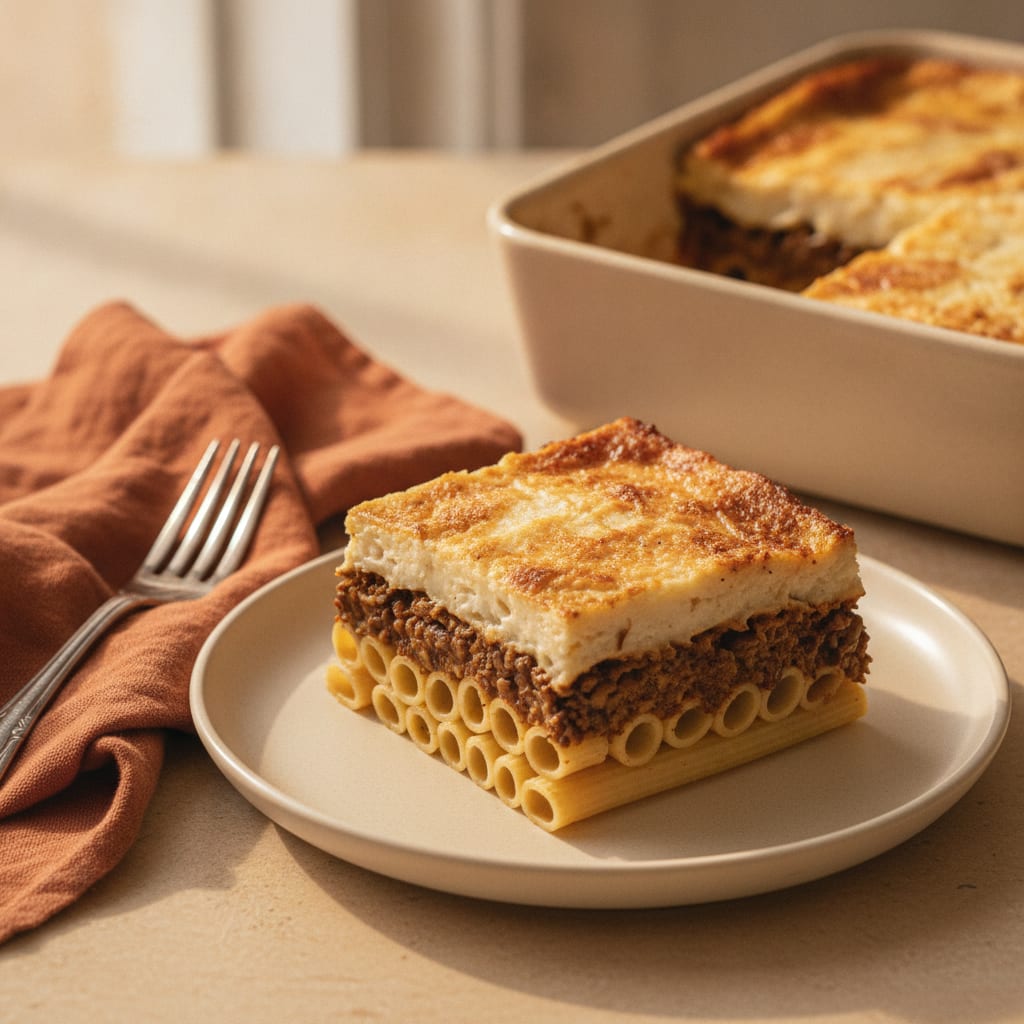
Greek baked pasta, two ways: long tubes standing up, a cinnamon-clove lentil-mushroom ragù, and a thick béchamel that sets into clean slices without egg.
- Prep
- 45 min
- Cook
- 1h
- Total
- 1h 45min
- Servings
- 8
- Difficulty
- Ambitious
Getting ready…
Ingredients
For 8 servings · 21 items
For the pasta
For the lentil-mushroom ragù
For the béchamel
Method
7 steps · check as you go
- →
Serve
Cut into generous squares once fully rested, so each piece shows its three layers — the standing tubes, the dark spiced ragù, the browned béchamel crown. Serve warm, not scalding, with a horiatiki on the side and bread. A glass of a rough Greek red, an Agiorgitiko or a Xinomavro, is the right pour.
The story
Athens, autumn 2017. The summer tourists had thinned, the nights turned cool, and Eleni’s menu swung back to the baked dishes that had been too hot to make in July. Pastitsio came out of the oven on Sundays in a battered deep tray, and she cut it the way she did everything — decisively, in big squares, the knife going straight down through three layers so each piece stood up on the plate showing its stripes. The first slice I tried to cut, I dragged the knife and the whole thing slumped sideways into a heap. She watched, said nothing, then pointed at the clock. “You cut it when it is ready. Not when you are ready.”
What I remember most is the smell — not tomato, not pasta, but cinnamon and clove rising out of the ragù as it baked, a warm sweetness that made the whole kitchen smell like something between dinner and dessert. She steeped the spices whole and pulled them out before they ever reached the dish, so you got the perfume and never the bite. And she made her béchamel stiff enough to stand a spoon in. “It has to hold the knife,” she said, tapping the side of the pot. A loose béchamel was, to her, a confession.
Pastitsio is Greek cooking with Italian bones: the name is the Italian pasticcio, a baked pasta pie that came in during the centuries of Venetian presence, and the modern layered form — with its French béchamel crown — is usually credited to Nikolaos Tselementes, the chef who reworked Greek cooking around French technique in the early twentieth century. This one has no meat: a lentil-and-mushroom ragù carries the body, and the béchamel sets with starch instead of egg. It is not a vegan version of pastitsio. It is pastitsio — the standing slice, the cinnamon and clove, the browned crown — built with what is in my hands.
À la maison
The weeknight reading is the recipe above, and though it has three components it asks for patience more than skill. Cook the mushroom water all the way off so the ragù is deep, not watery, and steep the cinnamon and cloves whole, then pull them out — that warm spice is the soul of the dish. Lay the bucatini all running one way so the slice stands up striped. And make the béchamel genuinely thick, set with a little cornflour as well as the flour roux, because without egg the starch is the only thing holding your clean slice together. Then — the one rule you cannot break — rest it at least half an hour before you cut. Eleni pointed at the clock for a reason.
Au bistrot
The bistronomique reading keeps the three layers but builds them in a ring and refines each one — the same dish, read as a plated course.
Cook the bucatini, toss it with a little of the béchamel so it binds, and pack it tight into individual ring moulds, the tubes upright this time so each portion cuts as a perfect striped cylinder. Reduce the lentil-mushroom ragù further, until it is dark and almost dry, and fold a knob of the béchamel through it so it holds together as a clean middle layer. Spoon a thick disc of the stiff béchamel on top and brown it hard under a salamander or torch so the crown blisters and crackles like a crème brûlée. Unmould the cylinder onto a warm plate. Around it, a brushstroke of the ragù reduced further into a glossy sauce, a few crisp mushroom chips for texture, and a fine grating of fresh nutmeg over the browned top. Serve one precise tower per guest, the layers sharp, the crown shattering under the fork.
Le dressage — Three-quarter, low. A single upright pastitsio cylinder centre-plate, the cut face showing the standing tubes, dark ragù, and crackled brown béchamel crown. A brushstroke of glossy ragù sauce beneath, crisp mushroom chips alongside, a dusting of fresh nutmeg. Warm side light to rake across the brûléed top. The plate should say a Sunday tray bake has been read as a refined course, its cinnamon and its standing stripes intact.
What the other recipes get wrong
Most egg-free pastitsio recipes online — I read the top ten in May 2026 — make the béchamel like a pouring sauce and then wonder, in the comments, why it slid off the slice in a puddle. Egg does real structural work in a pastitsio top, and you cannot just leave it out and change nothing. I ran the test over a week that May: nine trays, identical pasta and ragù, changing only three things in the béchamel — how thick it was (flour roux only, vs. roux plus cornflour), the milk (oat vs. soy), and the rest time before cutting (10 minutes vs. 40).
- Thin roux-only béchamel, oat milk, cut at 10 minutes: delicious, but it slumped into a soft landslide the moment the knife went in. No standing slice at all.
- Thick roux-only béchamel, oat milk, rested 40 minutes: much better edge, but the top still sagged a little and wept at the cut.
- Roux plus slaked cornflour, soy milk, rested 40 minutes: a firm, clean, standing slice with a browned crown that held its corners. The only batch that cut like the dish is supposed to.
The reason is starch gelatinisation and protein. Egg sets a béchamel because its proteins coagulate with heat into a firm gel; remove it and you have to replace that structure. A heavier dose of starch — the flour roux backed by a little cornflour — does it, because gelatinised starch granules swell, knit together, and on cooling set into a sliceable gel (the same reason a cold custard or a set sauce holds its shape). Soy milk helps because it carries more protein than oat or almond, adding its own set on top of the starch. And the rest matters as much as the recipe: starch gels firm up as they cool, so a pastitsio cut hot will always slump no matter how thick the sauce. Across all nine trays, only the cornflour-plus-soy, fully-rested batch gave the clean standing slice — and the difference was structure, not luck.
The line I draw
I will not cut a pastitsio hot to get it on the table faster. The standing slice — the three clean layers, the tubes on end, the firm browned crown — is the entire identity of the dish, and that slice exists only after the starch in the egg-free béchamel has cooled and set. Cut it straight from the oven and it slumps into a heap; correct in flavour, but it is no longer pastitsio, it is a baked pasta you eat with a spoon. The rest is the last cooking step, not a delay before serving. Thirty minutes minimum, forty-five if you can wait. Eleni pointed me at the clock the first time I reached for the knife too soon, and every slumped slice since has proved her right.
When this can fail
Three ways, all from my own kitchen between 2022 and 2026:
- The slumping slice. Made the béchamel like a pouring sauce and cut it too soon; the top slid off in a puddle and the layers collapsed. Fix: build the béchamel stiff with a flour roux plus slaked cornflour, and rest the dish at least 30 minutes so the starch sets before you cut.
- The watery, pale ragù. Rushed the mushrooms and didn’t cook their water off; the ragù stayed loose and flat and soaked the pasta layer grey. Fix: cook the mushrooms hard until all their liquid boils away and they begin to brown before the tomato goes in.
- The lost spice. Skipped the whole cinnamon and cloves the first time, thinking a pinch of ground would do; the dish tasted like a generic tomato pasta bake with no warmth or depth. Fix: steep cinnamon stick and whole cloves in the ragù and remove them before layering — that perfume is what makes it pastitsio.
FAQ
QWhat pasta is used for pastitsio?
Long, hollow, tubular pasta — thicker than spaghetti, with a hole down the middle. In Greece it's sold simply as 'pastitsio no. 2,' but bucatini, perciatelli, or long ziti all work. The hollow tube is the point: it holds the béchamel and the ragù, and when laid all in one direction it gives pastitsio its signature standing-up striped cross-section. Avoid short macaroni or penne if you want the classic look and bite — they tangle and the slice comes out messy.
QWhy does pastitsio have cinnamon and cloves?
The warm baking spices — cinnamon and clove, sometimes a little allspice or nutmeg — are the signature of Greek baked pasta and what distinguishes it from an Italian bake. They come from the dish's roots in Ottoman and Byzantine cooking, where sweet spices in savoury meat dishes were normal. Steep them whole in the ragù and remove them before layering so you get the perfume without biting into a clove. Leave them out and you have a generic tomato pasta bake, not pastitsio.
QHow do you make pastitsio béchamel set without egg?
Egg yolks normally set a pastitsio béchamel firm enough to slice. Without them, the work is done by starch: a generous flour roux plus a little slaked cornflour. As the starch granules absorb the hot milk and gelatinise, then cool and bake, they form a firm gel that holds a clean edge. The keys are to make the béchamel genuinely thick — stiffer than a pouring sauce — and to rest the finished dish at least 30 minutes so the gel sets. Soy milk, which is higher in protein, sets firmer than oat or almond.
QWhere does pastitsio come from?
It's a Greek dish with Italian bones. The name comes from the Italian pasticcio, a baked pasta pie, brought into Greek-speaking lands during the long Venetian presence in the Mediterranean. The modern layered form — pasta, spiced meat, and a French-style béchamel on top — is usually credited to the chef Nikolaos Tselementes (1878–1958), who trained in Europe and reworked much of Greek cooking around French technique in the early twentieth century. The béchamel is his French touch on an older Mediterranean baked pasta.
QCan I make pastitsio ahead?
Yes, and it slices better for it. Assemble and bake it, then cool completely — the layers set firm and cut into clean squares once cold. Reheat the squares, covered, in a moderate oven until hot through. You can also assemble it unbaked a day ahead and bake it fresh. Either way the rest is your friend: pastitsio is a dish that wants to settle before it's cut, so making it ahead works with the dish rather than against it.