Grated, never sliced.
Pan con tomate.
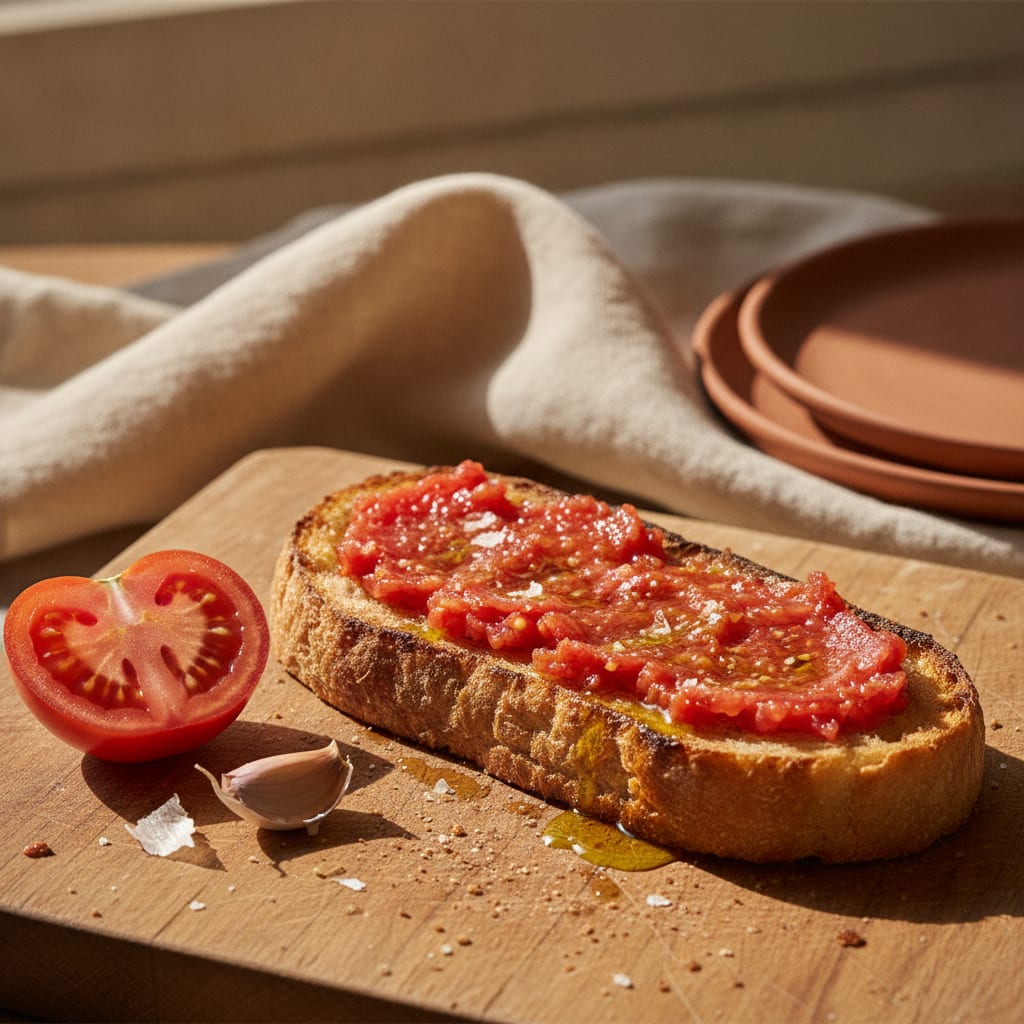
Catalan pa amb tomàquet, two ways: grilled bread rubbed with garlic and ripe grated tomato, never sliced, drowned in good olive oil and flaky salt.
- Prep
- 10 min
- Cook
- 5 min
- Total
- 15 min
- Servings
- 4
- Difficulty
- Easy
Getting ready…
Ingredients
For 4 servings · 5 items
For the bread
For the tomato
Method
5 steps · check as you go
- →
Serve
Serve immediately, while the toast is hot and crisp under the soft, juicy tomato — it does not keep, and a made-ahead slice goes sodden. Eat it on its own for breakfast or a snack, or as the base of a spread, topped with anchovies, manchego, jamón-style mushrooms, or grilled vegetables. Put the tomato, oil, garlic, and toast on the table and let people build their own, the Catalan way.
The story
Pan con tomate — pa amb tomàquet in Catalan, which is where it belongs — is the most disarming dish in the Spanish repertoire, because it is almost nothing: bread, tomato, oil, salt, and an optional clove of garlic. It is also a dish that the rest of the world reliably gets wrong, usually by slicing the tomato and laying it on the bread like a sandwich. The Catalan way is to grate the tomato into a juicy pulp and let the bread drink it. And for all its air of timelessness, it is young: tomatoes only reached Iberian kitchens in the 18th century, and the first written record of bread dressed with tomato dates to 1884, when stale bread was softened with tomato and drowned in oil so that nothing went to waste.
I learned to make it the summer I spent at La Riuà in 2018, cooking arroces in the lanes of El Carmen in Valencia. It was the first thing put in front of me most mornings, made by a woman who ran the front of the kitchen — Montse, I think, though after eight years I won’t swear to the name — who grated a soft tomato into a bowl while the bread toasted and looked at me like I had two heads when I asked if she ever sliced it. “Mai. Ratllat.” Never. Grated. She drowned each slice in oil with a hand far heavier than I expected, and that, it turned out, was the other half of the lesson.
This pan con tomate has nothing animal in it and never did — it is one of those dishes that was always just bread, fruit, and oil. Day-old bread toasted hard, a clove of garlic rubbed in while it’s hot, ripe tomato grated to pulp, the best oil you have, flaky salt. It is not a “vegan starter.” It is pa amb tomàquet, the way Montse made it every morning, grated and never sliced.
À la maison
The weeknight reading is the recipe above, and it lives or dies on three things, none of which is technique: ripe tomatoes, good bread, and good oil. Grate the tomato — never slice it — so the bread can drink the juice. Toast the bread hard enough to take a garlic rub without tearing. And be heavy-handed with the oil and salt, because in a dish this bare they are not a garnish, they are half the flavour. Day-old bread is not a compromise here; it is the original point of the dish, which began as a way to revive stale loaves.
Au bistrot
The bistronomique reading keeps every element honest and simply sharpens each one. Start with the bread: cut a slab of good sourdough, brush it with oil, and grill it hard over coals or a ridged pan so it carries real char lines and a shattering crust. For the tomato, grate ripe tomatoes as before, then let the pulp drain in a sieve for ten minutes — catch the clear tomato water that runs off and whisk it with olive oil into a light, loose vinaigrette. Spoon the drained, intensified pulp onto the toast so it sits bright and concentrated, not watery.
Compose rather than heap: a single rubbed, charred toast set on the plate, the concentrated tomato pulp spread to the edges, a few drops of the tomato-water vinaigrette pooled alongside, and the greenest oil drawn across in a line. Finish with a confit garlic clove smeared at one end instead of a raw rub, a scatter of flaky salt, and — if you want — a single anchovy-style cured mushroom or a sliver of black olive for a salty counterpoint. The same four ingredients, each pushed to its cleanest, brightest version. The plate should still taste like a Catalan breakfast, only slowed down.
El emplatado — Three-quarter, close and bright. One charred, garlic-rubbed toast on a pale plate, vivid concentrated tomato spread edge to edge, a line of green oil and a few drops of tomato vinaigrette beside it, flaky salt catching the light. Crumbs allowed. The plate should say the simplest thing, done perfectly — not reinvented, just sharpened.
What the other recipes get wrong
Most pan con tomate recipes online — I read the top ten in March 2026 — make one of two mistakes: they slice the tomato and lay it on the bread, or they go timid with the oil. I ran the test over three mornings in March 2026: twelve slices, the same bread, garlic, and oil, comparing sliced tomato against grated pulp, and a mean trickle of oil against a generous glug.
- Sliced tomato on toast: the tomato sat on top in a wet disc, slid off when bitten, and never soaked into the bread. The toast underneath stayed dry. It tasted like a deconstructed thing, not pa amb tomàquet.
- Grated pulp, mean oil: the bread drank the tomato beautifully, but with only a trickle of oil it tasted thin and a little austere — the tomato’s acidity had nothing to round it.
- Grated pulp, generous good oil and flaky salt: the bread soaked through with juice, the oil carried and softened the tomato, the salt lifted everything. This was Montse’s slice, exactly.
The reason grating wins is physical. A box grater shears the tomato into loose flesh and juice while leaving the tough skin behind in your hand; that juicy pulp has the surface area and looseness to soak into the toasted crumb, where a flat slice can only sit on top. And the oil is not optional richness — in a dish of four ingredients, the olive oil is a full quarter of the flavour, and it carries the fat-soluble aromatics that a watery tomato alone cannot. Grate the tomato so the bread drinks it; drown it in good oil so the dish has body. Skip either and you have made dry toast with tomato on it.
The line I draw
I will not slice the tomato. It is the one move that turns pa amb tomàquet into something else — a wet tomato sitting on dry bread, sliding off at the first bite. The whole identity of the dish is bread that has drunk the tomato, and that only happens when the tomato is grated to a loose, juicy pulp that can soak into the crumb. A sliced tomato cannot do it; it has neither the surface area nor the looseness. If you want tomato slices on toast, make that and enjoy it — but it is not pa amb tomàquet, and a Catalan will tell you so before you finish chewing.
When this can fail
Three ways, all from my own kitchen between 2022 and 2026:
- The soggy slice. Made it ten minutes ahead for guests; by the time it reached the table the toast had gone limp and sodden under the juice. Fix: assemble at the very last second — grate the tomato in advance if you like, but toast, rub, spread, and oil only just before eating.
- The dull, austere bite. Used a pale, anonymous oil and a thin trickle of it; the dish tasted thin and a little sour, the tomato unsupported. Fix: use the best, greenest, most peppery extra virgin you have, and use it generously — it is half the flavour, not a finishing drizzle.
- The harsh garlic. Rubbed raw garlic onto bread that had cooled and softened, and it sat sharp and aggressive on top. Fix: rub the garlic on while the toast is hot and rough, so it melts into the crumb — and go gently, or skip it, the Catalan way.
FAQ
QWhy grate the tomato instead of slicing it for pan con tomate?
Grating is the defining technique of authentic pa amb tomàquet. It gives you loose, juicy pulp that soaks into the toasted bread, where a sliced tomato just sits on top and slides off. Grating also separates the flesh and juice from the skin, which you discard, leaving a smooth red pulp. The original rustic method was to rub a halved tomato directly onto the bread; grating is the refined version of the same idea, and it is what makes the bread drink the tomato rather than wear it.
QWhat bread is best for pan con tomate?
A good country loaf — Catalan pa de pagès, or a sturdy sourdough — with an open, chewy crumb and a real crust. Day-old bread is traditional and ideal: pa amb tomàquet began as a way to revive stale bread by softening it with tomato. Toast it well so it is crisp and firm enough to take the garlic rub and hold the juicy tomato without collapsing. Soft sandwich bread goes sodden and tears.
QDid pan con tomate always have tomato?
No — it could not have. Tomatoes are a New World fruit and only reached Iberian kitchens in the 18th century; the first written record of bread spread with tomato dates to 1884, when stale bread was softened with tomato and drizzled with oil. So the dish as we know it is at most a couple of centuries old. The bread, oil, and garlic are far older; the tomato is the relatively recent arrival that gave the dish its name and its colour.
QDo you have to use garlic in pan con tomate?
No. Rubbing the hot toast with a cut clove of garlic is classic and adds a savoury edge, but plenty of Catalans make pa amb tomàquet with just tomato, oil, and salt, especially at breakfast. If you do use garlic, rub it on while the toast is hot and rough so it melts into the crumb gently rather than tasting raw. Use as little or as much as you like — it is a matter of preference, not authenticity.
QCan I make pan con tomate ahead of time?
Not really — it is a last-minute dish and is best eaten the moment it is assembled, while the toast is still crisp beneath the juicy tomato. Made ahead, the bread goes sodden and sad. You can grate the tomato up to a few hours in advance and keep it covered in the fridge, and toast the bread fresh; but assemble — garlic, tomato, oil, salt — only just before eating.