In bianco, the old way.
Osso buco.
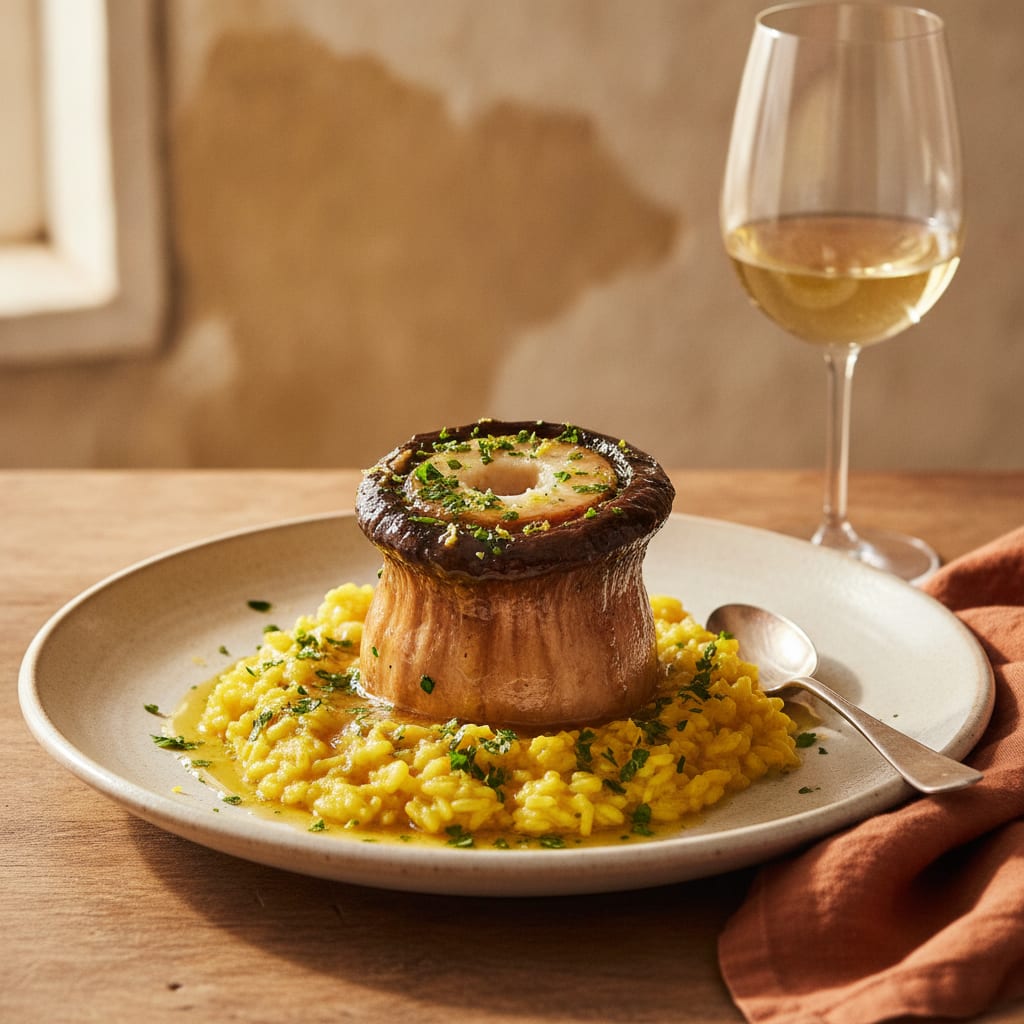
Milan's braised shank, two ways: king oyster 'shanks' braised in bianco with white wine and brodo, a marrow center, sharp gremolata, over saffron risotto.
- Prep
- 30 min
- Cook
- 1h 10min
- Total
- 1h 40min
- Servings
- 4
- Difficulty
- Ambitious
Getting ready…
Ingredients
For 4 servings · 16 items
For the shanks
For the marrow center
For the braise (in bianco)
For the gremolata
To serve
Method
7 steps · check as you go
- →
Serve
Serve each shank standing on a bed of saffron risotto alla milanese, sauce spooned around, gremolata showered over the top at the last second, and a small spoon for the marrow center. A soft polenta is the other classic bed. Pour a Lombard white or a light red — a Nebbiolo or a fresh Barbera. The marrow scoop, then the shank dragged through risotto and gremolata, is the way to eat it.
The story
Osso buco is a dish about a bone, and the bone is the part you can’t buy. The name means bone with a hole — the cross-cut veal shank with its ring of marrow at the center — and the whole architecture of the Milanese braise is built to coax that marrow and the gelatin around it into a glossy sauce. It is one half of the most iconic pairing in Lombard cooking: the braised shank set on saffron-yellow risotto alla milanese, the two so bound together that you rarely see one without the other. And the original is made in bianco — in white, without tomato — because tomatoes didn’t reach Milanese kitchens until the late 19th century. The purists still cook it that way and finish it, always, with gremolata.
I met it in 2014, in Florence, in a kitchen off Via dei Neri in the Oltrarno, the same room where I learned to make risotto move. The chef there was Milanese by training and cooked osso buco in bianco out of stubborn principle — “il pomodoro è arrivato dopo,” he’d say, the tomato came later, as if that settled it. He tied each shank like a parcel, browned it hard, braised it slow in white wine and brodo, and would not let the gremolata anywhere near the heat: chopped at the last second, showered raw over the top as the plate went out. Skip it, he told me, and you’ve made a stew. With it, you’ve made osso buco.
This osso buco has no veal in it and reaches the dish another way: king oyster rounds tied and braised like shanks, a bored center filled with a soft white-bean-and-roasted-garlic marrow, a shiitake-kombu brodo for the savour the long-simmered bone gave. The method holds entirely — the tie, the deep sear, the soffritto, the white-wine braise in bianco, the reduction, the gremolata raw at the end, the risotto beneath. It is not a “meatless version” of osso buco. It is osso buco in bianco, the way the Milanese chef in Florence made it, with what is in my hands.
À la maison
The weeknight reading is the recipe above — and it is genuinely a project, so call it a Sunday rather than a Tuesday. The moves that matter: tie each king oyster round like a real shank so it braises tall and intact instead of splaying open; sear it hard for the browned, roasted depth; and braise it gently in white wine and brodo until a knife slides in with no resistance. Make the brodo from shiitake and kombu — that is the deep savour the bone and the long simmer used to give. Fill the bored center with the soft bean-and-garlic marrow at the end so it stays a distinct, rich scoop. And the gremolata goes on raw, at the very last second. Serve it on saffron risotto, or a soft polenta if that’s easier.
Au bistrot
The bistronomique reading is the same braise, refined into a single tall, composed plate with the components pulled apart and set with intent.
Keep the in bianco braise exactly as it is, but treat every element as deliberate. Braise the tied shanks the same way, then glaze them: lift them out, reduce the braising liquid to a dark, glossy jus, and brush each shank with it until it shines like a real glazed shank. Pipe the marrow purée into the bored center smooth and flush, and torch its surface lightly for a faint roasted top. Cook the risotto alla milanese all’onda and spread it loose as the base. For lift and contrast, fry a few wisps of king oyster into crisp threads, and instead of scattering the gremolata loose, lay it as a precise green line along the top of the shank, plus a few drops of bright gremolata oil around the plate. Stand the glazed shank on the loose saffron risotto, spoon the jus around in a clean ring, draw the gremolata line down the shank, scatter the crisp threads for height, and grate fresh lemon zest over at the pass. The marrow scoop stays the hidden center; the gremolata, the bright green hit; the saffron risotto, the gold.
Il piatto — Three-quarter, slightly above, warm low Lombard light. A tall glazed king oyster shank standing on loose saffron risotto alla milanese, a clean ring of dark jus around it, a precise green line of gremolata down the shank, crisp mushroom threads for height. A grating of lemon zest, faint steam. Negative space, heavy ceramic. The plate should say bone with a hole, in bianco — the Milanese braise read once, at a white tablecloth.
What the other recipes get wrong
Most plant osso buco recipes online — I read the top ten in June 2026 — make a tomato stew of vegetables and call it osso buco, skipping the in bianco braise, the marrow, and the gremolata that actually define the dish. I ran the test over a week in June 2026: six braises, same king oyster shanks, changing only the braising medium and whether the dish was finished the Milanese way.
- Tomato braise, no marrow, no gremolata: a perfectly nice red mushroom stew, deep and sweet, but indistinguishable from a dozen other braises — none of the white-wine clarity or the bright lemon finish that says Milan. Generic.
- In bianco braise, but gremolata cooked into the pot: better, cleaner, the white wine and brodo reading right — but the gremolata had gone dull and muddy in the heat, and the whole plate sat heavy with nothing to cut it.
- In bianco braise, marrow center, raw gremolata at the end, on saffron risotto: tender sliceable ‘shank’, a soft rich marrow scoop, a glossy white sauce, and a sharp raw lemon-parsley-garlic hit over the top — the dish, recognisably. Not close.
The reasons are history and chemistry. The in bianco braise is the older, defining form — no tomato, because tomato didn’t reach Milanese kitchens until the late 19th century, so a tomato braise is a later variant wearing the name, not the original. The marrow matters because osso buco is structurally a dish about the bone’s center; a soft white-bean-and-roasted-garlic purée delivers the same unctuous, scoopable richness the marrow gave. And the gremolata has to go on raw at the end because its punch is volatile: the aromatic oils in lemon zest and raw garlic, and the fresh note of parsley, are driven off by heat, so cooked into the braise they go flat and the rich plate has nothing to balance it. Across all six braises, only in-bianco-with-marrow-and-raw-gremolata gave the plate the Milanese chef would have sent out.
The line I draw
I will not finish an osso buco without gremolata, and I will not call a tomato stew the Milanese original. The braise in bianco is rich, deep and one note from heavy — gremolata is the entire counterweight, the raw lemon-parsley-garlic hit that lifts every bite and keeps the dish from collapsing under its own richness. Leave it off, or cook it dull into the pot, and you have made a good braise that is missing its reason. And the in bianco point is worth holding too: the tomato came later, and the white-wine version is the dish’s older self. The Milanese chef in Florence chopped the gremolata to order and threw it on as the plate left his hands. He was right: it is the last note, raw, or it isn’t osso buco.
When this can fail
Three ways, all from my own kitchen between 2022 and 2026:
- The shank that fell apart. Skipped the twine to save a step; the king oyster rounds splayed open in the braise and plated as a collapsed pile instead of a tall shank. Fix: tie each round with a loop of twine like a real shank before searing, and snip it off only at plating.
- The dull gremolata. Stirred the gremolata into the braise early, thinking it would infuse; by serving it had gone muddy and lost its sharpness, and the plate ate heavy. Fix: chop it fresh and shower it on raw at the very last second, off the heat.
- The thin, pale sauce. Didn’t reduce the braising liquid and didn’t sear the shanks hard enough; the sauce came out watery with no body or roasted depth. Fix: sear deep for the Maillard crust, then boil the braising liquid down to a glossy nap and finish it with a little cold vegan butter.
FAQ
QWhat is osso buco alla milanese and what makes it 'in bianco'?
Osso buco is a Milanese braise — traditionally cross-cut veal shank, slow-cooked until the meat is silky, finished with gremolata and served with saffron risotto alla milanese. The original Milanese version is made in bianco, meaning 'in white': no tomato, because tomatoes were unknown in Milan until the late 19th century. The older recipe leans on white wine, soffritto, brodo and aromatics like bay and lemon peel, and it is finished with gremolata. A later, now-common version adds tomato and a mirepoix and often drops the gremolata. The dish here follows the in bianco original.
QCan you make osso buco without meat?
Yes, because osso buco is defined by its method and its companions — the braise in bianco, the marrow, the gremolata, the saffron risotto — not by veal alone. Large king oyster mushrooms cut into tall rounds, tied like a shank and braised the same way, take on a tender, sliceable body and soak up the white-wine brodo. A bored center filled with a soft purée of white beans and roasted garlic gives the unctuous marrow scoop, and a shiitake-kombu brodo supplies the deep savour the bone and long simmer used to. Finished with gremolata over risotto alla milanese, it eats as osso buco.
QWhat is the difference between osso buco in bianco and with tomato?
They are two versions of the same dish. Ossobuco in bianco is the older, purist Milanese recipe — no tomato and traditionally no carrot for colour, built on white wine, soffritto and brodo, finished with gremolata. The modern, more widespread version adds tomato and a full mirepoix and often omits the gremolata, giving a redder, deeper-coloured braise. Purists in Milan still call the original in bianco. Hybrid versions that keep both the tomato and the gremolata also exist.
QWhy is gremolata essential to osso buco?
Because the braise is rich and deep, and gremolata is the bright note that cuts it. It is simply raw lemon zest, finely chopped parsley and a little raw garlic, scattered over the shank just before serving. The lemon and garlic lift and sharpen every bite, balancing the unctuous sauce and marrow so the dish doesn't read as heavy. Add it raw and at the last second; cooked into the braise it loses its fresh, pungent edge. In the in bianco original it is considered indispensable.
QWhat do you serve with osso buco?
Risotto alla milanese — saffron risotto — is the classic and near-inseparable partner, its golden, creamy richness mirroring the braise and its saffron echoing the Milanese table. The two are often served on the same plate, the shank set on the risotto with the sauce spooned around. A soft polenta is the other traditional bed. Both give a starchy, mellow base to carry the sauce and to catch the marrow and gremolata.