Grill it as you like.
Okonomiyaki.
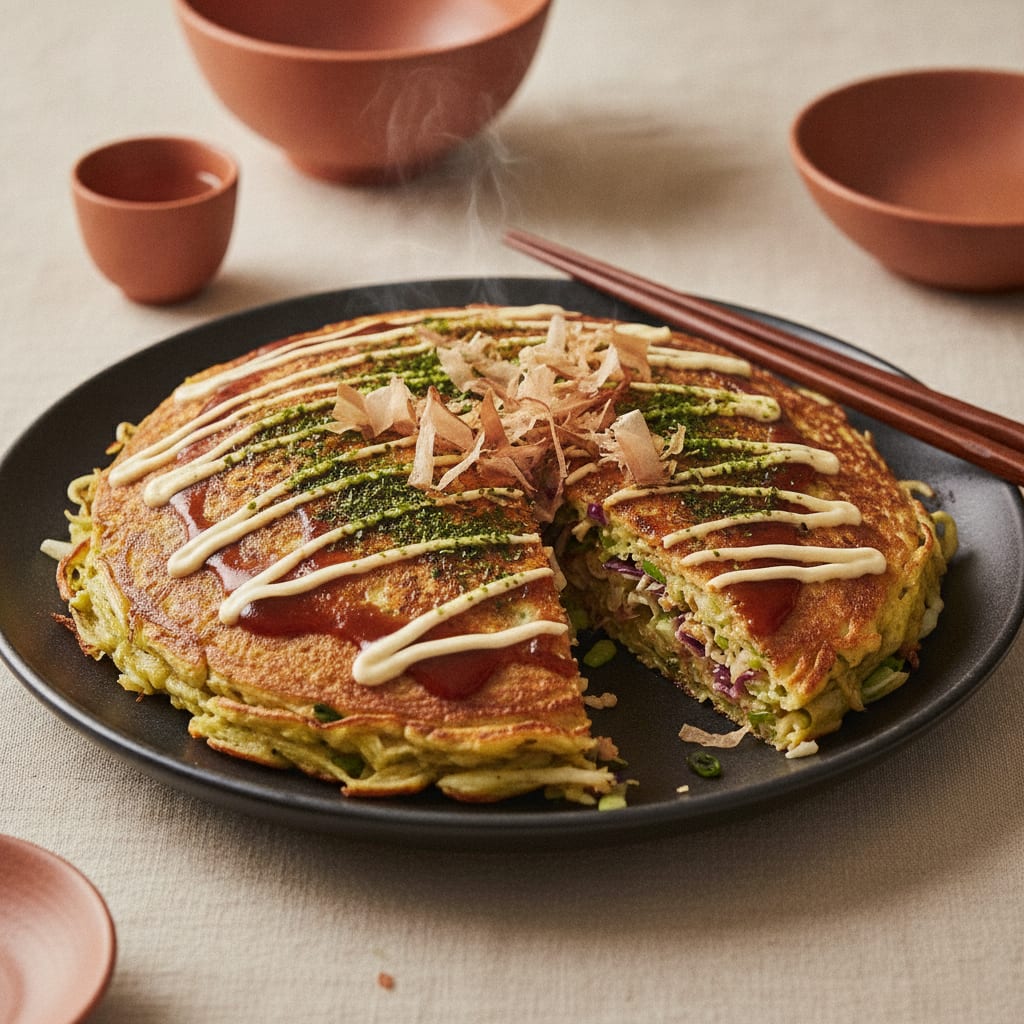
Osaka's as-you-like savoury cabbage pancake, two ways: dashi batter bound with grated nagaimo yam, okonomi sauce, aonori, a snow of bonito-style flakes.
- Prep
- 25 min
- Cook
- 20 min
- Total
- 45 min
- Servings
- 2
- Difficulty
- Medium
Getting ready…
Ingredients
For 2 servings · 15 items
For the dashi
For the batter
For the pancake
To finish
Method
7 steps · check as you go
- →
Serve
Serve straight from the pan, whole, while the top flakes are still waving in the rising heat. Cut into wedges at the table. Eat with chopsticks, and add extra okonomi sauce and a squeeze of mayo as you go — the whole point of the dish is that you finish it to your own taste.
The story
The first okonomiyaki I cooked from start to finish was not in Osaka. It was in Sapporo, in the spring of 2020, on a quiet Sunday at Tetsu’s counter when the ramen pots were resting and he wanted to feed the two of us something fast. He was Hokkaido to the bone, but his wife was from Osaka, and her okonomiyaki was the house standard — mixed, not layered, tall and fluffy, finished with so much sauce and mayo that the first bite was almost embarrassing. He grated the nagaimo into the bowl, looked at the grey, slithering paste, and laughed at my face. “Tamago ja nai,” he said. Not egg. He pointed at it again, proud of it. It does the egg’s work, and better.
The name is the dish’s whole philosophy. Okonomi — as you like. Yaki — grilled. It is the one Japanese dish that hands you the spatula and the sauce bottle and tells you to finish it to your own taste. It surfaced under that name in Osaka in the 1930s, descended from a line of grilled-batter snacks reaching back to funoyaki, a sweet miso crêpe served at Edo-period tea ceremonies. Two centuries of grilled batter, and the through-line is the same: cheap, fast, dressed to please.
This okonomiyaki has no egg in it and no bonito on it. It has dashi in the batter, grated nagaimo for lift, a mound of cabbage barely held together, and a snow of dried-tomato flakes that wave in the steam the way the bonito used to. It is not a “version” of okonomiyaki. It is okonomiyaki, made as I like it now.
À la maison
The weeknight reading is the recipe above, and it stands on two moves. First, grate the nagaimo to a slick paste and trust it — that gluey liquid is your binder and your fluff, the egg’s whole job done by a yam. Second, build the pancake tall and never press it. The cabbage steams inside while the base crusts, and you get the custardy interior that makes okonomiyaki worth the name. A quick cold dashi in the batter carries the savour right through. Everything after that is sauce, mayo, aonori and flakes — dressed exactly as you like.
Au bistrot
The bistronomique reading keeps the as-you-like spirit but plates it as a single composed course rather than a slathered round.
I make the okonomiyaki smaller and a little thinner so it cooks evenly and stays elegant on the plate, and I split the dressing into its parts instead of crosshatching them on top. The okonomi sauce gets reduced to a glossy lacquer and brushed across the base of a wide plate in one stroke. The pancake goes down off-centre, its crust deep and even. The mayo becomes a sharp aioli — vegan, sharpened with rice vinegar and a little karashi mustard — dotted, not piped. Instead of loose aonori, I make a fine nori oil and spot it green around the plate. The dancing flakes are dried-tomato shavings, placed so a few stand upright and catch the heat. A small tangle of fresh beni shoga and micro scallion goes on as the bright, sharp top note, and a quenelle of grated daikon on the side cuts the richness. The plate reads as one deliberate okonomiyaki, taken apart and set back down with intention — the same flavours, the same fluff, composed rather than piled.
Mori-tsuke — Three-quarter, slightly above. A wide dark matte plate, one stroke of glossy sauce, the small thick pancake off-centre with a clean wedge cut to show the cabbage crumb. Dots of pale aioli, beads of green nori oil, a few flakes standing upright in the heat. Negative space. The plate should say one careful bite of a street dish, not abundance.
What the other recipes get wrong
Most plant-based okonomiyaki recipes online — I read the top ten in February 2026 — treat the binder as a problem to patch over, reaching for flax eggs, extra flour, or baking powder to fake the rise. They are solving the wrong puzzle. So I ran the test: eight pancakes over a week in February 2026, same cabbage, same dashi batter, same pan and heat, changing only the binder and lift.
- Flax egg, no nagaimo: held together but flat and gummy. It tasted of wet flour and bound cabbage. No lift, no custard.
- Extra flour plus baking powder: rose a little, but the crumb was cakey and the inside dry — bread, not okonomiyaki. The cabbage went chalky.
- Grated nagaimo, no other binder: tall, fluffy, custardy at the centre, the cabbage juicy and distinct. It set into a pancake that held a clean wedge yet pulled apart in soft, airy layers. This was the bowl. It was not close.
The reason is mechanical, not a matter of taste. Grated nagaimo releases a mucilage-rich, viscous liquid that behaves like egg white: it forms a flexible network that traps air and water vapour, and as the pancake heats, that trapped steam expands and inflates the crumb before the starch sets around it. Flax gel binds but does not aerate; baking powder gasses up a flour batter into something cakey, not custardy. The yam does both jobs at once — bind and lift — which is exactly why Osaka shops keep grating it in even when they have eggs on the bench. Across all eight, the nagaimo pancakes were taller and lighter every time.
The line I draw
I will not press the pancake flat on the pan. Every griddle cook’s reflex is to lean on it with the spatula, and every time you do, you squeeze out the steam and the air the nagaimo worked to trap, and you turn a fluffy round into a dense, weeping disc. Okonomiyaki is supposed to be tall and aerated, custardy at the centre — that height is the dish. Build it thick, leave it completely alone while it crusts, flip it once with conviction, and never, ever press. The moment you flatten it you are cooking a cabbage fritter, not an okonomiyaki.
When this can fail
Three ways, all from my own kitchen between 2022 and 2026:
- The weeping batter. Folded the cabbage in early and let the bowl sit while I found the sauce; the salt drew the water out, the batter went soupy, and the pancake steamed grey instead of crusting. Fix: shred the cabbage ahead but fold it into the batter only at the last minute, and get it into the hot pan straight away.
- The collapsed flip. Tried to turn a tall, soft pancake with one small spatula; it folded and broke and the inside spilled. Fix: slide it onto a plate, invert the pan over the plate, and flip the whole thing back in one committed motion — or use two wide spatulas and mean it.
- The dense centre. Skimped on the nagaimo because the paste looked unappealing, and the pancake came out flat and gummy in the middle. Fix: use a full weight of grated nagaimo, roughly equal to the flour, and trust the slick — that is the lift, and there is no faking it.
FAQ
QWhat does okonomiyaki mean?
Okonomiyaki splits into okonomi — 'how you like' or 'as you like' — and yaki, 'grilled' or 'fried.' It is, literally, grill-it-as-you-like: a savoury pancake whose contents and toppings bend to the cook. The name first appears in Osaka in the 1930s, though grilled-batter ancestors like funoyaki, a sweet miso crêpe served at Edo-period tea ceremonies, go back much further. The 'as you like' is not marketing; it is the design of the dish.
QWhat can I use instead of egg in okonomiyaki?
Grated nagaimo (mountain yam) is the traditional move and it does the egg's whole job. Grated fine, nagaimo releases a viscous, egg-white-like liquid full of mucilage that binds the batter and traps air and steam as it cooks — which is exactly why okonomiyaki has its fluffy, almost custardy interior. Many Osaka shops add it even when they are using egg. Use about 120 g of grated nagaimo to 120 g of flour, and you need no egg at all.
QWhat is the difference between Osaka and Hiroshima okonomiyaki?
Osaka style is mixed: cabbage, batter and fillings are folded together and cooked as one thick, fluffy round, then cut into wedges. Hiroshima style is layered and built: a thin crêpe of batter goes down first, then a tall pile of cabbage, then fillings and a bed of yakisoba noodles, the layers kept distinct and pressed together on the griddle into a tower. This recipe is the Osaka style — one batter, one fold, one tall pancake.
QWhat can replace bonito flakes on top of okonomiyaki?
The dancing flakes are katsuobushi, shaved dried bonito, and they wave because the hot steam catches their thin, light shavings. For a fish-free version that keeps the drama, shave dried tomato into paper-thin slices, or slice dried king oyster mushroom very thinly — both are light enough to flutter in the rising heat and carry a smoky-savoury note. The waving is a steam effect, so any thin, dry shaving will do it.
QWhy is my okonomiyaki dense instead of fluffy?
Three usual culprits. You skipped or skimped the grated nagaimo, so there is nothing trapping air. You over-mixed the cabbage into the batter and knocked the volume out, or let it sit and weep water. Or you pressed the pancake flat on the griddle, which squeezes out the steam and air that make it rise. Fold the cabbage in gently at the last minute, build the pancake tall, and never press it down.