The navy's homesick stew.
Nikujaga.
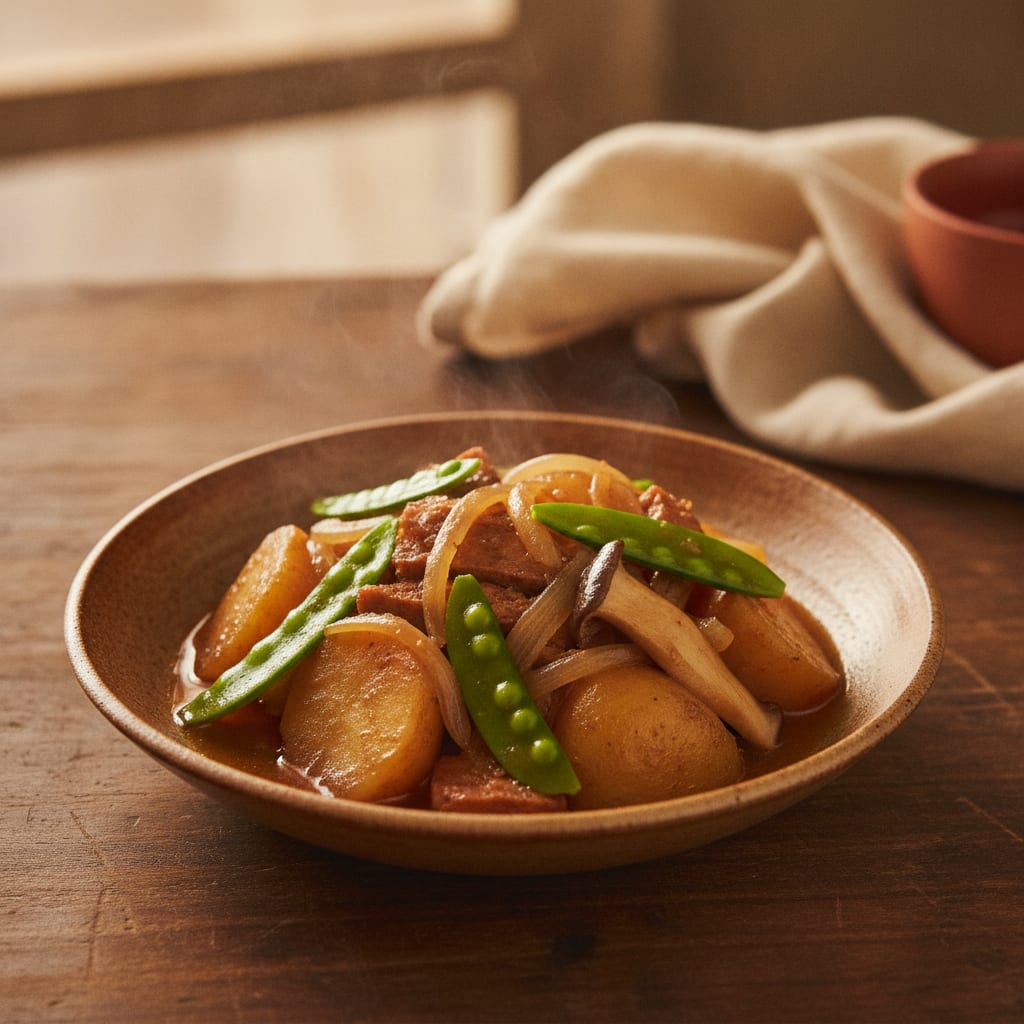
Japan's meat-and-potatoes simmer, two ways: waxy potatoes and onions cooked under a drop-lid in a dashi-soy-mirin-sugar wari-shita, with king oyster and seitan.
- Prep
- 20 min
- Cook
- 35 min
- Total
- 55 min
- Servings
- 4
- Difficulty
- Easy
Getting ready…
Ingredients
For 4 servings · 14 items
For the simmer
For the wari-shita
To finish
Kit
Method
6 steps · check as you go
- →
Serve
Serve warm, not scalding, in a shallow bowl so the glossy potatoes, onion and king oyster sit in a little of the reduced amber broth, snow peas scattered for colour. It is home food — eaten with rice, miso soup, and a small pickle alongside, the classic teishoku set. Better an hour later, and better still the next day.
The story
Nikujaga was the dish Tetsu made when someone at the counter looked tired. Not a menu item — a pot at the back, the smell of soy and sugar reducing, comfort food for a cook who’d been on his feet since dawn. He kept a battered wooden drop-lid for it, the otoshibuta, worn pale and smooth from years in the simmer, and he set it down on the potatoes with a kind of ceremony. One slow evening in November 2020, Sapporo dark and freezing, the Susukino neon just blinking on, he gave me a small bowl of it with rice and said it was the most homesick food he knew — the taste, he said, that every Japanese person measures their mother’s cooking against. Then he told me the story about the admiral. I have since learned to hedge it.
The story goes that Admiral Tōgō Heihachirō, who studied in Britain in the 1870s, had his naval cooks recreate a British beef stew, and nikujaga was the result. It is a lovely origin — homesick beef stew rebuilt with soy and dashi — but it is shaky history: the claim was pushed largely by the tourist boards of Maizuru and Kure, two rival cities both claiming the dish, and historians treat it as legend, not documented fact. What is solid is that nikujaga is one of Japan’s defining tastes of home.
This nikujaga has no beef in it. It has waxy potatoes and sweet onions, king oyster and thin ribbons of seitan for the chew, all simmered under a drop-lid in a dashi-soy-mirin-sugar wari-shita. The method is unchanged — the premixed liquid, the seared start, the drop-lid, the rest. It is not a “vegetable version” of nikujaga. It is nikujaga, made with what is in my hands now.
À la maison
The weeknight reading is the recipe above, and it rests on two pieces of technique the blogs skim. First, the wari-shita: mix the dashi, soy, mirin, sake and sugar before you start, so the seasoning is balanced and even and you pour it once. Second, the otoshibuta — a drop-lid resting right on the food. You simmer in only a little liquid, two-thirds up the vegetables, and the drop-lid pushes it up and over the tops as it bubbles, basting everything evenly. No special kit needed: a circle of parchment cut to fit the pot does the same job. Use waxy potatoes so they hold their shape, never stir (shake the pot instead), and — this is the secret — let it rest before serving. Nikujaga is better an hour later and better still tomorrow.
Au bistrot
The bistronomique reading keeps the wari-shita and the drop-lid but plates nikujaga as a small, precise composed dish.
I cook the elements toward control rather than rusticity. The potato becomes a single turned, peeled cylinder, simmered gently in the wari-shita under parchment until it is glazed and saturated through, then glazed harder at the pass to a soy-amber lacquer. The onion is cooked separately into a smooth, sweet purée — the melted-onion sweetness of the simmer, concentrated and refined — and brushed across the plate. The king oyster is scored, seared and lacquered in reduced wari-shita; the seitan is sliced paper-thin, rolled, and glazed so it reads as the shaved beef of the original. The carrot is turned and glazed in its own juices. On a small dark plate, the onion brushstroke down the middle, the glazed potato cylinder upright, the king oyster and a rolled seitan ribbon leaning in, a few snow peas blanched bright and split lengthwise, and a spoon of the reduced wari-shita poured around as a glossy sauce. A single sansho leaf or a thread of yuzu zest on top. It is still the homesick stew at heart — that is the whole point — but every element is placed and every glaze is deliberate.
Mori-tsuke — Three-quarter, low. A small dark plate, an amber wari-shita sauce pooled glossy. A turned, lacquered potato cylinder upright, onion purée brushed beneath, seared king oyster and a rolled seitan ribbon leaning in, split snow peas, a thread of yuzu. Warm side light catching the soy glaze. The plate should say home food, plated with respect — a mother’s stew brought to attention.
What the other recipes get wrong
Most nikujaga recipes online — I read the top ten in March 2026 — skip the drop-lid entirely, simmering the pot covered or open and stirring it to “stop it sticking.” That single shortcut undoes the dish. I ran the test over a week in March 2026, in my Washington kitchen, four pots, identical wari-shita, potatoes and timing, changing only how the pot was lidded and handled:
- No lid, open simmer, stirred: the tops cooked dry and underseasoned while the bottoms over-reduced; stirring broke the softened potatoes into mush and clouded the broth to a starchy slick. Uneven and ragged.
- Full pot-lid on, not stirred: evenly cooked but bland on top and watery — the lid trapped steam so the liquid never concentrated, and the exposed tops never got basted into the seasoning.
- Otoshibuta drop-lid, gentle shake, no stir: the limited wari-shita pushed up and over everything, basting the tops continuously; the potatoes cooked through, held their shape, and drank the seasoning evenly; the broth stayed clear and reduced to a glaze. This was nikujaga. It was not close.
The reason is fluid mechanics, not tradition for its own sake. Nikujaga is deliberately simmered in too little liquid to submerge the food — that is what concentrates the wari-shita into a glaze. A drop-lid resting directly on the surface forces the bubbling liquid up the sides and back over the exposed tops, so every piece is basted and seasoned at the same rate even though only the bottom sits in broth; it also presses gently down so the soft potatoes hold together without being stirred. A normal lid traps steam and dilutes; no lid leaves the tops dry and unseasoned; stirring destroys the potatoes and clouds the liquid. The waxy potato matters here too — it holds its shape and drinks the wari-shita where a floury one would disintegrate. Across all four pots, the drop-lid, unstirred and gently shaken, won every time. The otoshibuta is not optional kit. It is the technique that makes the dish.
The line I draw
I will not stir a pot of nikujaga. Not to keep it from catching, not to “mix the flavours.” The potatoes go in waxy and whole and cook soft under a drop-lid, and a spoon dragged through them breaks them into a starchy mush that clouds the clear amber liquid the dish depends on. If the pot needs redistributing, I shake it — a gentle swirl that moves the wari-shita without touching the pieces. The drop-lid does the basting; the rest does the seasoning; the shake does the mixing. A stirred nikujaga is a broken, cloudy one, and there is no stirring it back to whole.
When this can fail
Three ways, all from my own kitchen between 2022 and 2026:
- The dry, unseasoned tops. Simmered open with no drop-lid; the liquid never reached the upper pieces, so the potato tops came out pale and bland while the bottoms over-reduced. Fix: always set an otoshibuta — or a fitted parchment circle — right on the food so the limited wari-shita bastes the tops evenly.
- The broken, cloudy stew. Stirred the pot to stop it sticking; the soft potatoes fell apart and turned the clear broth into a starchy slick. Fix: never stir — shake the pot gently to redistribute, and use waxy potatoes that hold their shape.
- The flat, sharp seasoning. Threw the soy, mirin and sugar in separately and by eye; one batch came out harshly salty, another cloyingly sweet. Fix: premix the wari-shita in balance before you start so the whole pot seasons evenly, and let it rest after cooking to draw the flavour in.
FAQ
QWhat is nikujaga and where does it come from?
Nikujaga means 'meat and potatoes' — a homely Japanese simmer of potatoes, onions, carrot and thin-sliced meat in a sweet-savory dashi-soy-mirin broth. The most-told origin story credits Admiral Tōgō Heihachirō, who studied in Britain in the 1870s and supposedly had naval cooks recreate a British beef stew, which became nikujaga. It is a good story but a shaky one: the Tōgō claim was largely promoted by the tourist boards of Maizuru and Kure — rival cities both claiming the dish — and historians treat it as legend rather than documented fact. What's solid is that nikujaga is yōshoku-adjacent comfort food and a defining 'taste of home' in Japan.
QWhat is a wari-shita and why mix it first?
Wari-shita is the master simmering liquid for many Japanese simmered dishes — here, dashi, soy sauce, mirin, sake and sugar combined in balance before cooking. Mixing it first gives an even, repeatable seasoning across the whole pot. Added piecemeal, the balance between salty soy and sweet mirin and sugar drifts, and the dish ends up too sharp or too sweet. With a premixed wari-shita you pour once, set the drop-lid, and let it season everything at the same rate.
QWhat does an otoshibuta (drop-lid) do?
An otoshibuta is a lid that sits directly on the food rather than on the pot's rim. Because nikujaga simmers in only a little liquid — about two-thirds up the vegetables — the drop-lid pushes that liquid up and over everything as it bubbles, continuously basting the exposed tops so the whole pot seasons and cooks evenly without being submerged. It also holds gentle pressure on the soft pieces so they keep their shape. A circle of parchment cut to fit the pot works just as well.
QWhy use waxy potatoes, and why not stir nikujaga?
Waxy potatoes hold their shape through a long simmer; floury, starchy potatoes break down and turn the broth cloudy and thick. Cut them into big chunks so they stay intact and drink the wari-shita slowly. And don't stir — stirring breaks the softened potatoes apart and muddies the clear amber liquid. Instead, gently shake the pot to redistribute the broth, and rely on the drop-lid to baste the tops evenly.
QIs nikujaga better made ahead?
Yes — it is one of the classic make-ahead Japanese dishes. As it rests and cools, the seasoning is drawn deep into the potatoes and onions, so nikujaga is noticeably better an hour after cooking and better still the next day. Cook it, rest it off the heat at least ten minutes (ideally longer), then reheat gently to serve. Add the blanched green peas only at the end so they stay bright.