The Western dish Japan kept.
Curry japonais.
Kare raisu, two ways: a dark roux brick made from scratch, onions cooked low to sweet, apple and a square of chocolate for body, over short-grain rice.
- Prep
- 20 min
- Cook
- 50 min
- Total
- 1h 10min
- Servings
- 4
- Difficulty
- Easy
Getting ready…
Ingredients
For 4 servings · 17 items
For the roux brick
For the curry
To serve
Method
6 steps · check as you go
- →
Serve
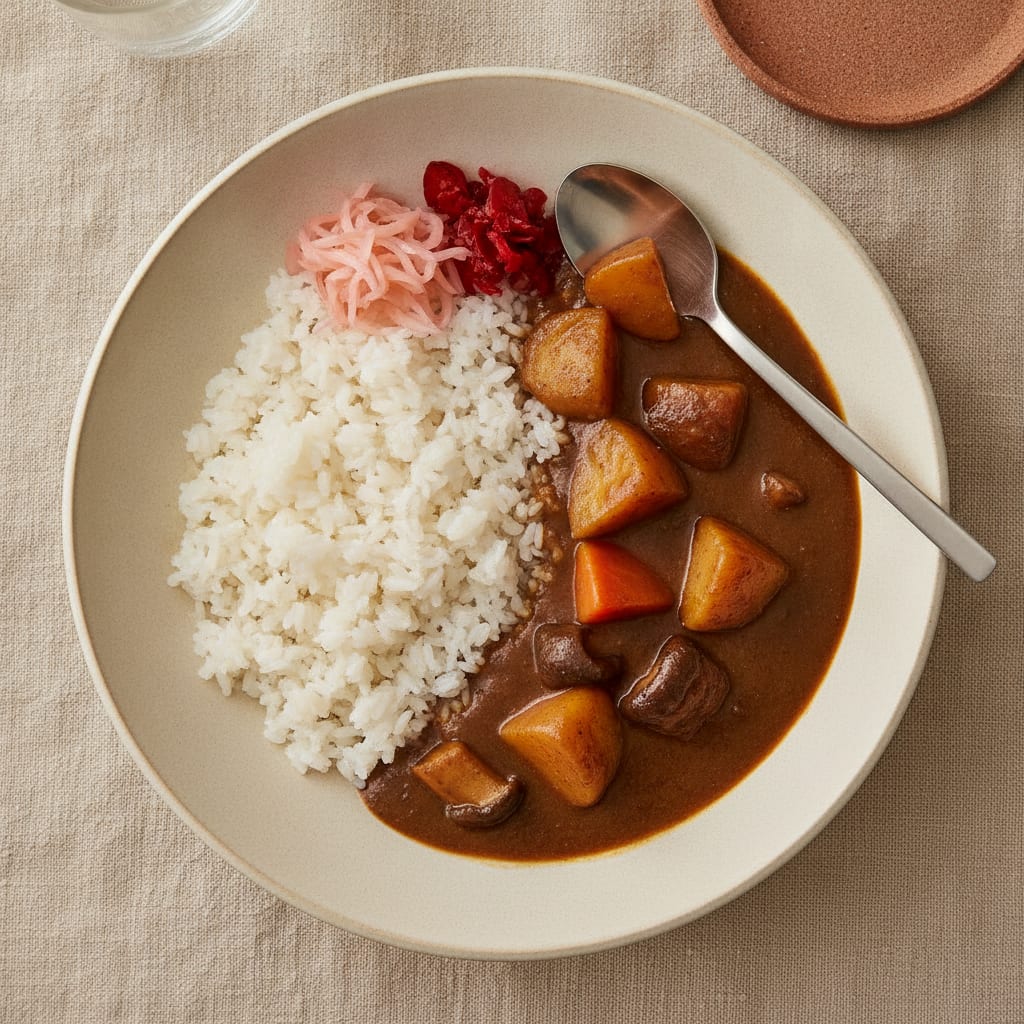
Mound the rice on one side of a wide shallow plate and ladle the thick glossy curry over the other half so the two meet in the middle. A heap of bright red fukujinzuke or pink pickled ginger at the edge cuts the richness. Eat with a spoon. Leftovers are even better the next day — and become curry udon (see the recipe).
The story
The curry nights at Tetsu’s were the quiet ones. Wakō was a ramen counter first — eight seats in Sapporo, the snow piled past the sill from December — but on slow afternoons he made a pot of kare for the staff, and the smell of it filled the little room differently from broth: warmer, sweeter, more like a kitchen at home than a restaurant. He cooked the onions down for what felt like forever, stirring with a long wooden spatula, and dropped a single square of dark chocolate into the pot at the end. The first time I saw it I thought he’d made a mistake. One grey afternoon in November 2020, Susukino dark by four o’clock, he slid me a plate — half rice, half thick brown curry — and told me curry wasn’t really Japanese at all. The British navy brought it. Japan just never gave it back.
He was right about the history. Kare raisu is yōshoku — a Western food adopted in the Meiji era, when Japan reopened to the world after 1868. Curry came not straight from India but through the British Royal Navy, which carried curry powder in its shipboard rations; the first Japanese curry recipe was printed in 1872. Japan thickened it with a flour roux, sweetened it, set it over short-grain rice, and made it so thoroughly its own that today it is one of the country’s most-eaten dishes.
This curry has no meat in it. It has onions cooked to sweet gold, a roux brick built from scratch, king oyster mushroom for the braising chew, grated apple for the House Vermont sweetness, and a square of chocolate for depth — over a bowl of rice. The method is unchanged. It is not a “vegetable version” of kare raisu. It is kare raisu, made with what is in my hands now.
À la maison
The weeknight reading is the recipe above, and it asks for patience in exactly one place: the onions. Cook them low and slow until they are jammy and deep gold — twenty-odd minutes, no shortcuts — because they are the sweetness and body that a meat stock would otherwise give. Everything else is easy. You make a roux brick from scratch in a separate pan, which is just flour and butter cooked to peanut-butter brown with curry powder stirred in off the heat. Mushroom dashi carries the savor; grated apple brings the gentle sweetness; one square of dark chocolate rounds the whole pot out. Let it rest ten minutes before serving — it thickens and settles — and make extra, because tomorrow it becomes curry udon.
Au bistrot
The bistronomique reading keeps the roux and the apple-sweet depth but plates the curry as a composed course rather than a comforting pool.
I split the sauce from the garnish. The curry base is cooked, then blended smooth and passed through a sieve into a glossy, lacquer-dark sauce — pure, intense, no chunks. The vegetables become individual, deliberate elements: a fat king oyster steak scored and seared hard, glazed with a little of the curry reduced to a brushing consistency; carrots turned and glazed in their own juices and a touch of curry oil; a single confit potato, crisped in the pan. The rice is no longer a mound but a neat quenelle or a pressed disc, brushed with a thread of curry oil bloomed from the spice powder. On a wide pale plate, I pool the smooth sauce, set the king oyster steak off-centre, lean the glazed carrot and the crisp potato against it, and finish with a quick fukujinzuke I make myself — daikon and lotus root pickled bright — for the sharp red note the dish always carries. A scatter of micro-shiso. The flavours are home curry exactly; the plate is a restaurant’s.
Le dressage — Overhead, soft directional light. Wide ivory plate, a deep glossy pool of sieved curry sauce. A seared king oyster steak off-centre, glazed carrot and a crisp confit potato leaning in, a pressed disc of rice with a thread of curry oil. A small bright heap of house fukujinzuke for the red. The plate should say a humble Western import, plated with respect — comfort food at attention.
What the other recipes get wrong
Most Japanese curry recipes online — I read the top ten in March 2026 — reach for the boxed roux brick and stop there, or, going from scratch, rush the onions over high heat to “save time.” Both miss where the dish actually lives. I ran the test over a week in March 2026, in my Washington kitchen, four pots of curry, identical roux, vegetables and dashi, changing only how the onions were treated:
- Onions sweated 5 minutes, soft but pale: thin, sharp, one-dimensional. The curry tasted of spice powder and not much else — no backbone, no sweetness, the raw onion still poking through.
- Onions browned hard and fast over high heat, 8 minutes: bitter at the edges, acrid notes from the scorched bits, and still raw-sharp in the middle. Loud in the wrong way.
- Onions cooked low and slow, 22 minutes, to deep jammy gold: sweet, round, deep, the whole pot resting on a savory-sweet base that the spice sat into rather than on top of. This was the curry. It was not close.
The reason is what slow heat does to an onion. Held low and long, the onion’s cells break down and its sugars concentrate and slowly caramelize while its harsh sulfur compounds cook off, turning sharp raw allium into sweet, mellow, savory jam — that is the body a meat curry gets from stock and a meatless one has to build here. Rushed hot, the surface scorches bitter before the interior softens, so you get burnt edges and raw centres at once. The apple and the square of chocolate then layer onto that base — fruity sweetness from the apple, a rounding bitterness from the chocolate for colour and depth — but they only land if the onion has done its slow work first. Across all four pots, the low-and-slow onions won every time. The onions are not a step to rush. They are the stock.
The line I draw
I will not rush the onions. Not on a weeknight, not when I am hungry, not by cranking the heat. Japanese curry has no meat stock under it, which means the slow-cooked onion is the entire base — the sweetness, the body, the savor the dish stands on. Sweat them five minutes and you get a thin, sharp curry that tastes of spice powder. Brown them hard and fast and you get bitter scorched edges over a raw middle. Twenty-odd minutes, low heat, stirred to deep jammy gold — there is no shortcut that does not show in the bowl. The roux can be quick. The onions cannot.
When this can fail
Three ways, all from my own kitchen between 2022 and 2026:
- The thin, sharp curry. Sweated the onions barely soft because I was in a hurry; the finished pot tasted of raw spice and harsh allium with no depth. Fix: cook the onions low and slow for a full twenty minutes to deep gold jam before anything else goes in — that is the base the whole dish rests on.
- The lumpy sauce. Dumped all the roux in at once into hot liquid; it seized into floury clumps that never smoothed out. Fix: add the roux a spoonful at a time, stirring each fully smooth before the next, and lower the heat while you do it.
- The scorched bottom. Let the thickened curry sit on full heat after the roux went in; the flour-thick sauce caught and burned on the base and threw a bitter note through the whole pot. Fix: once thickened, drop to the gentlest simmer, stir often, and rest it off the heat to finish.
FAQ
QWhy is Japanese curry considered a Western dish in Japan?
Because it arrived as one. Kare raisu belongs to yōshoku — Western-style foods adopted during the Meiji era after Japan reopened to the world in 1868. Curry reached Japan not from India directly but via the British Royal Navy, which had folded curry powder into its shipboard rations; the first Japanese curry recipe, 'raisukare,' was printed in 1872. So in Japan curry is filed alongside croquettes and hamburg steak as a Western import the country made entirely its own — thickened with a flour roux, sweetened, and served over short-grain rice with a spoon.
QWhat is the roux brick in Japanese curry?
It is a block of curry-spiced roux — flour and fat cooked to a nutty brown, loaded with curry powder, and set firm. S&B made Japan's first domestic curry powder in 1923, and in 1966 launched Golden Curry, the shelf-stable roux brick that made curry a thirty-minute weeknight dish. This recipe makes the same thing from scratch: butter and flour cooked to peanut-butter brown, then curry powder and garam masala stirred in off the heat. Cooking the flour out kills the raw taste and the browning builds the depth.
QWhy put apple and chocolate in Japanese curry?
Both are classic. House Foods launched Vermont Curry in 1963 — a milder curry built on apple and honey, aimed at families with children — and apple-and-honey sweetness became a defining note of home-style Japanese curry. A small square of dark chocolate is a separate home trick: it deepens the colour and adds a rounding bitterness that balances the sweetness, without making the curry taste of chocolate. Grated apple here does the fruity-sweet work; the chocolate rounds it out.
QWhy cook the onions so slowly?
Because they are the body and sweetness of the whole dish. There is no meat stock doing that work, so the onions have to. Cooked low and slow for twenty-odd minutes they collapse into a sweet, savory jam that dissolves into the sauce and gives it depth. Rushed over high heat, they char at the edges and stay sharp and raw inside, and the curry tastes thin and harsh. This is the one step you cannot hurry.
QIs Japanese curry better the next day?
Famously, yes. As it rests, the roux fully hydrates, the spices round out, and the flavours settle and meld, so a day in the fridge deepens it. Reheat gently with a splash of water to loosen. Leftover curry is also the origin of curry udon — ladled over udon and thinned with dashi the next day — which has its own recipe here.