Yesterday's rice, today's dinner.
Nasi Goreng.
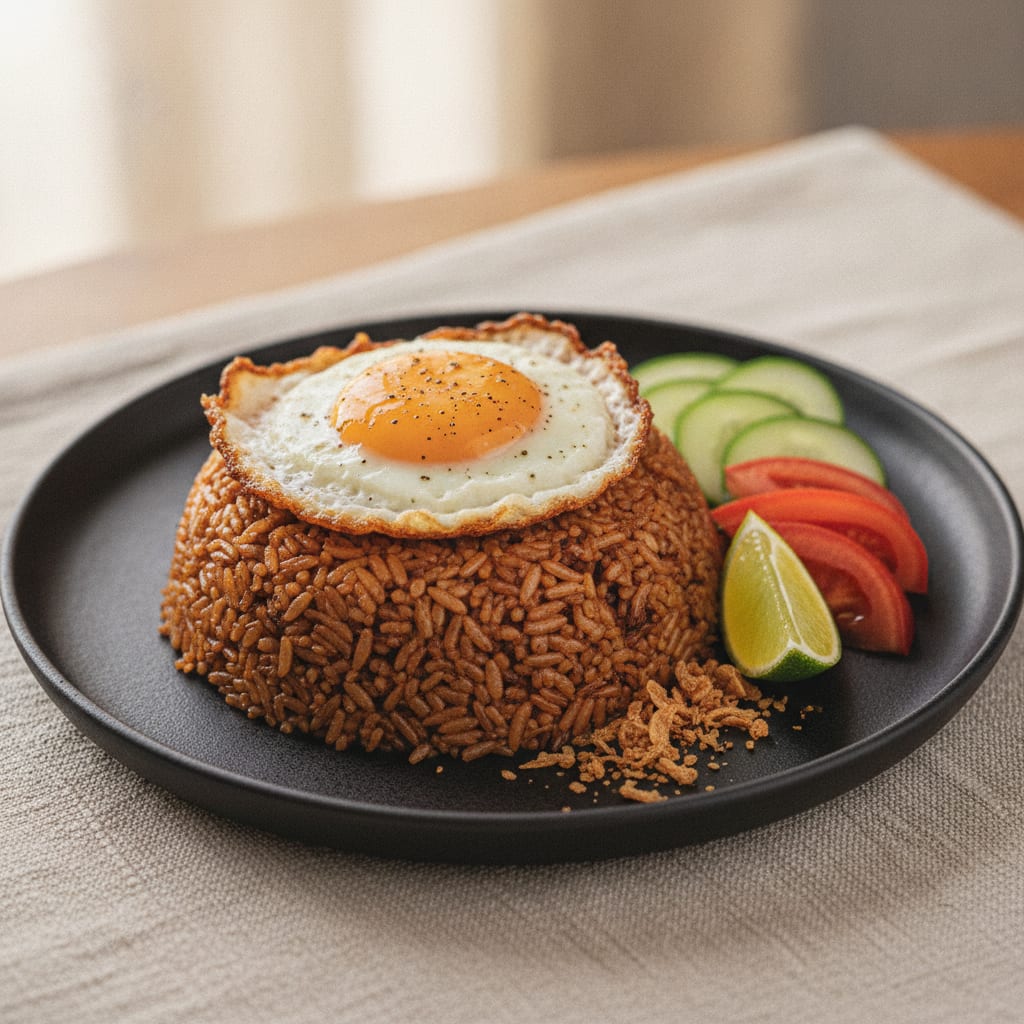
Indonesia's fried rice, two ways: cold day-old rice seared hard over a sambal-and-miso base, lacquered with sweet kecap manis, crowned with a crisp-edged fried egg.
- Prep
- 15 min
- Cook
- 15 min
- Total
- 30 min
- Servings
- 4
- Difficulty
- Easy
Getting ready…
Ingredients
For 4 servings · 16 items
For the rice
For the bumbu (spice base)
For frying
For the sauce
To top and serve
Method
8 steps · check as you go
- →
Serve
Serve hot, mounded, each plate crowned with its own crisp-edged fried egg and a heavy scatter of bawang goreng (fried shallots). Sliced cucumber and tomato go to the side; a lime wedge and a spoon of extra sambal go on the rim for each person to adjust. Krupuk (prawn-free crackers) alongside are traditional and worth it. Nasi goreng is breakfast, lunch, or a late-night plate in Indonesia — there is no wrong hour.
The story
I cooked nasi goreng most nights in April 2025, in my D.C. kitchen, the spring I was trying to stop wasting rice. There is a rice cooker in my apartment that runs most evenings, and the bottom inch always went to the fridge in a covered bowl. By morning it had dried to firm, separate grains — exactly what fried rice wants. I’d buy kecap manis and sambal at the Lotte on University Boulevard up in Wheaton, just over the line in Maryland, and stand at the wok at eleven at night turning yesterday’s rice mahogany. The smell of the bumbu hitting hot oil — shallot, garlic, chili, the funk of miso — is the smell of that whole spring.
Nasi goreng is built on three non-negotiable moves: cold day-old rice, a pounded spice base, and kecap manis — the thick, sweet, palm-sugar soy that lacquers the grains dark and gives the dish its name-recognition color and taste. The fourth, traditionally, is the crisp-edged fried egg crowning the plate.
This nasi goreng has no shrimp paste in it. In its place the bumbu carries white miso — the same fermented, savory bottom note that terasi gives, drawn from soybeans instead of krill. There is crisped tofu where the chicken or shrimp would be. The cold-rice rule is unchanged, the kecap-manis lacquer is unchanged, the egg on top stays. It is not a “plant-based version” of nasi goreng. It is nasi goreng, made with what is in my hands now.
À la maison
The weeknight reading is the recipe above, and it lives or dies on two things. First, the rice must be cold and a day old — this is the whole game, and there is no shortcut worth taking except spreading fresh rice thin and chilling it hard for an hour. Second, get the pan properly, frighteningly hot, and let the rice sit against the metal in stillness between tosses so it toasts instead of steams. The miso goes into the bumbu, the kecap manis goes in around the hot edge of the pan to caramelize, and the egg goes on last. Everything else is chopping.
Au bistrot
The bistronomique reading keeps the rice the centre but treats it as a composed plate — the nasi goreng pressed and turned out clean, the egg and garnishes arranged rather than scattered.
Fry the rice exactly as above, then pack it warm into an oiled ring mould or a small bowl and turn it out onto the plate as a clean, glossy dome — a single deliberate mound instead of a heap. Make the egg the star: fry it in a little extra oil, spooning the hot oil over the white so the edges blister into a brown lace while the yolk stays liquid, then set it on the dome so the yolk sits at the peak, ready to break and run down the rice tableside. Around the base, arrange a few thin coins of cucumber, two halved cherry tomatoes blistered in the pan, and a quenelle of fresh sambal. Finish with a deliberate tuft of bawang goreng — fried shallots — fried fresh and golden, and a single lime wedge. Where the home plate is generous and scattered, the bistrot plate is one clean read: the dome, the lacquer-dark rice, the lace-edged egg, the heat held to one side.
Le dressage — Three-quarter, slightly above. Dark plate, a clean mahogany dome of rice, the lace-edged fried egg crowning it with the yolk catching the light. A quenelle of red sambal off-centre, a tuft of golden fried shallots, one lime wedge. Negative space around the mound. The plate should say a street plate composed with restraint — the yolk about to break.
What the other recipes get wrong
Most nasi goreng recipes written for Western kitchens — I read the top ten in March 2026 — quietly drop the shrimp paste and replace it with nothing, or with more soy sauce, and call the loss a rounding error. It is not. The fermented funk is structural. I ran the test over a week in March 2026, four pans, same cold rice, same kecap manis, same heat — only the umami base changed.
- No terasi, no replacement: clean and pleasant, but it tasted like generic fried rice with sweet soy. The savory bottom was missing entirely; nothing anchored the sweetness of the kecap manis.
- Extra soy sauce to compensate: saltier, but flat — more of the same top note, none of the fermented depth. It just made the dish salty-sweet without a floor under it.
- A spoon of nutritional yeast: cheesy and slightly off-register; it added savoriness but in the wrong key, reading more like a cracker than a fermented paste.
- White miso pounded into the bumbu: this was it. A deep, fermented, almost marine savoriness under the sweet lacquer — the bottom note that makes nasi goreng taste unmistakably Indonesian rather than just like fried rice.
The reason is that terasi and miso are the same kind of ingredient doing the same job. Terasi is krill fermented for weeks to months; miso is soybeans fermented with koji. Both break proteins down into free glutamates and a whole spectrum of funky, savory fermentation compounds — that is the deep bottom note. Plain soy sauce has glutamate but lacks the dense, paste-concentrated fermentation funk, and nutritional yeast brings glutamate in a cheesy register that fights the chili. Miso, pounded into the bumbu and fried until its raw edge cooks off, lands in exactly the right place. Every pan, across the week, the miso version had a floor and the others floated.
The line I draw
I will not fry warm, fresh rice and call it nasi goreng. Not “just this once,” not because I forgot to cook rice the night before. Fresh rice steams in the pan, clumps, and goes wet and sticky — you get a soft, pale rice porridge tossed with sauce, not the dry, toasted, separate-grained dish nasi goreng is supposed to be. The cold, day-old rice is the foundation, not a preference. If I don’t have it, I either spread fresh rice thin and chill it hard for an hour first, or I cook something else. There is no version of this dish on warm rice that is worth serving.
When this can fail
Three ways, all from my own kitchen between 2022 and 2026:
- The wet, clumping rice. Used rice straight from the cooker because I was hungry and impatient; it steamed, clumped, and went sticky the moment it hit the pan. Fix: only cold day-old rice, broken into separate grains — or fresh rice spread thin and chilled hard for at least an hour.
- The pale, flat bowl. Skipped the miso and leaned on extra soy; the dish tasted like sweet fried rice with no savory floor under the kecap manis. Fix: pound a tablespoon of white miso into the bumbu for the fermented depth terasi gives.
- The steamed, gray egg. Cooked the egg slow and gentle on top of the rice like a lazy fried egg; it went pale and rubbery with no crisp edge. Fix: fry it separately in hot oil, spooning oil over the edges until they lace and brown, yolk still runny.
FAQ
QWhy does nasi goreng need day-old rice?
Freshly cooked rice is warm, moist, and soft; when you fry it, the surface moisture turns to steam and the grains clump into a sticky, wet mush. Rice cooked the day before and chilled overnight loses surface moisture and its starches retrograde — they firm up — so the grains stay separate and individual. When that dry, firm rice hits a hot pan, it toasts and fries instead of steaming. If you only have fresh rice, spread it thin on a tray and chill it in the fridge for an hour to drive off moisture, but overnight is genuinely better.
QWhat can I use instead of shrimp paste (terasi) in nasi goreng?
Terasi is fermented shrimp paste, and it supplies a deep, funky, fermented savory bottom note that plain soy sauce cannot. The best plant swap is white miso — about a tablespoon pounded into the bumbu — which brings the same fermented umami depth from soybeans instead of krill. A teaspoon of fermented bean paste or a dab of doenjang works too. The point is to replace the fermented funk, not just the saltiness, which is why miso beats simply adding more soy sauce.
QWhat is kecap manis and can I substitute it?
Kecap manis is Indonesian sweet soy sauce — soy sauce thickened and sweetened with palm sugar to a dark, syrupy consistency. It is the defining flavor and the signature mahogany color of nasi goreng, and it caramelizes when it hits the hot pan, which is why the dish is darker and sweeter than Chinese or Thai fried rice. If you can't find it, approximate it by simmering 3 tablespoons soy sauce with 2 tablespoons palm or brown sugar until syrupy, but a bottle from any Asian grocery is cheap and lasts.
QWhy is there a fried egg on top of nasi goreng?
The fried egg — telur ceplok, traditionally fried with crisp lacy edges and a runny yolk — is part of the classic nasi goreng, not a garnish you can skip. When you break the yolk into the hot rice, it coats and enriches the grains as you eat, adding richness the rice doesn't have on its own. For a plant-based plate, a folded chickpea-flour egg or a store-bought vegan fried egg plays the same role; the runny, rich element on top is what matters.
QHow do I get the smoky 'wok breath' flavor at home?
The slightly charred, smoky note — wok hei, or 'wok breath' — comes from very high heat and from letting the rice sit still against the hot metal for a few seconds at a time rather than stirring constantly. Use your hottest burner, a wide pan you've preheated until it's nearly smoking, don't crowd it, and add the kecap manis around the edge so it caramelizes on the metal. Constant stirring keeps the pan cool and steams the rice; intermittent searing is what builds the toasted flavor.