The crepe that ferments itself.
Masala Dosa.
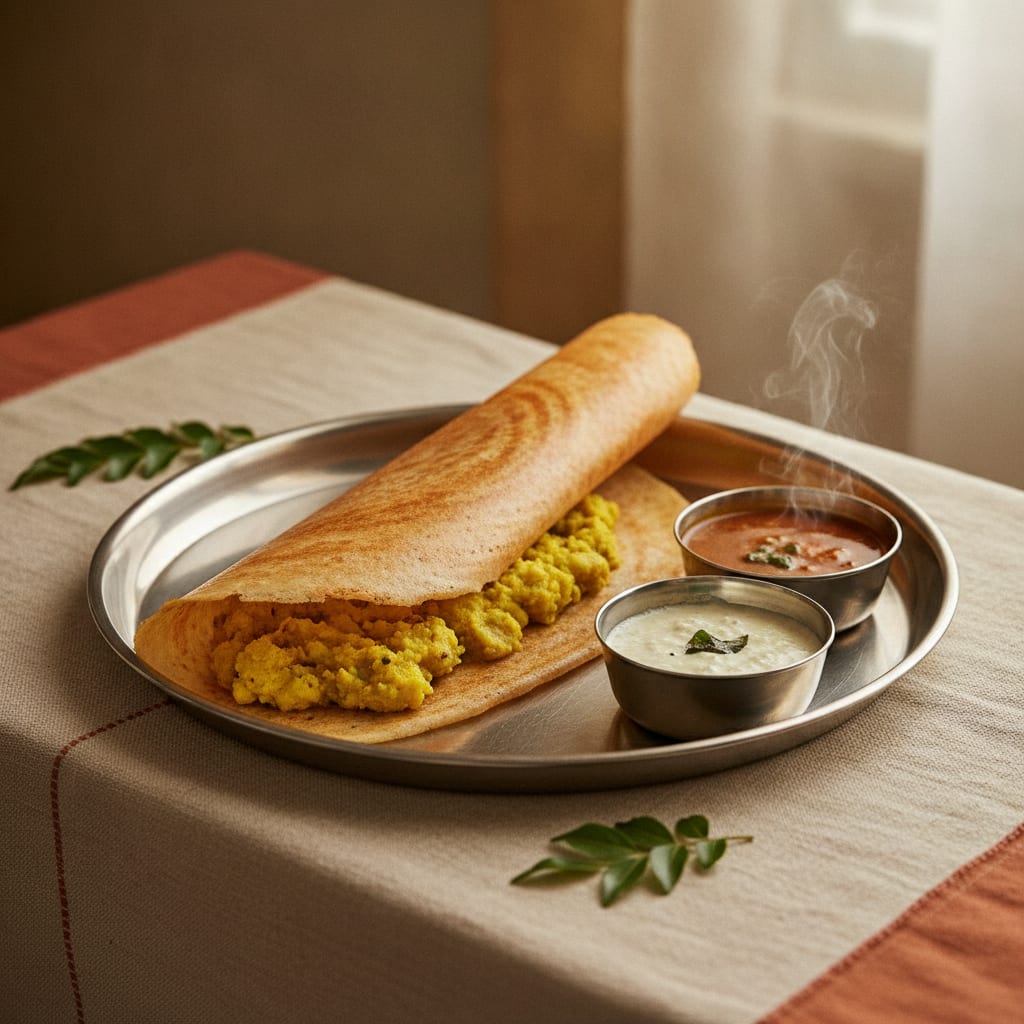
A fermented rice-and-urad-dal crepe spread crisp and lacy, wrapped around soft turmeric potato masala, with coconut chutney and a quick sambar.
- Prep
- 30 min
- Cook
- 30 min
- Total
- 1h
- Servings
- 4
- Difficulty
- Ambitious
Getting ready…
Ingredients
For 4 servings · 18 items
For the batter (start a day ahead)
For the potato masala
For frying the dosas
To serve
Method
7 steps · check as you go
- →
Serve
Serve each dosa the instant it's folded, golden side out, on a warm steel plate, with a mound of coconut chutney and a small bowl of hot sambar to dip and pour. Eat with your hand: tear, scoop the potato and chutney, dunk the crisp edge in the sambar. Make them one at a time and feed people as they come off the pan — the cook eats last, always.
The story
The best masala dosa I ate in 2025 was in a fluorescent-lit canteen in Langley Park, just over the D.C. line into Maryland, on an August morning so humid the steel plates sweated. The man working the tava — everyone called him Anna, “elder brother,” which is what you call any Tamil cook of a certain age and I never learned his real name — had a rhythm I could have watched for an hour: ladle, spiral, oil, fold, slide, wipe, again. The dosas came off lacquer-thin and shattering at the edge, folded over a turmeric-yellow potato that steamed when you tore it. He fermented his batter in a five-gallon bucket in the back, and when I asked what he added to make it rise, he looked at me like I’d asked what he added to make water wet. “Nothing. You leave it. It does it itself.”
That “it does it itself” is the whole dish. The dosa is old — a fermented rice-and-lentil crepe referenced in South India more than a thousand years back. The masala dosa, the one folded around spiced potato, is far younger: a 20th-century invention of the Udupi temple kitchens on the Karnataka coast, carried out into the world by Udupi restaurateurs who opened canteens in every Indian city. What never changed is the wild ferment — no yeast, no starter, just soaked grain, warmth, and time.
This masala dosa has nothing in it that ever came from an animal, and it never did. The batter ferments itself, the potato is turmeric and mustard seed and curry leaf, the chutney is coconut. It is not a “vegan dosa.” It is dosa — the thing Anna made in a bucket, the thing the temple cooks made when rice was dear and potatoes were cheap.
À la maison
The weeknight reading is the recipe above, and the only hard part is that it isn’t a weeknight at all — it’s two days. Start the batter the morning before, let it ferment overnight, and the actual cooking is fast and forgiving. The two moves that matter: ferment the batter all the way (warm spot, until doubled and domed and sour-smelling), and get the pan properly hot and barely oiled before you spread. A non-stick pan is honestly easier than cast iron here, and there’s no shame in it. Make them one at a time and eat them as they come — a dosa is a thing you cook for someone standing right there, not a thing you stack.
Au bistrot
The bistronomique reading keeps the wild-fermented batter exactly as it is and turns the plate into a study in crisp, soft, and sharp.
Make the dosa smaller and more precise — a neat tuile-thin disc, or rolled tight into a slim cylinder and cut on the bias so the spiral of crisp crepe and yellow potato shows in cross-section. Pass the potato masala through a ricer for the filling so it’s silk-smooth, and reserve a spoonful to fry into crisp little potato pearls for texture. Treat the coconut chutney two ways on one plate: a smooth quenelle and a few drops of a brighter, looser coconut-coriander emulsion. Reduce the sambar separately into an intense lentil-tamarind sauce and serve it as a warm pool, not a soup — a swipe of deep brown-orange under the dosa. Add a scatter of tempered mustard seeds and a single fried curry leaf, shatteringly crisp, laid on top like a leaf pressed in a book. Plate the cut dosa cylinders standing or leaning over the sambar swipe, the chutney quenelle to one side, the potato pearls and curry leaf finishing it.
Le dressage — Tight three-quarter, low angle to catch the cross-section spiral. Dark slate or matte steel plate. A swipe of burnt-orange sambar, slim dosa rolls cut on the bias standing in it, a clean white coconut quenelle, crisp potato pearls, one glossy-fried curry leaf on top. Hard side light to read the crisp ridges. The plate should say a humble crepe, taken seriously — the canteen dosa, reframed without losing its soul.
What the other recipes get wrong
Most dosa recipes online — I read the top ten in February 2026 — treat fermentation as a vague “leave it 8 hours” and skip the one thing that actually controls it: temperature. They blame failed dosas on the rice, the dal, the grinder, anything but the room. I ran the test over five days in February 2026 — one master batch of batter, identical rice and urad dal and grind, divided into four bowls — and changed only the fermentation environment:
- Cold kitchen, ~18°C/64°F, 12 hours: barely moved. Flat, dense, weakly sour. The dosas came out tough and pale — a crepe, not a dosa.
- Salted before fermenting, warm spot: rose, but slowly and meanly — the salt blunted the microbes. Half the lift of the unsalted bowl.
- Warm spot, ~28°C/82°F, 8 hours: doubled, domed, bubbly, cleanly sour. Crisp, lacy, properly leavened dosas.
- Oven with the light on overnight, ~30°C/86°F: the same — risen, airy, fragrant. The most reliable of the four, because the temperature held steady through the cold night.
The reason is microbiology, not luck. Dosa is leavened by wild lactic acid bacteria — predominantly Leuconostoc mesenteroides, a heterofermentative species that produces both carbon dioxide and lactic acid. The CO₂, trapped in the aerated urad-dal foam, is what lifts the batter; the lactic acid is the clean sour. A 1965 study in Applied Microbiology identified this as the first known case of leavening produced by a lactic acid bacterium acting alone, rather than by yeast. Those bacteria are slow and warmth-dependent: drop the room to 18°C and they barely metabolise, so the batter neither rises nor sours. Salt early and you osmotically stress them and slow them further. Give them 25–30°C and a head start of aeration whipped into the dal, and they do in eight hours what they cannot do in twelve cold. Across all four bowls, the variable that mattered was never the grain. It was the temperature.
The line I draw
I will not add baking soda, yeast, or eno to a dosa batter to make it rise faster. The entire identity of the dish is that wild ferment — the slow lift and clean lactic sour that Leuconostoc gives it over a warm night. Chemical leaveners give you bubbles without the flavour: a batter that puffs but tastes of raw rice and bicarbonate instead of that gentle fermented tang. If the kitchen is too cold, the answer is to warm the batter — an oven with the light on, a sunny windowsill, a heating pad on low — not to chemically fake the rise. A dosa that didn’t ferment isn’t a fast dosa. It’s a different, lesser crepe wearing the name.
When this can fail
Three ways, all from my own kitchen between 2022 and 2026:
- The batter that wouldn’t rise. Fermented overnight in a January kitchen at maybe 17°C and woke to a flat, sour-less bowl. Cooked it anyway and got tough, leaden discs. Fix: ferment somewhere genuinely warm — oven with the light on, top of the fridge, a proofing box — and give it longer if the room is cool. Cold is the killer, not time.
- The dosa that stuck and tore. Tried to spread on a tava that wasn’t hot enough and was pooled with oil; the batter slid, gripped in patches, and ripped when I lifted it. Fix: get the pan properly hot, wipe it to a barely-oiled surface with the cut onion, do the water-dance test, and spread fast — and re-wipe between every single dosa.
- The dry, crumbling filling. Mashed the potato masala too stiff and too dry once; it wouldn’t hold a line and tore the thin crepe as I folded it. Fix: keep the masala soft and lightly bound with a splash of water — scoopable, almost loose. It should yield, not crumble, when the dosa folds over it.
FAQ
QWhy does dosa batter ferment without any yeast?
Because it ferments itself, wild. The soaked rice and urad dal carry naturally occurring lactic acid bacteria — chiefly Leuconostoc mesenteroides — which, given warmth and time, produce carbon dioxide that leavens the batter and lactic acid that sours it. A 1965 study identified this as the first documented case of leavening produced by a lactic acid bacterium alone, rather than by yeast. No commercial culture is needed; the microbes are already on the grains and on your hands.
QWhere does masala dosa come from?
The dosa itself is ancient South Indian, referenced over a thousand years ago. The masala dosa — the crepe wrapped around a turmeric-potato filling — is much younger, generally traced to the Udupi temple-town kitchens of coastal Karnataka in the early 20th century. Udupi restaurateurs migrating to Mumbai, Chennai and Bangalore carried it across India and then the world.
QHow do I get a crisp, lacy dosa?
Four things. Ferment the batter fully so it's airy. Get the pan genuinely hot and season it with an oiled onion so the surface is hot and barely filmed, not wet with oil. Spread the batter thin in one quick continuous spiral. And add a little poha or a splash of water to thin the batter slightly — too thick and it cooks up like a pancake, too thin and it tears. Then leave it alone to crisp before you fill it.
QWhy is my dosa batter not rising?
Almost always temperature. The wild bacteria need warmth — ideally 25–30°C (77–86°F); in a cold kitchen the ferment stalls and the batter stays flat and sour-less. Put it in an oven with the light on, or a warm spot. The other common cause is salting before fermentation, which slows the microbes — always add salt after the batter has risen, not before.
QCan I use a regular non-stick pan instead of a cast-iron tava?
Yes. A well-heated non-stick pan makes excellent dosas and is much more forgiving than a raw cast-iron tava, which needs careful seasoning before it will release. Whatever the pan, the rules are the same: get it properly hot, wipe it to a barely-oiled surface, do the water-dance test, and spread fast. Wipe and re-season between every dosa.