Orange, caramel, fire.
Crêpes Suzette.
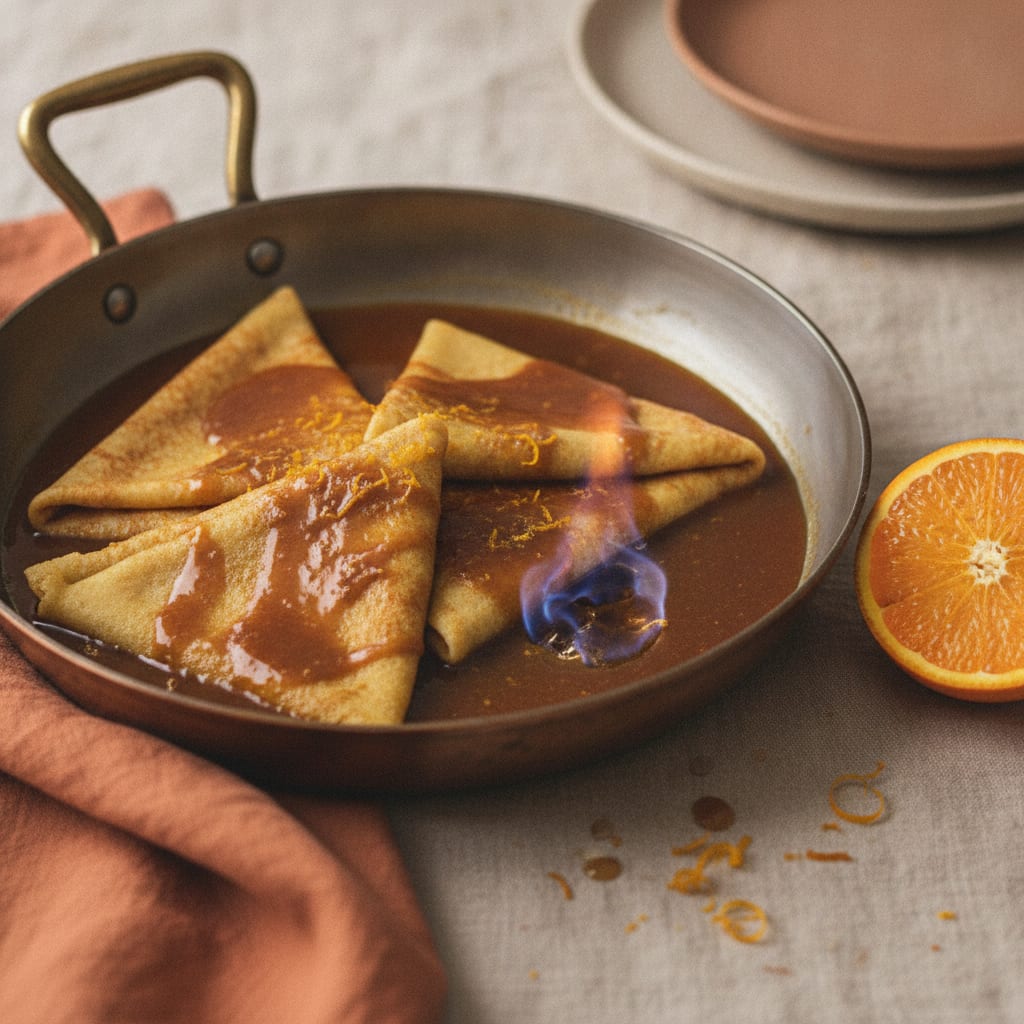
The flambéed orange-caramel crêpes, two ways: a beurre Suzette and folded crêpes at home, and a tableside-flamed plated dessert with candied zest at the bistro.
- Prep
- 25 min
- Cook
- 20 min
- Total
- 1h 15min
- Servings
- 4
- Difficulty
- Medium
Getting ready…
Ingredients
For 4 servings · 12 items
For the crêpes
For the beurre Suzette (orange-caramel sauce)
For the flambé
Method
8 steps · check as you go
- →
Serve
Serve crêpes Suzette straight from the flambé — two folded crêpes per plate, the orange-caramel sauce spooned generously over, a scatter of fresh orange zest, and a scoop of vanilla plant ice cream alongside if you like the hot-cold contrast. It is a dessert meant to arrive while still glossy, ideally flamed in front of your guests.
The story
Crêpes Suzette is the most theatrical dessert in the French canon, and I learned to respect it properly in Paris, in the spring of 2024, during a stage at Le 110 de Taillevent on the Avenue George V. A chef de partie named Théo ran the dessert tableside cart, and he flamed Suzettes with a calm I found maddening — pan tilted, the blue flame leaping up over the folded crêpes, his face perfectly still while mine flinched. The smell was burnt orange and warm caramel and the sharp top-note of cognac flashing off. “Le feu, c’est pour le spectacle, mais le beurre, c’est le plat,” he told me. The fire is for the show; the butter is the dish. The flambé is the theatre. The emulsion is the cooking.
The origin is gloriously disputed, and I won’t pretend to settle it. The famous story — a fourteen-year-old Henri Charpentier flaming them by accident in 1895 for the future Edward VII and a girl called Suzette — is almost certainly too good to be true; historians note he’d have been far too junior to serve a prince, and Larousse Gastronomique contradicts him. A rival claim credits a Monsieur Joseph in Paris in 1897, naming the dish for the actress Suzanne “Suzette” Reichenberg. What is solid: Escoffier printed a version in his 1903 Guide Culinaire — made with tangerine and curaçao, and pointedly with no flambée at all — which means the dish was already established before the romantic myth, and the fire came later.
This Suzette has no egg and no dairy. The crêpes are bound with soy milk, whose protein gives them the strength to fold into quarters in the sauce without tearing; the beurre Suzette is built with vegan butter whisked cold into an orange caramel exactly the way a beurre blanc is built. It is not a “vegan crêpes Suzette.” It is crêpes Suzette — the caramel, the orange, the emulsion, the fire — made with what is in my hands now.
À la maison
The weeknight reading is the recipe above, and it is the one dish in this set I’d call medium rather than easy — not because any single step is hard, but because there are three components and an open flame. Make the crêpes ahead; they keep happily stacked. The move that matters most is the sauce: build it from a real caramel, deglaze with orange juice, then whisk in cold butter bit by bit off the boil so it emulsifies glossy instead of splitting oily. The flambé is optional theatre — warm the spirit first or it won’t light — but the folded, sauce-soaked crêpes are the dish with or without the fire.
Au bistrot
The bistronomique reading is the same dish brought back to its origin — flamed tableside — and plated with a little more precision and one extra component.
Make the crêpes especially thin and trim them into neat rounds. Build the beurre Suzette as above but strain it silk-smooth, and prepare a garnish of candied orange zest: fine julienne of zest blanched and simmered in sugar syrup until glossy and tender. Bring the folded crêpes to the table in a copper pan and flame them in front of the guests — warm the cognac in a ladle, light it, and pour it glowing over the crêpes so the blue flame runs across the surface. Plate two crêpes per guest folded into sharp quarters, the strained sauce spooned in a clean pool, a quenelle of vanilla plant ice cream set against the heat, the candied zest scattered for chew and shine, and a few segments of supremed orange for freshness. The dessert that was born as tableside theatre, returned to it — the same orange-caramel emulsion and the same fire, composed.
Le dressage — Three-quarter, slightly low to catch the flame at the moment of the pour. Copper pan or warm plate, sharply folded crêpes glossy in dark amber sauce, candied zest gleaming, a quenelle of pale ice cream, the blue flambé flame just licking the surface. Dim warm light so the fire reads against the dark sauce. The plate should say theatre with discipline behind it — the show, and the emulsion under it.
What the other recipes get wrong
Most crêpes Suzette recipes — I read the top ten in May 2026 — skip the caramel and build the sauce by just melting butter into orange juice, then add the butter over a hard boil and wonder why it goes oily. Both shortcuts cost the dish. I ran the test over a week in May 2026, four sauces, same crêpes, changing only how the sauce was built:
- Melted butter + orange juice + sugar, simmered: thin, one-dimensionally sweet-sour, no depth, and it split into an oily slick on the plate as it cooled.
- Caramel deglazed with juice, butter added all at once over high heat: good flavour from the caramel but it broke — the fat separated out into a greasy pool around the crêpes.
- No caramel, butter emulsified cold and slow: glossy and stable, but flat and pale-tasting; it missed the bittersweet backbone entirely.
- Caramel base, deglazed with juice, cold butter whisked in slow off the boil, flamed: dark, glossy, bittersweet, emulsified, the flambé rounding the orange into something toasted. This was the dish.
The reason is two pieces of technique most recipes drop. First, the caramel: cooking the sugar to amber before the juice goes in builds a bittersweet depth that plain sugar syrup cannot — it is the difference between an orange sauce and a beurre Suzette. Second, the emulsion: butter is fat and water held together by milk solids (or, in vegan butter, by its emulsifiers), and that emulsion only survives if you whisk cold butter into a warm — not boiling — base, piece by piece, so each cube emulsifies before the next. Boil it hard or dump it in cold and the emulsion shatters and the fat weeps out. Caramel for depth, cold butter off the boil for gloss: get both and the sauce is right every time.
The line I draw
I will not build the sauce without a caramel. Not by just melting butter into orange juice “to save a step,” not by reaching for marmalade as a shortcut. The soul of a beurre Suzette is the bittersweet backbone that only caramelised sugar gives, deglazed with the juice and emulsified with cold butter into something glossy and deep. Skip the caramel and you have a sweet orange butter sauce — pleasant, but it is not Suzette, and the crêpes deserve the real thing. Théo flamed the fire for the room, but he would not let the sauce go out without its caramel. Neither will I.
When this can fail
Three ways, all from my own kitchen between 2022 and 2026:
- The split, oily sauce. I added all the butter at once over a rolling boil; it broke and wept fat around the crêpes. Fix: lower the heat and whisk cold cubed butter in a few pieces at a time, off the boil — and if it splits, a splash of cold juice or a fresh cold cube whisked in brings it back.
- The torn crêpes. I skipped the rest and used a low-protein milk; the crêpes were fragile and ripped when I tried to fold them in the sauce. Fix: rest the batter and use soy milk for its protein, so the crêpes hold together when folded.
- The flambé that wouldn’t light. I poured cold spirit straight from the bottle over the pan; it never caught and just watered down the sauce — and pouring from the bottle is how a flame travels up the stream. Fix: warm the spirit in a small pan or ladle first, ignite it off the burner with a long match, and pour the flame over.
FAQ
QWho invented crêpes Suzette?
Nobody can prove it, and the famous story is shaky. The popular tale credits a fourteen-year-old waiter, Henri Charpentier, who claimed in his autobiography that he flamed them by accident in 1895 in Monte-Carlo for the future King Edward VII and a girl named Suzette. Historians doubt it — he'd have been too junior to serve the prince, and Larousse Gastronomique contradicts the account. A rival story credits a Monsieur Joseph at the Paris restaurant Marivaux in 1897, naming them for the actress Suzanne 'Suzette' Reichenberg. What is documented is that Escoffier published a version in his Guide Culinaire in 1903 — with tangerine and curaçao, and notably no final flambée — so the dish predates and outlasts the romantic origin myth.
QWhat is beurre Suzette?
Beurre Suzette is the orange-butter sauce the crêpes are bathed in. Properly it is built like a beurre blanc: a caramel deglazed with orange juice, then cold butter whisked in piece by piece off a hard boil so it emulsifies into a glossy, slightly thick sauce rather than an oily one, finished with orange liqueur. Vegan butter emulsifies the same way — the trick is cold butter, gentle heat, and patience, so the sauce stays glossy and never splits.
QHow do you make crêpes Suzette without eggs?
The crêpe batter is the only egg in the dish, and egg there is doing two jobs: binding and giving the crêpe enough protein structure to stay thin and foldable. Soy milk rebuilds that — its protein content lets the crêpes hold together and fold into quarters in the sauce without tearing, where lower-protein milks give a fragile crêpe. Rest the batter so the flour hydrates, cook the crêpes thin, and the rest of the dish — the orange-caramel beurre Suzette and the flambé — is naturally egg-free.
QHow do you flambé crêpes Suzette safely?
Warm the spirit first — cold alcohol will not light and just waters down the sauce. Take the pan off the direct burner, ignite the warmed spirit with a long match or lighter, and pour the flame over the crêpes (or tilt the pan toward a gas flame to catch it). Keep your face, hair, and sleeves well back, work away from anything flammable, and keep a lid nearby to smother the flame if needed. Never pour spirit from the bottle over an open flame — the fire can travel up the stream. Let it burn down on its own; it only takes a few seconds.
QWhy is my Suzette sauce oily or split?
Almost always because the butter was added over too high a heat or all at once. Beurre Suzette is an emulsion: whisk cold cubed butter into the warm orange-caramel a few pieces at a time, off a hard boil, letting each melt and bind before the next. If it does split, pull it off the heat and whisk in a splash of cold orange juice or a fresh cold cube of butter to bring it back. Keep it warm, not boiling, once it's emulsified.