Numbing, hot, rust-red.
Mapo Tofu.
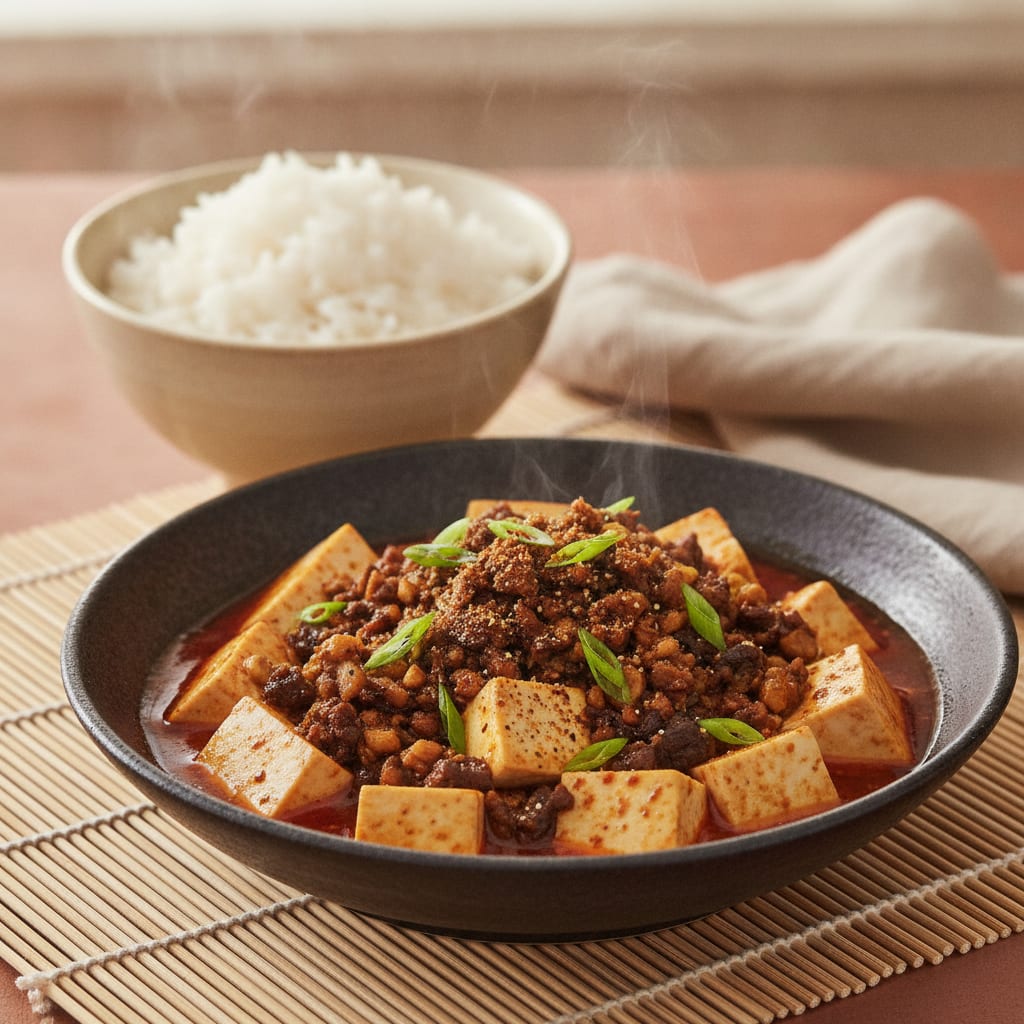
Silken tofu in a rust-red doubanjiang sauce with a shiitake-walnut crumble, finished with toasted-and-ground Sichuan pepper for the full má-là buzz.
- Prep
- 20 min
- Cook
- 25 min
- Total
- 45 min
- Servings
- 4
- Difficulty
- Medium
Getting ready…
Ingredients
For 4 servings · 17 items
For the crumble (the meat element)
For the sauce
To finish
To serve
Method
6 steps · check as you go
- →
Serve
Spoon over bowls of hot short-grain rice, with extra ground Sichuan pepper and chili oil at the table. Mapo tofu is meant to be eaten hot, fast, and a little messy — the sauce is the seasoning for the rice as much as a sauce for the tofu. A pot of jasmine or roasted barley tea cuts the heat.
The story
Mapo tofu came to me late, and in Washington. I learned it properly in the spring of 2025, in a cramped Sichuan place off H Street in Chinatown, from a cook who let me stand at the pass on a slow Tuesday afternoon and watch her bloom doubanjiang until the oil ran the color of brick dust. She did not give me her name and I did not push for it; she gave me something better, which was the order of operations. Pepper last, she said, miming a dusting motion over the wok. Always last. The kitchen smelled of toasted husk and fermented bean, and my lips were buzzing before I had eaten a thing.
The dish is older than any of us. It was created in the 1860s outside Chengdu by a woman named Chen Liu, the pockmarked wife of an innkeeper near the Wanfu Bridge, who cooked tofu and chili for the oil-porters passing through. Mápó means “pockmarked grandmother.” The restaurant that grew from her stall still stands in Chengdu, and the dish she improvised for laborers is now on Sichuan menus from San Francisco to Singapore.
This mapo tofu has no pork in it. It has a crumble of crisped shiitake and toasted walnut where the minced pork used to be, doubanjiang bloomed to rust in hot oil, soft tofu slid in whole, and a final storm of toasted, freshly ground Sichuan pepper. It is not a “vegetable version” of mapo tofu. It is mapo tofu — the sauce is the dish, and the sauce is intact.
À la maison
The weeknight reading is the recipe above, and it asks two things of you. First, bloom the doubanjiang slowly until the oil turns red — that is where the color and the depth come from, and you cannot rush it. Second, grind the Sichuan pepper fresh and put it on at the very end, off the heat. Everything else is gentle: slide the tofu in, nudge rather than stir, thicken in stages until the sauce just naps. Twenty-five minutes on the stove, and most of that is hands-off simmering.
Au bistrot
The bistronomique reading keeps the same sauce and tofu but composes the plate and adds two quiet refinements.
Press a block of silken tofu very gently between cloths for ten minutes, then cut it into clean cubes and blanch them for sixty seconds in salted water so they hold an exact edge. Build a separate má-là oil: warm neutral oil with extra Sichuan pepper, star anise, and a cinnamon shard, infuse off the heat, and strain — this becomes a clear, perfumed slick to spoon over at the end. Cook the shiitake-walnut crumble darker and crisper, almost a praline of savory rubble. Plate in a wide shallow bowl: a low pool of the rust-red sauce, three or four tofu cubes set with intention, a deliberate line of the crumble across them, the clarified má-là oil dotted around the rim so it beads against the red, and the fresh-ground pepper dusted in a single arc. A quenelle of plain rice sits to the side, not under, so the contrast of clean and fiery stays sharp.
Le dressage — Overhead, tight. Dark matte bowl, the sauce a low rust-red pool, tofu cubes and crumble arranged off-centre with negative space around them. Beads of clear má-là oil catching the light. One arc of ground pepper. The plate should say precision over a peasant fire — restraint holding back real heat.
What the other recipes get wrong
Most no-pork mapo tofu recipes online — I read the top ten in April 2026 — replace the meat with plain crumbled firm tofu or a wet soy mince, and they treat the Sichuan pepper as a garnish you can sprinkle from a jar. Both moves kill the dish. I ran the test over a week in my Washington kitchen in April 2026: four batches, identical sauce, identical tofu, only the “meat” element and the pepper handling changed.
- Crumbled firm tofu, jarred ground pepper: bland and soft. The crumble had no chew and disappeared into the sauce; the pepper gave a faint, stale bitterness and almost no buzz.
- Soy mince, jarred ground pepper: better body but a flat, processed savoriness, and still no numbing lift — the pre-ground pepper was inert.
- Shiitake-walnut crumble, jarred ground pepper: real chew and fat, genuine savory depth, but the dish still fell oddly quiet on the tongue. The pepper was the missing half.
- Shiitake-walnut crumble, peppercorns toasted and ground at the last second: this was a different dish. The crumble read as minced meat, the sauce had depth, and the first bite lit up the lips electrically.
The reason is chemistry. The numbing compound in Sichuan pepper, hydroxy-alpha-sanshool, is volatile — it degrades within hours of grinding, which is why jarred ground pepper tastes of woody bitterness and nothing else. Toasting whole peppercorns blooms the aroma and burns off raw notes; grinding them at the moment of serving delivers the alkylamide intact to your nerves, where it blocks KCNK potassium channels and fires the trigeminal touch fibers at around 50 Hz. That buzz is half the dish’s name. On the meat side, shiitake brings glutamate-rich savory chew and walnut brings fat and an irregular minced texture; crisped together first, they hold up where plain crumbled tofu collapses. Drop either move and you get a competent stew. Keep both and you get mapo tofu.
The line I draw
I will not grind the Sichuan pepper ahead of time, and I will not cook it into the sauce. The numbing ‘má’ is the entire reason the dish has its name, and that numbness lives in a compound that starts dying the moment the husk is broken and fades faster under heat. Pre-ground pepper from a jar is bitter dust with the buzz already gone. Toast the whole peppercorns, grind them at the last possible second, and dust them on off the heat. The day you treat the pepper as an optional garnish is the day you are making a generic chili-bean tofu that happens to share a name with mapo tofu.
When this can fail
Three ways, all from my own kitchen between 2022 and 2026:
- The muddy sauce. Threw the doubanjiang into the pan and immediately added liquid, no blooming. The sauce came out brown and raw-tasting, with none of the rust-red sheen or the deep fermented depth. Fix: fry the doubanjiang gently in oil for two to three full minutes first, until the oil itself turns red, before any liquid goes near it.
- The broken tofu. Stirred the silken tofu like a stew to “coat” it; by serving it had collapsed into a grainy slurry and lost all its wobble. Fix: slide the cubes into already-simmering sauce, never stir with a spoon, and move things only by nudging and shaking the pan.
- The dead pepper. Used pepper I had ground three days earlier and stored in a jar. The dish tasted hot but had zero tingle — the whole má-là balance gone, just là. Fix: keep the peppercorns whole until the minute you serve; toast, grind, and dust them on last.
FAQ
QCan you make mapo tofu without pork?
Yes. Mapo tofu is defined by its sauce — fermented chili-bean paste (doubanjiang), fermented black beans, and the numbing-hot má-là of toasted Sichuan pepper — and by the soft tofu, not by the minced pork. A crumble of crisped dried shiitake and toasted walnut supplies the savory chew and the fat that ground pork gave, in irregular minced-textured pieces. The dish reads as mapo tofu because the doubanjiang, the rust-red bloomed oil, and the fresh Sichuan-pepper dusting are all intact.
QWhy does Sichuan pepper make your mouth tingle?
Sichuan peppercorns contain hydroxy-alpha-sanshool, an alkylamide that activates the light-touch and vibration nerve fibers in your lips and tongue by blocking two-pore (KCNK) potassium channels that normally keep those nerves quiet. Your trigeminal nerve reads the signal as a buzzing at roughly 50 Hz — which is why the sensation feels electric and tingly rather than hot. No actual vibration is happening; the molecule is chemically tricking touch nerves. The effect peaks at one to two minutes and is the 'má' (numbing) half of má-là.
QWhat is doubanjiang and can I substitute it?
Doubanjiang is a fermented paste of broad (fava) beans and chilies, aged until deeply savory and rust-colored. The Pixian style from Sichuan is the benchmark. It is the single most important ingredient in mapo tofu and there is no clean substitute — a mix of miso plus chili paste gets you a rough approximation but lacks the specific aged-bean funk. Look for it in Chinese groceries or online; a jar keeps for months in the fridge.
QHow do I keep silken tofu from falling apart?
Three moves. Cut it into generous 2.5 cm cubes rather than small ones. Slide it into already-simmering sauce instead of stirring it in. And never stir with a spoon once it is in — nudge and shake the pan, and push gently with the back of a ladle to move things around. Some cooks blanch the cubes for a minute in lightly salted water first, which firms the surface and makes them more forgiving.
QIs mapo tofu supposed to be very spicy?
It is supposed to be má-là — numbing and hot together, not just hot. The chili heat (là) from doubanjiang and chili powder is balanced by the tingling numbness (má) from Sichuan pepper, and the two sensations play off each other. You can dial the chili down to taste, but if you cut the Sichuan pepper you lose the dish's defining character. Authentic Chengdu mapo tofu is assertively numbing.