The sauce a leftover built.
Makhani.
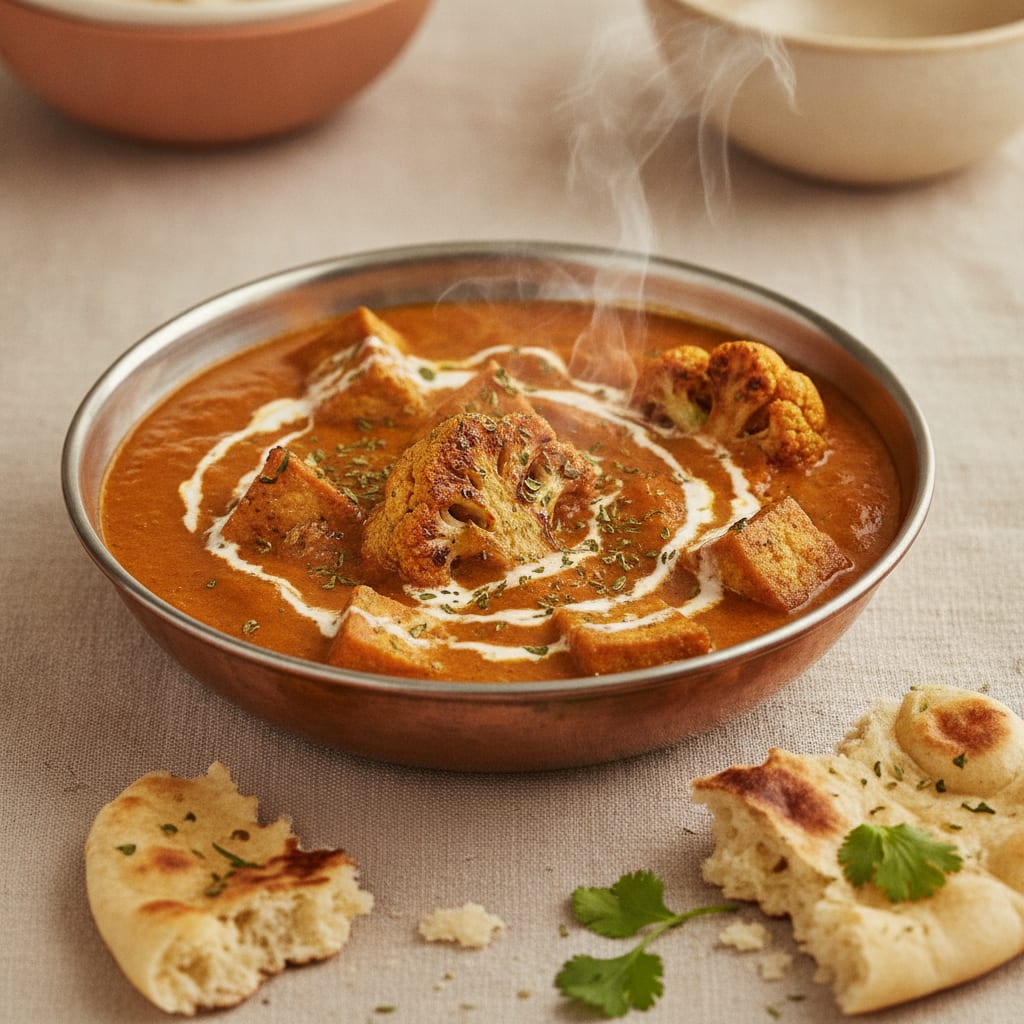
The buttery Moti Mahal tomato gravy over charred cauliflower and tofu — a silky emulsion of tomato, vegan butter and cashew, finished with kasoori methi.
- Prep
- 20 min
- Cook
- 40 min
- Total
- 1h
- Servings
- 4
- Difficulty
- Medium
Getting ready…
Ingredients
For 4 servings · 21 items
For the cauliflower and tofu
For the makhani gravy
To finish
Method
6 steps · check as you go
- →
Serve
Serve hot with naan or basmati rice, the cashew cream swirled on top and a final pinch of crushed kasoori methi. Makhani gravy is rich, so a sharp side — a kachumber of onion, tomato and lime, or a plain cucumber raita made with vegan yogurt — cuts it well. The gravy holds and even improves over 3 days; keep the roasted cauliflower a little firm so it doesn't go soft on reheating.
The story
I came to makhani backwards — through a leftover, which is exactly how the dish itself was born. It was a January night in 2025, in my own kitchen in the District, and I had a tray of cauliflower I’d charred too hard for something else and didn’t want to waste. I built a quick buttery tomato sauce to rescue it, finished it with a pinch of dried fenugreek I crushed between my palms out of habit, and folded the blackened florets in. It tasted, unmistakably, of makhani. Only afterward did I read the origin and laugh: the gravy was invented for precisely this purpose.
The story is well documented. After the 1947 Partition, Kundan Lal Gujral, a Punjabi cook who had fled to Delhi, ran Moti Mahal, where his tandoori chicken was the star — but with no refrigeration, the unsold pieces dried out overnight. Rather than throw them away, he simmered them in a rich tomato-and-butter gravy that revived the meat and became, on its own, one of the most famous sauces on earth. Makhani means buttery. It was, from the start, a sauce built to coat something roasted.
This makhani goes over charred cauliflower and golden tofu instead of tandoori meat — which suits it, because both take char the way the gravy was designed for. It is not a “plant-based butter chicken.” It is makhani: the strained tomato gravy, the bloomed butter, the cashew body, the crushed fenugreek at the end. Made with what is in my hands now.
À la maison
The weeknight reading is the recipe above, and the three things that make it taste like makhani rather than tomato soup are all simple. Roast the cauliflower and tofu hard — you want char, not just cooked, because the gravy was built around roasted flavour. Blend the gravy completely and then strain it, which is the one step home cooks skip and the reason restaurant makhani is glass-smooth. And crush the kasoori methi between your palms and add it at the end — that fenugreek aroma is the signature, and it goes in late so it survives. Bloom the chilli in the butter for colour, whisk the last knob of butter in off the heat for shine, and balance the tomato with a teaspoon of sugar. That is the whole dish.
Au bistrot
The bistronomique reading keeps the strained makhani gravy but treats the cauliflower as a single deliberate object and pushes the sauce to a true emulsion.
Instead of florets, cut a thick cross-section “steak” from the heart of the cauliflower and roast it whole and hard, basting it with spiced butter so it chars at the edges and stays dense at the core — one striking roasted centrepiece rather than scattered pieces. Take the strained gravy further: reduce it a little more, then mount it with cold cubes of vegan butter whisked in off the heat one at a time, the way you’d finish a beurre blanc, so it sets into a glossy, stable emulsion that coats the back of a spoon. Plate a pool of the gravy, set the cauliflower steak in it, lean two or three of the crispest tofu batons against it, and dot cashew cream around. For texture and smoke, a scatter of crisp fried curry leaves or a few toasted, spiced cashews. Crush the kasoori methi over the plate at the table so the fenugreek aroma is the first thing the guest meets.
Le dressage — Three-quarter, slightly above. Shallow copper or dark bowl. A glossy pool of emulsified red-orange gravy, the charred cauliflower steak standing in it, golden tofu batons leaning, dots of cashew cream, toasted cashews scattered. The sauce catching the light with a real sheen. Methi crushed over at the last second. The plate should say one roasted thing, one luxurious sauce — the leftover-rescue gravy plated as the luxury it became.
What the other recipes get wrong
Most makhani recipes get the texture wrong by stopping a step early: they blend the gravy and call it smooth. Blended is not smooth — strained is smooth. I ran the test over a week in February 2025 — five batches of the same gravy, changing only how I treated the texture and the emulsion:
- Blended, not strained, no final butter mounted in: rough on the tongue from tomato skins and seeds, and dull rather than glossy. It tasted of cooked tomato, not makhani.
- Strained, but the butter all simmered in early over high heat: smooth, but the sauce had broken slightly — little beads of fat sitting on the surface instead of a unified sheen.
- Strained, chilli bloomed in butter, final butter whisked in off the heat: glass-smooth and properly glossy, the colour deep red, the body coating the spoon. This was the bowl.
The reason is that makhani is an emulsion, and emulsions are made and broken by how you handle the fat. The tomato purée brings acid, pectin, and — with the cashew — the emulsifiers that hold butterfat suspended through the sauce, which is what gives makhani its rounded, glossy body rather than a greasy slick. Boil the butter in hard and you can shock the emulsion apart, so the fat beads out on top. Whisk the final butter in off direct heat, the way you’d finish any butter sauce, and it melts into suspension and sets the shine. The straining matters for the same end: skins and seeds are not just gritty, they keep the sauce from reading as the smooth, unified thing it is supposed to be. Smooth and glossy aren’t garnish words for makhani — they are the definition of the sauce, and both come from steps after the blend.
The line I draw
I will not skip the strain. I have watched cooks blend the gravy, see it look orange and saucy in the blender, and pour it straight into the pan to save five minutes and a dirty sieve. The result always has the faint grit of tomato skin and the dull surface of a sauce that hasn’t been refined. Makhani is, at its heart, a smooth sauce — that silk is most of what separates it from a rough tomato curry — and the silk lives in the strainer. If I’m too rushed to strain, I’m too rushed to make makhani, and I make a different tomato dish and call it that.
When this can fail
Three ways, all from my own kitchen between 2022 and 2026:
- The broken gravy. Simmered all the butter into the sauce over a hard boil to “cook it in,” and the fat split out into beads on the surface. Fix: bloom the chilli butter early for colour, but whisk the finishing butter in off direct heat so it stays emulsified and glossy.
- The grainy sauce. Blended the gravy with cashews that hadn’t softened and didn’t strain it, so the sauce went out sandy. Fix: simmer the cashews with the tomato until soft (or soak them), blend fully, and pass it through a sieve.
- The flat, sweet bowl. Forgot the kasoori methi and over-corrected the tomato acidity with too much sugar; the sauce tasted like sweet tomato cream with no backbone. Fix: go easy on the sugar, and crush the kasoori methi in at the end — that fenugreek bitterness is what makes it taste like makhani.
FAQ
QWhat is makhani gravy?
Makhani — from the Hindi makkhan, meaning butter — is a rich, silky tomato gravy built on tomatoes, butter, cream or cashew, and warm spices, finished with crushed dried fenugreek. It traces to Moti Mahal in Delhi, where it was created after the 1947 Partition by Kundan Lal Gujral as a way to revive leftover roasted tandoori chicken: a buttery tomato sauce simmered the dried-out meat back to life. The same gravy is the base of butter chicken (murgh makhani) and dal makhani. Here it goes over roasted cauliflower and tofu, which give the gravy the roasted, charred element it was designed around.
QWhy is my makhani gravy not smooth?
Smoothness comes from two steps most home cooks skip. First, blend the simmered tomato, onion, cashew and spices completely — until there is no texture left. Second, pass the blended purée through a sieve to remove tomato skins, seeds, and any cashew grit. Restaurant makhani is strained, which is why it has that glass-smooth sheen. If you only blend and don't strain, you keep the skins and seeds and the sauce stays slightly rough. The cashews must also be soft — simmer them with the tomato, or soak them first — so they emulsify rather than leaving grit.
QWhat does kasoori methi do in makhani?
Kasoori methi is dried fenugreek leaves, and it is the signature aroma of makhani gravy. Crushed between the palms and stirred in at the end, it adds a slightly bitter, savoury, almost maple-syrup note that balances the sweet, buttery tomato. Fenugreek contains sotolon, the same aromatic compound found in maple syrup and caramel, which is where that distinctive undertone comes from. It goes in near the end so its volatile aroma survives, and a makhani that tastes flat and one-dimensional is usually one that is missing the methi.
QCan makhani be made vegan?
Yes, and the gravy converts cleanly because its silk and richness come as much from cashew and tomato as from dairy. Use vegan butter for the buttery body the name promises, blended cashews for the cream and emulsion, and a swirl of cashew cream to finish. The roasted cauliflower and tofu stand in for the tandoori protein the gravy was built to coat — both take char well, which is exactly what makhani wants. Nothing about the method changes; the butter and cream simply come from plants.
QWhat is the difference between makhani and tikka masala?
They overlap but are not the same. Makhani gravy is smoother, sweeter, and more butter-forward — a strained tomato-and-butter emulsion finished with cream and fenugreek, traceable to Moti Mahal in 1950s Delhi. Tikka masala is generally a chunkier, more onion-driven and spice-forward sauce, often with a looser texture and a different, often Anglo-Indian origin story. Makhani leans rich and silky; tikka masala leans spiced and rustic. The roasted-protein-in-a-creamy-tomato-sauce idea is shared, but the makhani gravy is the more refined, butter-built one.