Coconut, chili, rempah.
Laksa.
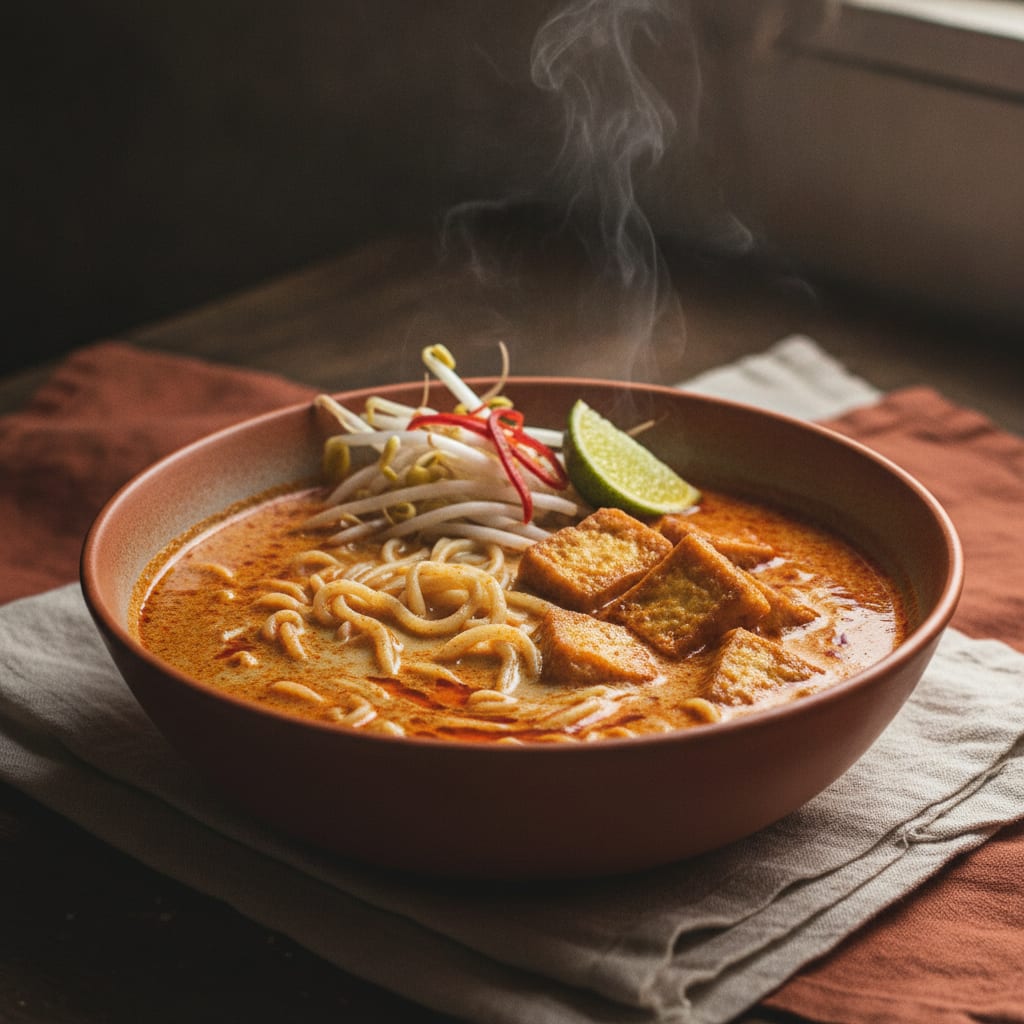
Peranakan curry laksa: a toasted rempah loosened with coconut milk, tofu puffs that drink the broth, rice noodles, bean sprouts and a lime-and-chili lift.
- Prep
- 30 min
- Cook
- 35 min
- Total
- 1h 5min
- Servings
- 4
- Difficulty
- Medium
Getting ready…
Ingredients
For 4 servings · 21 items
For the rempah (spice paste)
For the broth
To serve
Method
6 steps · check as you go
- →
Serve
Serve in deep bowls, very hot, with extra lime wedges, sliced fresh chili, and a spoonful of sambal on the side for those who want more heat. Laksa is eaten with both chopsticks and a spoon — chopsticks for the noodles and tofu puffs, spoon for the broth. Squeeze the lime in just before eating. A cold drink and plenty of napkins.
The story
Laksa found me in Washington, in the autumn of 2025, in the food court at Eden Center out in Falls Church — that loud, fluorescent warren of Vietnamese and Malaysian stalls where the menus are photographs and the broth is the whole argument. I had come for pho and ended up at a laksa counter run by a Malaysian woman who watched me wince at the first spoonful of chili and slid a lime wedge across the counter without a word. Squeeze, she said. The sourness cut straight through the coconut richness and the bowl came alive. Later, when it was quiet, she showed me her pot of rempah and the dark slick of red oil pooling at its edge. You fry until it cracks, she said. Then you have laksa. Before that, you have nothing.
The word laksa covers a family that splits down one great line. There is asam laksa — Penang’s sour, coconut-free, tamarind-and-fish broth, sharp enough to make your jaw ache. And there is laksa lemak, also called curry laksa or nyonya laksa: the rich, creamy, coconut version born in the Peranakan kitchens of Penang, Melaka, and Singapore, where Chinese and Malay cooking married. Lemak means rich, fatty. This is that one.
This curry laksa has no shrimp paste and no fish. It has white miso folded into the rempah for the fermented depth belacan would give, tofu puffs as the flavor sponges, and a vegetable stock under the coconut. It is not a “vegetable version” of laksa. It is curry laksa — the cracked rempah, the creamy coconut, the lime lift, all intact.
À la maison
The weeknight reading is the recipe above, and it asks for one act of patience: frying the rempah until the oil cracks. That is eight to twelve minutes of near-constant stirring, and it is not optional — it is the difference between a deep, married broth and a raw, harsh one. After that the dish is forgiving: simmer the stock, stir in the coconut gently (never a hard boil, or it splits), drop in the tofu puffs to drink the broth, and finish with lime off the heat. Assemble in the bowl, noodles and sprouts cool, hot broth poured over.
Au bistrot
The bistronomique reading keeps the cracked rempah and coconut broth but refines the bowl into a composed, layered course.
Make the broth richer and cleaner: after simmering, pass it through a fine sieve so it is silky rather than rustic, then enrich it with a spoon of coconut cream whisked in off the heat for a glossy, unified body. Fry a separate chili oil from the reserved rempah oil to drizzle in a deliberate ring on the surface. Treat the tofu puffs as a feature — split, gently pressed of excess broth, and arranged rather than scattered. Build the bowl with intention: a tidy nest of noodles set to one side, the tofu puffs leaned against it, blanched bean sprouts in a small deliberate pile, then the silky broth poured tableside so the steam rises. Finish with a single perfect coriander sprig, a few rings of red chili laid in a line, a brush of the chili oil, and a lime wedge balanced on the rim. Same dish, plated as a course.
Le dressage — Three-quarter, low. Deep dark bowl, the broth a glossy orange-red poured tableside. Noodle nest to one side, tofu puffs leaned against it, a clean line of chili rings, a single coriander sprig, a ring of chili oil on the surface. Steam, warm light, lime on the rim. The plate should say a street bowl, composed — abundance disciplined into one deliberate read.
What the other recipes get wrong
Most no-seafood laksa recipes online — I read the top ten in May 2026 — make two mistakes: they rush or skip the rempah fry, dumping the raw paste straight into liquid, and they boil the coconut milk hard to “thicken” it. Both wreck the dish. I ran the test over a week in my Washington kitchen in May 2026: three pots, identical rempah, identical noodles and tofu puffs, only the rempah fry and the coconut handling changed.
- Raw rempah straight into stock, coconut boiled hard: harsh and thin. The broth tasted of raw shallot and sharp chili with a metallic edge, and the coconut had split into greasy beads floating on a watery base.
- Rempah fried 4 minutes, coconut simmered gently: better, but the broth still carried a raw vegetal sharpness underneath, and the depth was shallow — the aromatics hadn’t fully bloomed.
- Rempah fried 10 minutes until the oil cracked, coconut simmered gently: this was laksa. Deep, rounded, the chili heat married into the coconut richness, the broth creamy and unified, a red slick of bloomed oil on top.
The reasons are technique and chemistry. The long rempah fry — pecah minyak, cracking the oil — does two things: it cooks the raw, harsh volatiles out of the shallot, garlic, and chili, and it blooms the fat-soluble flavor compounds (the capsaicin, the curcumin in turmeric, the aromatic oils of lemongrass and galangal) into the cooking oil, where they dissolve and carry through the whole broth. You can see it finish when the oil separates and pools red at the edges. On the coconut side: coconut milk is an oil-in-water emulsion stabilized by coconut proteins, and a hard boil shears that emulsion apart — the fat coalesces into greasy droplets and the water thins out. Held at a gentle simmer, the emulsion stays intact and the broth stays creamy. Rush the rempah and you taste raw. Boil the coconut and you taste broken. Get both right and you get laksa.
The line I draw
I will not boil the coconut milk hard, not to speed it up and not to thicken it. The whole pleasure of curry laksa is a broth that is creamy and unified — coconut fat and spiced stock held together in one rich, glossy body. The moment it reaches a hard rolling boil, the emulsion shears: the fat breaks out into greasy beads, the liquid thins and goes watery, and the bowl looks and tastes split. There is no thickening a broken coconut broth back to silk by boiling it harder — boiling is what broke it. Coconut goes in at the end, the broth stays at a gentle simmer, and the lime goes in off the heat. Patience over the pot, every time.
When this can fail
Three ways, all from my own kitchen between 2022 and 2026:
- The raw, harsh broth. Dumped the rempah straight into the stock without frying it, in a hurry. The laksa tasted of raw onion and sharp chili with no depth, and no amount of simmering fixed it. Fix: fry the rempah patiently in oil for eight to twelve minutes until it darkens and the oil cracks and pools red before any liquid goes in.
- The split coconut. Let the broth come to a hard boil after the coconut milk went in, to reduce it faster. It separated into greasy curds and watery liquid. Fix: keep the broth at a bare simmer once the coconut is in, never a rolling boil, and stir off the heat to bring it back if it starts to break.
- The flat, cloying bowl. Cooked the lime juice into the broth early, so its acidity went dull, and the rich coconut sat heavy with nothing to cut it. Fix: stir the lime in off the heat at the very end, and serve extra wedges so each eater can lift their own bowl.
FAQ
QWhat is the difference between curry laksa and asam laksa?
They are two distinct dishes that share a name. Curry laksa — also called laksa lemak ('lemak' means rich or fatty) or nyonya laksa — is the creamy, coconut-milk-based version from the Peranakan communities of Penang, Melaka, and Singapore, built on a fried rempah spice paste. Asam laksa is the Penang sour version: no coconut at all, a tamarind-based ('asam' means sour) fish broth, tangy and sharp. This recipe is curry laksa — the rich, coconut, rempah-driven style.
QWhat is rempah and why fry it so long?
Rempah is the foundational spice paste of Malaysian and Peranakan cooking — chilies, shallots, garlic, lemongrass, galangal, ginger, turmeric, and candlenuts ground smooth. It must be fried patiently in oil, 8 to 12 minutes, until it darkens and the oil separates and pools red at the edges. Cooks call this 'cracking the oil' (pecah minyak). The long fry cooks out the raw, sharp edge of the aromatics and blooms their fat-soluble flavor compounds into the oil. Skip or rush it and the whole laksa tastes raw and harsh.
QCan you make laksa without shrimp paste or fish?
Yes. Laksa is defined by its fried rempah, its coconut broth, its tofu puffs and noodles, and the salty-sour-sweet balance — not specifically by belacan (shrimp paste) or fish. White miso in the rempah supplies the fermented, savory umami depth that belacan provides, and a good vegetable stock carries the body. The tofu puffs soak up the spiced broth as the dish's flavor sponges. Everything that makes curry laksa curry laksa — the cracked rempah, the creamy coconut, the lime lift — is present.
QWhy does my laksa broth split or look greasy?
Coconut milk is an emulsion of fat and water held together by coconut proteins, and a hard rolling boil shears that emulsion apart into greasy fat and thin watery liquid. Once the coconut milk goes in, keep the broth at a gentle simmer and never let it boil hard. Stir occasionally. If it does start to split, take it off the heat and whisk it back together, or add a splash of cold stock. A small amount of oil pooling on the surface from the rempah is normal and desirable — that is different from a broken broth.
QWhat are tofu puffs and what do they do in laksa?
Tofu puffs are cubes of tofu deep-fried until they balloon into light, golden, hollow pillows with a spongy interior. In laksa they are the perfect vessel: their open structure soaks up the spiced coconut broth, so each one bursts with flavor when you bite it. They are sold ready-made in the refrigerated or frozen section of Asian groceries. Halve them so they drink up more broth. If you can't find them, fried firm tofu is a fair stand-in, though it won't soak quite as dramatically.