Tang-fried, the dry way.
Karaage.
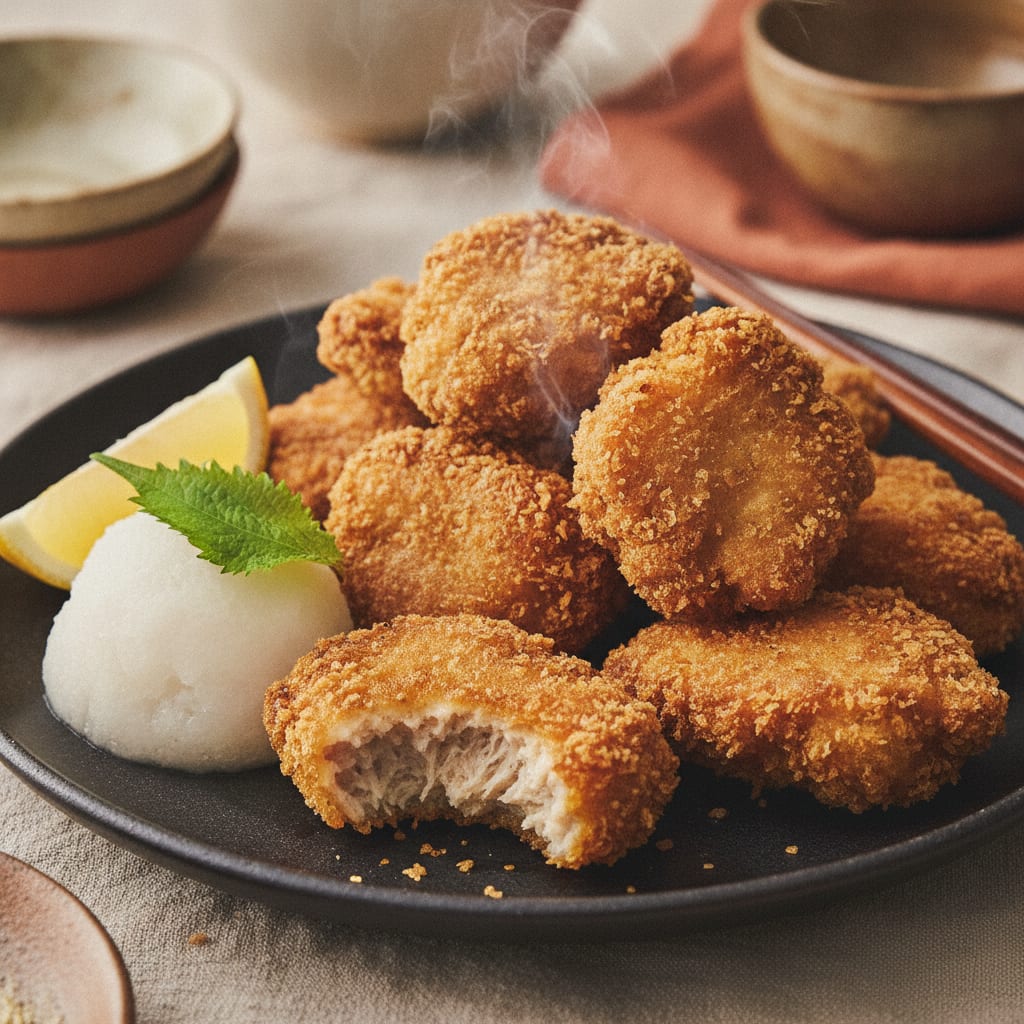
Japanese fried karaage, two ways: cauliflower and king oyster in a soy-ginger-garlic marinade, a katakuriko potato-starch crust, double-fried crisp.
- Prep
- 30 min
- Cook
- 20 min
- Total
- 50 min
- Servings
- 4
- Difficulty
- Medium
Getting ready…
Ingredients
For 4 servings · 14 items
For the pieces
For the marinade
For the crust
For frying
To serve
Method
6 steps · check as you go
- →
Serve
Serve immediately, piled high and steaming, with lemon wedges and grated daikon on the side and a little vegan Kewpie-style mayo for dipping if you like. Karaage is an izakaya dish — eat it hot with cold beer, squeezing the lemon over each piece just before it goes in. The crust is at its best in the first five minutes.
The story
Friday nights at Tetsu’s counter in Sapporo meant karaage. Not on the menu — there was no menu, eight seats and whatever Tetsu felt like — but the regulars who came in after work expected it, and in the autumn of 2020 he handed the job to me. The first batch I made was a disaster: I had marinated the pieces an hour, dredged them in plain flour, fried them once, and served up something pale, soft and soggy that he ate one bite of, set down, and corrected without a word of English. He pointed at the soy bowl: fifteen minutes. He pointed at the bag of katakuriko, not the flour. He held up two fingers: fry twice. Then he made a batch beside mine, and the difference was the whole lesson — his crust shattered, mine slumped.
The name carries its own argument. Most people write it 唐揚げ — kara meaning Tang, after the Chinese frying technique that came to Japan with envoys in the Nara period, age meaning fry. But there is an older, drier reading, 空揚げ, “empty frying” — fried with no wet batter, just a thin dry coat. Both point at the same craft: a lightly-dressed dry fry, not a battered one. By the Genroku period, the late 1600s, the word was already in cookbooks, though it then meant any fried thing — tofu, vegetables, meat — not the chicken it later became.
This karaage has no chicken in it. It has cauliflower and torn king oyster mushroom, a soy-ginger-garlic marinade, a heavy coat of potato starch, and a double fry. It is not a “version” of karaage. It is karaage — Tang-fried, the dry way, made with what is in my hands now.
À la maison
The weeknight reading is the recipe above, and Tetsu’s three corrections are the whole recipe. Marinate fifteen minutes, not an hour, so the pieces are seasoned but not waterlogged. Use potato starch, never flour, because the crust depends on it. And fry twice — cooler first to cook through, hotter second to shatter. Tear the king oyster instead of slicing it so the ragged edges grab the starch, and par-steam the cauliflower so the inside is tender when the crust is done. Squeeze the lemon at the table, not in the kitchen, so the crust stays crisp to the last bite.
Au bistrot
The bistronomique reading treats karaage as a plated izakaya course rather than a heaped bowl.
I keep the pieces a touch smaller and more uniform so they fry evenly and sit precisely, and I build the plate around the cut between rich and sharp. The grated daikon becomes a proper mizore — finely grated, lightly squeezed, dressed with a few drops of ponzu — and goes down as a cool, glistening base on one side of the plate. The karaage is stacked just three or four pieces high, craggy side up, so the blistered crust catches the light. A brushstroke of karashi-spiked aioli runs underneath. Where the lemon wedge would go, I make a fine yuzu or lemon gel and dot it, so the acid is placed exactly rather than squeezed loose. A single fried shiso leaf, translucent and crisp, leans against the stack, and a scatter of toasted sesame and micro shiso finishes it. The richness, the crust, the soy-ginger depth, the bright acid to cut it — all the karaage elements, set down with the restraint of a plated course.
Mori-tsuke — Three-quarter, slightly above. Dark matte plate, three or four karaage pieces stacked craggy-side up to catch a hard side light, the blistered crust the hero. A cool mound of dressed grated daikon, a dot of yuzu gel, a single crisp shiso leaf. Negative space. The plate should say one precise read of an izakaya snack, not a pile.
What the other recipes get wrong
Most plant-based karaage recipes online — I read the top ten in March 2026 — reach for a wet batter or a plain-flour dredge, and they fry once. They are making fritters and calling them karaage. So I ran the test: nine batches over a long weekend in March 2026, same cauliflower and king oyster, same marinade, same oil, changing only the coating and the number of fries.
- Plain flour, single fry: pale, bready, soft within two minutes. It tasted of fried dough over vegetable, not karaage. The crust went limp before it reached the plate.
- Cornflour, single fry: thin and patchy — much of the coating simply dissolved into the oil, leaving bald spots and a fine, fragile shell that wept the moment it sat.
- Potato starch, double fry: deeply craggy, glassy, blistered, and still shattering crisp twenty minutes later. The torn mushroom edges held lace-like shards of crust; the cauliflower stayed tender inside. This was it, and it was not close.
The reason is in the starch granule. Potato starch has large granules and a high amylopectin-to-amylose ratio; hydrated by the damp marinade into a clingy paste, it sets in the oil into a rigid, glassy, blistered crust that resists going soft even when it later meets moisture. Cornflour’s granules are so fine they slough off and dissolve before they can set. Plain flour brings gluten, which makes a softer, breadier coating that traps steam and goes limp. The double fry then does what a single fry can’t: the cooler pass cooks the core and sets the shell, the rest dries the surface, and the hotter pass drives off the last moisture and locks the crust rigid. Across all nine, potato starch plus a double fry shattered every time. The other combinations sogged every time.
The line I draw
I will not coat karaage in flour, and I will not fry it once. The crust is the entire identity of the dish — that craggy, glassy, shattering shell is what makes karaage karaage and not a fritter. Flour brings gluten and a soft, bready coat that goes limp before it reaches the table; a single fry either burns the outside or leaves the crust pale and weak. Potato starch and a double fry are not refinements you can skip when you’re in a hurry — they are the dish. Use the katakuriko, fry it cool, rest it, fry it hot. The moment you reach for the flour bag and fry it once, you have made something fried, but you have not made karaage.
When this can fail
Three ways, all from my own kitchen between 2022 and 2026:
- The soggy crust. Marinated the pieces a full hour because I thought more was better; they came out waterlogged, the starch turned to gum, and the crust never crisped. Fix: fifteen to twenty minutes only, then drain the pieces so they are damp, not dripping, before dredging.
- The bald patches. Dredged the pieces while they were still wet from the marinade and the starch clumped and slid off in the oil, leaving naked spots. Fix: let the marinade drip off first, press the potato starch on firmly, and let the coated pieces sit five minutes so the starch hydrates into a clinging paste before they fry.
- The raw centre, burnt shell. Tried to do it in one hot fry to save time; the crust browned hard while the cauliflower was still chalky inside. Fix: two fries — a cooler 160°C pass to cook through, a rest, then a 190°C pass to crisp. There is no shortcut past the double fry.
FAQ
QWhat does karaage mean?
Karaage is written 唐揚げ — kara (Tang) plus age (frying) — a nod to the Tang-dynasty Chinese frying technique that reached Japan via envoys in the Nara period. But the Japan Fried Food Association argues the older, more accurate writing is 空揚げ, 'empty frying' — meaning fried dry, without a wet batter. Both readings point at the same thing: a lightly-coated, dry fry rather than a battered one. Records from the late-17th-century Genroku period mention karaage, though back then it meant all sorts of fried foods — vegetables, tofu, meat — not specifically chicken.
QWhy use potato starch instead of flour for karaage?
Potato starch (katakuriko) is the traditional karaage coating and it makes a crust nothing else matches. Its granules are much larger than cornflour's, and it has a high ratio of amylopectin, which sets into a glassy, blistered, lace-like crust that stays crisp and shatters when you bite it. Flour makes a softer, breadier coating; cornflour is so fine it can dissolve into the oil. For the craggy, shattering karaage crust, use potato starch.
QWhat can I use instead of chicken for karaage?
Cauliflower and king oyster mushroom together give you both textures karaage wants. Cauliflower par-steamed and fried has a tender, juicy interior under the crust; king oyster torn into chunks has the dense, fibrous, almost meaty chew, and its ragged torn edges grab the potato starch for an extra-craggy crust. The marinade — soy, sake, ginger, garlic — is what makes it read as karaage, and it seasons both equally well.
QWhy double-fry karaage?
A cooler first fry (160°C) cooks the interior and sets the crust without burning it; a short rest lets steam escape and the surface dry; then a hotter second fry (190°C) drives off the last surface moisture and pushes the crust to a deep, blistered crisp. A single fry either burns the outside before the inside is done or leaves the crust pale and soft. The double fry is the difference between karaage that shatters and karaage that sogs.
QHow long should I marinate karaage?
Fifteen to twenty minutes, no longer. The marinade is the soul of karaage, but cauliflower and mushroom are porous and a long soak leaves them too wet to crisp and too salty to enjoy. A short marinade seasons them through while keeping the surface dry enough to take the starch and fry up crisp. Drain off the excess before dredging so the pieces are damp, not dripping.