Yesterday's curry, today's bowl.
Curry udon.
Curry-dashi udon, two ways: leftover Japanese curry loosened with mushroom dashi, brought back to a silky coat with a starch slurry, over thick chewy udon.
- Prep
- 15 min
- Cook
- 25 min
- Total
- 40 min
- Servings
- 4
- Difficulty
- Easy
Getting ready…
Ingredients
For 4 servings · 13 items
For the broth
For the broth (if no leftover curry)
For the slurry
For the bowl
Method
5 steps · check as you go
- →
Serve
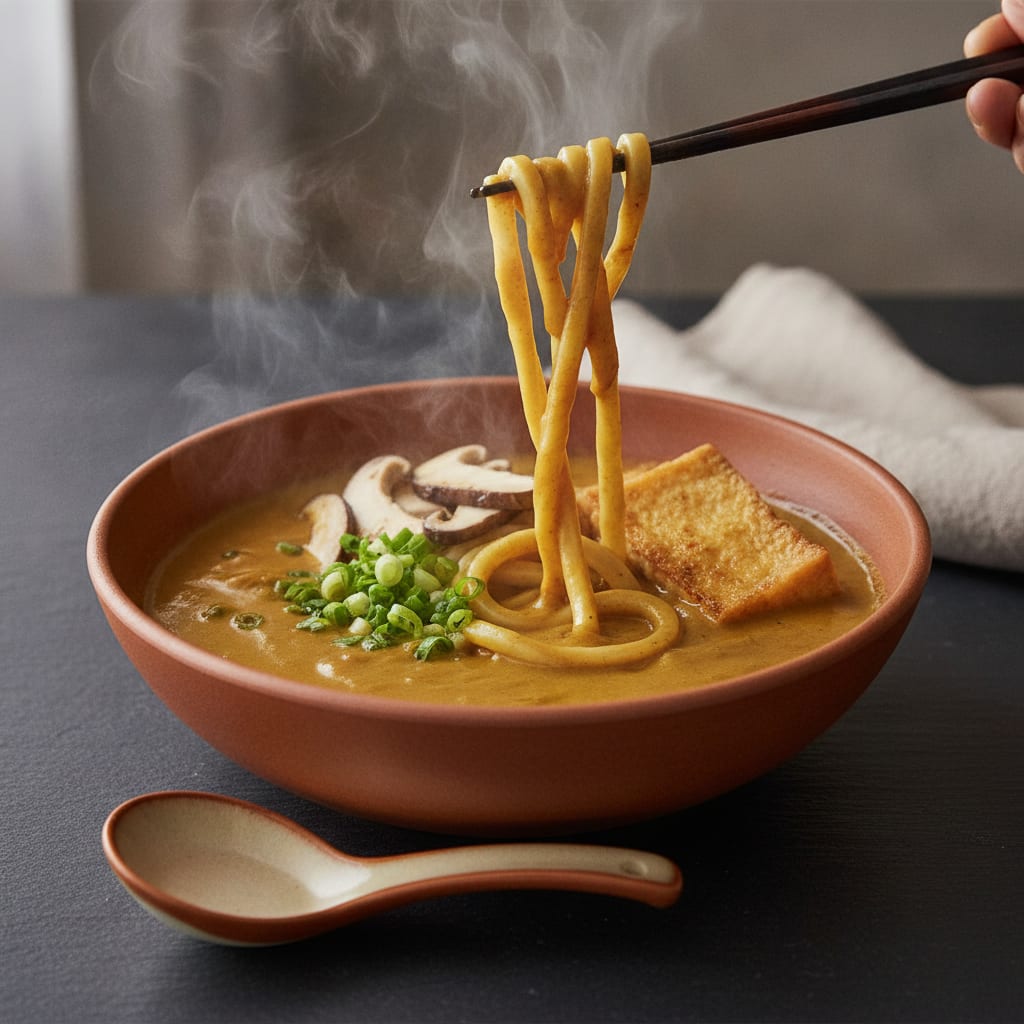
Serve scalding in deep bowls, the thick curry-dashi clinging to fat udon, king oyster and fried tofu under a scatter of bias-cut scallion. A pinch of shichimi togarashi on top if you like heat. Eat fast and lean over the bowl — curry udon famously splatters. A spoon for the broth, chopsticks for the noodles. No bread.
The story
Curry udon was the staff meal that came after the curry. Tetsu made a big pot of kare on a slow afternoon, and a day or two later, when there was a little left clinging to the sides, he would not throw it out — he loosened it with a ladle of dashi from the urn that always sat warm at the back of the Sapporo counter, dropped in a slurry to bring back the gloss, and poured it over fat udon for whoever was working. It was never on the menu. It was the cook’s lunch. One slushy afternoon in December 2020, the Susukino streets grey with melting snow, he handed me a bowl of it and warned me, deadpan, not to lean back — curry udon splatters, and he’d seen it ruin more than one clean apron. He was right. I wore the evidence through service.
Curry udon has a birthplace and a date. It was created around 1904 at a soba shop called Sanchōan, near Waseda University in Tokyo, which married its house dashi to the flavours of the curry rice then sweeping the city. The home version came later and simpler: yesterday’s curry, thinned with dashi, thickened back with starch, over thick noodles. That thrift is the dish.
This curry udon has no meat in it. It uses leftover curry japonais — or a quick from-scratch roux — loosened with a kombu-and-shiitake dashi, king oyster and fried tofu for the topping, and a starch slurry for the cling. The method is unchanged. It is not a “vegetable version” of curry udon. It is curry udon, made with what is in my hands now.
À la maison
The weeknight reading is the recipe above, and it is genuinely a fifteen-minute bowl if you have leftover curry from the curry japonais recipe — which is exactly the point. Whisk the thick leftover curry into mushroom dashi until it’s a pourable, slurpable broth; if you have none, a quick five-minute roux of butter, flour and curry powder stands in. The only technique to respect is the slurry: whisk cornstarch into cold water and stream it into the simmering broth, stirring, until it turns glossy and just coats a spoon — silky, never gluey. Cook the fat udon in its own pot so it stays springy and doesn’t cloud the broth. Eat it the second it’s built, leaning well over the bowl.
Au bistrot
The bistronomique reading keeps the curry-dashi and the thick noodle but composes the bowl with the precision of a soba course.
I build the broth from scratch rather than from leftovers, so I can control it: a clean kombu-and-shiitake dashi, curry oil bloomed slowly from the spice powder in fat and strained bright, the two married and brought to a glossy coat with a fine potato-starch slurry mounted to a lacquer sheen — a curry ankake rather than a thinned stew. The udon I make by hand, or at least cook precisely and shock cold and reheat so the bite is exact and elastic. The toppings become deliberate: a king oyster steak seared and lacquered in reduced curry; crisp-fried aburaage cut into neat triangles; a tempura element — a single perfect maitake fritter, or a shiso leaf fried lace-thin — set across the rim so it stays crisp above the broth. A nest of udon lifted and curled in the bowl, the glossy ankake poured around it, a brushstroke of curry oil on the surface, blanched scallion and a few threads of fine red pickle. The bowl is still the splattering cook’s lunch at heart — that honesty matters — but every element is placed and the broth is mirror-glossy.
Mori-tsuke — Three-quarter, low, shot into the steam. A wide dark stoneware bowl, ochre ankake broth with a mirror sheen. A curled nest of fat udon, a lacquered king oyster steak, a single crisp tempura element on the rim catching the side light. A brushstroke of curry oil, fine scallion, red pickle. The plate should say thrift made deliberate — a staff-meal bowl plated like a course.
What the other recipes get wrong
Most curry udon recipes online — I read the top ten in March 2026 — either pour straight leftover curry over noodles with no dashi at all, or thin it with dashi and stop, serving a loose, watery bowl. Both miss the texture that defines the dish. I ran the test over a week in March 2026, in my Washington kitchen, four bowls, same leftover curry and same udon, changing only how the broth was built and bound:
- Leftover curry poured straight over udon, no dashi: gloopy, heavy, pasty. It coated the noodles like a sauce, not a soup — you couldn’t slurp it, and the flavour was flat and over-concentrated with nothing to lift it.
- Curry thinned with dashi, no slurry: now it was a proper layered broth, but loose and watery; it ran straight off the noodles and pooled at the bottom, so each bite carried almost no soup.
- Curry thinned with dashi, then bound with a cornstarch slurry: glossy, silky, clinging — a broth thin enough to drink but thick enough to coat the fat udon so every slurp carried soup. This was curry udon. It was not close.
The reason is starch behaviour. Diluting the thick curry with dashi is what makes it a drinkable, layered soup instead of a pasty sauce — but it also drops it below the viscosity that lets a broth cling to a fat noodle. A cornstarch slurry, streamed in off a hard boil and stirred, gelatinizes evenly into a clear, glossy bind that re-thickens the soup to that exact clinging point without adding more roux or fat to weigh it down. Dumped in cold or boiled hard, the same starch clumps or breaks. The dashi gives the depth, the dilution gives the slurp, the slurry gives the cling — pull any one and the bowl is gloopy, watery, or flat. Across all four bowls, the dashi-thinned, slurry-bound broth won every time. The slurry is not a garnish-thickener. It is the texture of the dish.
The line I draw
I will not pour thick leftover curry straight over noodles and call it curry udon. The dish is not curry-as-sauce on udon — it is a curry-flavoured broth, thinned with dashi to drink and re-bound with starch to cling. Skip the dashi and you get a pasty, over-concentrated gloop that sits on the noodles; skip the slurry and you get a thin watery soup that runs off them. Curry udon lives in the narrow band between those two failures: a broth silky enough to coat the fat udon yet loose enough to slurp. The dashi and the slurry both go in, every time. There is no version worth serving that leaves either out.
When this can fail
Three ways, all from my own kitchen between 2022 and 2026:
- The gloopy bowl. Poured leftover curry straight over the udon without dashi; it coated the noodles like paste, too thick and concentrated to slurp. Fix: always thin the leftover curry with mushroom dashi into a pourable broth first, then re-thicken with the slurry to a clinging — not pasty — coat.
- The clumped slurry. Tipped the cornstarch in dry, or into a hard boil; it seized into gummy lumps that never dissolved. Fix: whisk the cornstarch into cold water first, then stream it slowly into a gentle simmer while stirring, and cook one minute to set it glossy and smooth.
- The bloated noodles. Boiled the udon in the broth to save a pot; they soaked it up, swelled to mush, and clouded the glossy curry-dashi to a thin paste. Fix: cook the udon in a separate pot of unsalted water, drain it well, and ladle the broth over at the last second — then eat it fast, before it swells.
FAQ
QWhat is curry udon and where did it come from?
Curry udon is thick udon noodles in a curry-flavoured dashi broth. It was created around 1904 in Tokyo, near Waseda University, at a soba shop called Sanchōan, which married its house dashi to the flavours of the then-fashionable curry rice to win back business lost to new Western-style restaurants. It was first called 'curry nanban,' after the scallion in it. Two styles coexist today: a restaurant version built on fresh dashi and curry powder, and the home version — leftover Japanese curry loosened with dashi the next day. This recipe takes the home route.
QHow do you turn leftover Japanese curry into curry udon?
Thin it with dashi, then re-thicken with starch. Leftover curry is gravy-thick — almost a sauce — so you whisk it together with mushroom dashi into a pourable, slurpable broth, season with soy and mirin, then bring it back to a silky, clinging texture with a cornstarch slurry. The dashi keeps it from tasting like watered-down curry; the slurry restores the cling that lets the broth coat the thick noodles. It is one of the best uses for yesterday's curry.
QWhy thicken curry udon with a starch slurry?
Because thinning the curry with dashi makes it drinkable but also loosens it, and curry udon's whole character is a broth thick enough to half-cling to the fat noodles. A cornstarch slurry re-thickens it cleanly, without adding more roux or fat that would make it heavy. Add the slurry slowly in a thin stream while stirring, off a hard boil, so it sets glossy and smooth rather than clumping. One minute of simmering cooks out the raw starch.
QWhat noodles are right for curry udon?
Thick, fat, chewy udon — frozen sanuki-style udon is ideal, with its springy bite. The heft of the noodle stands up to the rich, spiced broth and the thick curry-dashi clings to its surface so each slurp carries soup. Thin noodles get lost in this bowl. Cook the udon in a separate pot of unsalted water and drain it well before adding the broth, so its starch doesn't cloud and thin the glossy curry-dashi.
QWhy does curry udon splatter, and how do I eat it?
The broth is thick, clinging, and deeply coloured, so slurping the fat noodles flicks it everywhere — in Japan it is half-joked that you don't wear white to eat curry udon. Eat it leaning well over the bowl, lift the noodles low and short, and use the renge spoon for the broth. Serve and eat it immediately too: left to sit, the udon drinks the broth and swells, and the glossy soup turns to paste.