No lettuce. Ever..
Horiatiki.
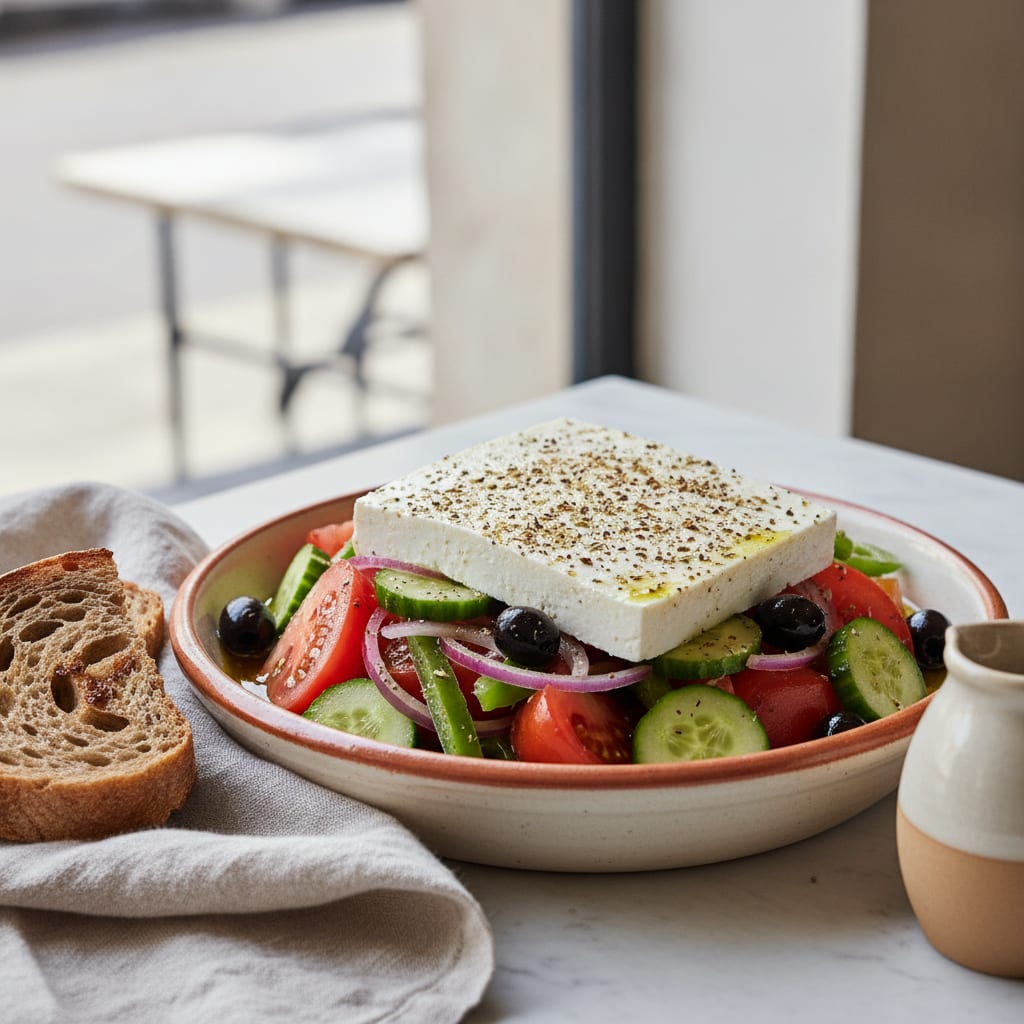
The real Greek village salad, two ways: no lettuce, ripe tomato in wedges, cucumber, onion, olives and a slab of marinated almond curd, dried oregano, good oil.
- Prep
- 15 min
- Cook
- 0 min
- Total
- 15 min
- Servings
- 4
- Difficulty
- Easy
Getting ready…
Ingredients
For 4 servings · 15 items
For the marinated curd (make ahead)
For the salad
To dress
Method
5 steps · check as you go
- →
Serve
Serve at room temperature, the curd slab whole on top, dusted with oregano, with crusty bread to mop the tomato-and-oil juices at the bottom of the bowl — the best part, the part Greeks fight over. No lettuce, no fridge-cold tomatoes, no thick dressing. A glass of cold retsina or an ouzo with water on the side.
The story
Athens, June 2017. I had been at Eleni’s a few weeks when she caught me shredding a head of lettuce into the bottom of a bowl, the way I’d plated a hundred “Greek salads” in France, and she stopped dead in the doorway. She didn’t shout. She just took the bowl, tipped the lettuce into the bin, and said, “We are not a hotel.” Then she showed me how it was actually done: tomatoes torn into wedges over the bowl to keep the juice, cucumber in fat half-moons, onion, pepper, olives with their stones still in, a slab of feta laid whole across the top and dusted heavy with oregano, and oil — a lot of oil — and nothing else. No vinaigrette. No lettuce. No fork-and-knife daintiness.
Her tomatoes never saw the fridge. They sat in a wooden crate by the back door, and she’d press a thumb to one before she cut it, the way you’d test a peach. “Cold tomato is a dead tomato,” she said. The whole dish, in her hands, was an argument that good ingredients at the right temperature need almost nothing done to them — that the cook’s job here is restraint, and the bread at the bottom of the bowl, soaked in tomato juice and oil, is the reward for getting out of the way.
Horiatiki means of the village — the peasant salad of whatever the garden gave, though the version with the feta slab is younger than people think. Most accounts place its modern form in Athens around 1970, when tavernas, working around government price caps on tomatoes and cucumbers, added a slab of unregulated feta to a plain tomato salad and quietly invented the dish tourists now order everywhere. This is not a vegan version of horiatiki. The tomatoes, cucumber, onion, olives, and oil were always the salad; only the slab on top stands in. It is horiatiki, built the way Eleni built it, lettuce-free and proud of it.
À la maison
The weeknight reading is the recipe above, and it is less a recipe than a set of refusals. No lettuce — the salad is tomato and cucumber. No cold tomatoes — take them out of the fridge an hour ahead and use them ripe, because cold kills their aroma. No thick dressing — good olive oil, a crush of dried oregano, flaky salt, and the tomato’s own juice are the whole dressing. And the curd goes on as a slab, on top, dusted with oregano, never crumbled and tossed through. The one thing that takes planning is the curd marinade: start it a day ahead so the salt, lemon, and miso soak all the way in.
Au bistrot
The bistronomique reading keeps every ingredient but composes the plate and sharpens each element — the same salad, read as a plated starter.
Concassé the tomatoes: skin and seed them, dice the flesh clean, and toss with salt and a little of the reserved tomato water so they stay loose and bright. Shave the cucumber into long ribbons on a mandoline and the red onion into near-translucent rings, then crisp the onion in iced water so it curls and loses its harsh edge. Whip the marinated curd with a splash of its marinade into a smooth, spoonable cream, and reserve a clean slab to crumble coarse at the end for texture and contrast. Make an oregano oil — warm good olive oil gently with a handful of dried oregano, then strain it bright green. On a wide plate, lay a swoosh of the curd cream, pile the dressed tomato concassé and cucumber ribbons off-centre, tuck in the onion curls and a few pitted, halved Kalamata olives, and finish with the coarse curd, a dusting of more oregano, and a generous pour of the oregano oil. A few croutons fried in olive oil stand in for the bread you’d have wiped the bowl with.
Le dressage — Overhead or three-quarter. A swoosh of white curd cream beneath a loose pile of glistening tomato concassé and cucumber ribbons, onion curls and halved olives tucked in, coarse curd and oregano scattered, oregano oil pooling green-gold at the edge. Wide pale plate, bright midday light. The plate should say a peasant salad has been read as a course without losing a single one of its ingredients or its restraint.
What the other recipes get wrong
Most Greek salad recipes online — I read the top ten in March 2026 — either put lettuce in it or, more quietly, tell you to crumble the feta through and dress it with a shaken vinaigrette. Both are wrong, and I wanted to know how much it mattered, so I ran the test over a week that March: I built the same salad eight ways for the same group of tasters, changing only three variables — tomato temperature, lettuce in or out, and cheese crumbled-and-tossed versus slab-on-top.
- Cold tomatoes, lettuce in, vinaigrette tossed: the “diner Greek salad.” Watery, sharp, the tomato flavourless, the whole thing tasting of dressing and nothing else.
- Room-temperature tomatoes, no lettuce, cheese crumbled and tossed: much better — but the cheese dissolved into the oil as seasoning and the salad read as uniform, with no centrepiece and no contrast.
- Room-temperature tomatoes, no lettuce, slab on top with oregano and oil: the tomatoes tasted of tomato, the oil and juice pooled into a dressing at the base, and the slab stayed creamy and distinct, a thing you broke into. Unanimous.
The reason starts with the tomato. Tomato flavour comes largely from volatile aromatic compounds, and those volatiles are temperature-dependent — chilling a tomato below roughly 12°C suppresses them, and a fridge-cold tomato genuinely tastes of less. Bring it to room temperature and the aroma returns. Lettuce, meanwhile, sheds water as it sits in salt and oil, diluting the dressing into a pale slick. And the slab-versus-crumble difference is about contrast: kept whole, the cheese holds its creamy texture and salt against the acid tomato, where crumbled it disperses into background seasoning. Across all eight bowls, the room-temperature, lettuce-free, slab-on-top build won every time, on every variable.
The line I draw
I will not put lettuce in a horiatiki. Not a handful “for bulk,” not a few leaves “to make it go further.” Horiatiki is a tomato-and-cucumber salad — that is its definition, not its preference — and lettuce does two things, both bad: it waters down the dressing as it weeps, and it signals to anyone Greek at the table that you have made the hotel-buffet version, the one Eleni tipped into the bin. The salad is ripe tomato, cucumber, onion, pepper, olives, oil, oregano, and a slab of curd. If that feels too plain, the answer is better tomatoes and better oil, not lettuce. Add the lettuce and it is no longer horiatiki; it is a sad bowl of leaves with some tomato in it.
When this can fail
Three ways, all from my own kitchen between 2022 and 2026:
- The flavourless tomatoes. Made it in January with hard, fridge-cold supermarket tomatoes and wondered why it tasted of nothing. Fix: this is a summer dish — use ripe tomatoes at room temperature, and if good tomatoes aren’t to be had, make something else and wait.
- The bland curd. Marinated the tofu for half an hour because I was rushing; the surface tasted seasoned but the centre was flat and chalky. Fix: marinate at least four hours, ideally overnight, so the salt, lemon, and miso reach the middle of the slab.
- The drowned, vinegary bowl. Whisked up a proper vinaigrette out of habit and tossed it through; the salad went sour and slick and lost the clean taste of oil and tomato. Fix: dress with good olive oil, a crush of oregano, flaky salt, and the tomato’s own juice — vinegar is optional and a splash at most.
FAQ
QDoes a real Greek salad have lettuce?
No. Horiatiki — the village salad — has no lettuce and never did. It is built on ripe tomato and cucumber, with green pepper, red onion, olives, a slab of cheese, olive oil, and dried oregano. Lettuce is the marker of a watered-down tourist version. If you see shredded lettuce under the tomatoes, you are looking at a 'Greek-style salad,' not horiatiki.
QWhere does the Greek salad come from?
The salad as we know it appears to have taken its modern form in Athens, most accounts say in Plaka, around the late 1960s or early 1970s. The common story is that taverna owners, working under government price controls on staples like tomatoes and cucumbers, added a slab of feta — which was not on the regulated list — to lift the price of a plain tomato salad. Whether or not every detail is exact, horiatiki is a relatively modern restaurant dish built on much older peasant ingredients, which is why the cheese sits on top as the 'extra' rather than being mixed in.
QWhy is the feta a slab on top and not crumbled?
Because that is how the dish is built and served in Greece. The cheese goes on whole, as a slab across the top, dusted with dried oregano and slicked with oil — the centrepiece you break into and share at the table. Crumbling it through is an American habit that turns the cheese into seasoning. On top and whole, the slab stays creamy and distinct against the tomato, and the oregano blooms on its surface in the oil.
QWhat can I use instead of feta in horiatiki?
A thick slab of firm tofu or a set almond or cashew curd, marinated. Feta's job here is three things: salt, sharp acidity, and a faint savoury funk. A day in a marinade of olive oil, white miso, lemon, vinegar, and salt gives a curd all three and lets them soak past the surface. Keep it as a slab on top, dusted with oregano, exactly as you would the cheese — the form is part of the dish.
QShould I refrigerate the tomatoes for Greek salad?
No — cold ruins the tomatoes, which are the whole point. Below about 12°C the aromatic compounds that give a tomato its flavour go dormant, and a fridge-cold tomato tastes of almost nothing. Keep your tomatoes at room temperature and use them ripe. A horiatiki lives or dies on the tomato; everything else is supporting it.