Volcanic-soil pea, silk purée.
Fava Santorini.
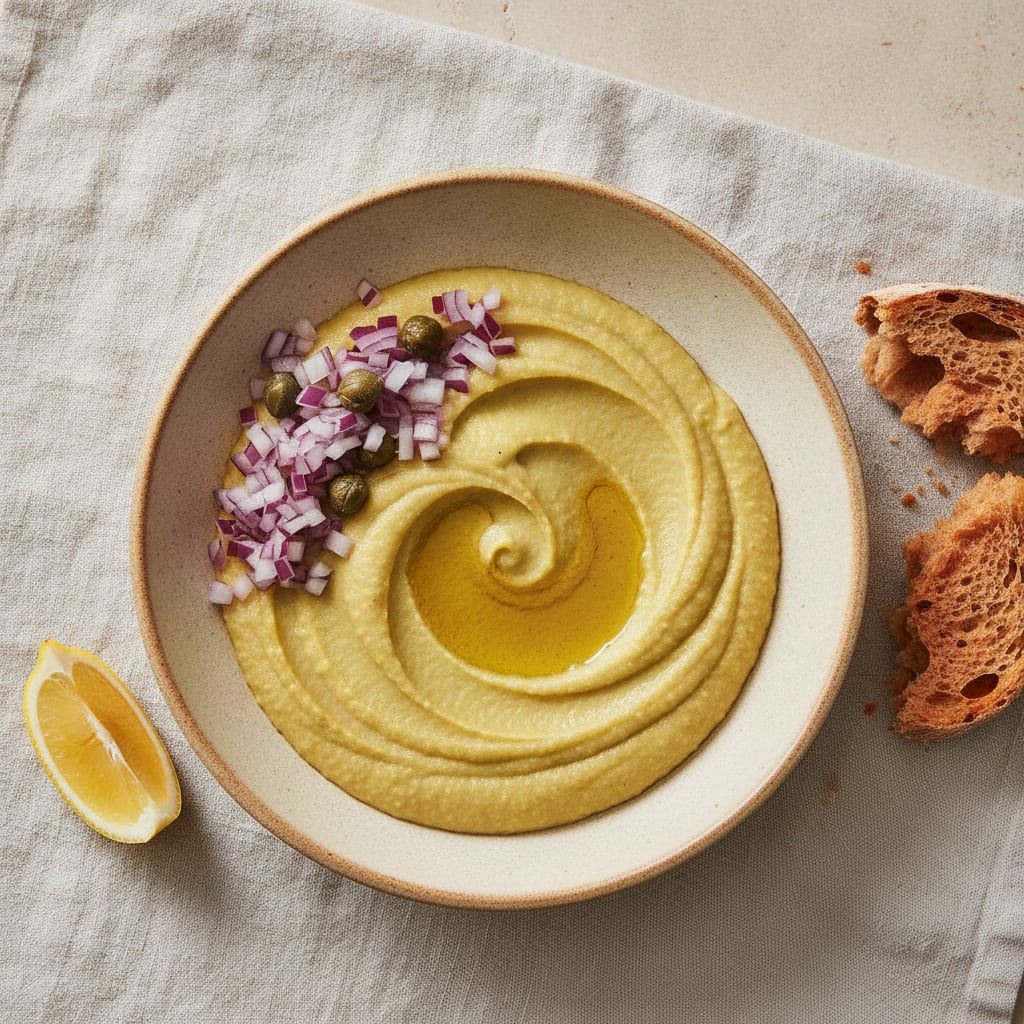
Santorini-style yellow split pea purée, two ways: a silky olive-oil mash, raw onion and capers on top, lemon to cut it, warm bread to scoop.
- Prep
- 10 min
- Cook
- 45 min
- Total
- 55 min
- Servings
- 6
- Difficulty
- Easy
Getting ready…
Ingredients
For 6 servings · 13 items
For the purée
For the topping
Method
5 steps · check as you go
- →
Serve
Serve at warm room temperature, never fridge-cold, in a shallow bowl with a pool of good olive oil, raw red onion, and capers on top, and warm bread or pita to scoop. A squeeze of lemon at the table. On Santorini it comes with everything — it's a starter, a meze, a side under grilled vegetables. Leftovers set firm in the fridge; loosen with hot water and oil and warm gently before serving.
The story
Athens, May 2017. There was a bowl of fava on the meze table at Eleni’s most days that spring, set out before service for the staff to pick at with torn bread — pale gold, a pool of green oil in the middle, raw onion and capers heaped to one side. I’d assumed, the way most people do, that fava meant fava beans. Eleni put me right with the flat patience she used for obvious things. “It’s peas. Yellow split peas. The good one comes from Santorini, from the volcano.” She said volcano like it explained everything, and it more or less does.
She had strong feelings about two things. First, that fava had to be blended properly smooth — she’d run the stick blender until I thought the motor would give out, then run it longer. “Grainy fava is lazy fava.” Second, that it was never, ever served cold. A bowl that had gone to the fridge got set out an hour before anyone touched it, or warmed gently with a splash of water and oil. Cold fava, she said, tasted of nothing and sat in your mouth like paste.
Fava is one of the oldest plant dishes in the Aegean, and it never needed making vegan — it was always split peas, oil, lemon, onion. It’s a fasting food, nistisimo, eaten through the Orthodox calendar as protein that asks nothing of an animal. The Santorini variety is a protected plant, Lathyrus clymenum, grown in volcanic soil so poor the plant has to fix its own nitrogen to survive — and milled seeds of it were dug out of the Bronze Age town of Akrotiri, buried under ash by the eruption around 1600 BCE. People on that island have been grinding this pea for three and a half thousand years. This is not a vegan dip. It’s one of the oldest things anyone in the Aegean still eats.
À la maison
The weeknight reading is the recipe above, and it’s nearly the simplest dish in this whole collection — its only demands are patience and a blender. Cook the split peas, with the onion and garlic and bay but no salt, until they completely collapse; if they still hold any shape, they won’t go silky. Then blend everything hot — peas, cooking liquid, olive oil — for a full minute, longer than feels necessary, until it’s glossy. Salt and lemon go in last. Let it rest fifteen minutes to set, then top with raw onion, capers, and a pool of oil. Serve it warm, never cold. That’s the whole thing.
Au bistrot
The bistronomique reading keeps the same silk purée as the base, and turns the raw-onion-and-capers topping into composed, contrasting components built across the plate.
Push the purée a step smoother by passing the blended fava through a fine sieve while still warm, so it’s flawless and pourable, then let it set just firm enough to hold a spoon-swoosh. Build three sharp things against its mild sweetness. First, caramelise sliced onions slow and dark in olive oil until jammy — the famous Santorini fava me koukia move — a sweet-savoury heap. Second, fried capers: drop drained capers into hot oil for a few seconds until they burst open and crisp into little salty flowers. Third, a raw element — thin slivers of red onion sharpened in lemon. Spoon a wide swoosh of the warm fava across the plate, set the dark caramelised onions in the hollow, scatter the crisp fried capers and the lemon-raw onion over, and finish with a thread of raw olive oil and a few drops of caper brine. Smooth and warm underneath, dark and sweet in the centre, crisp and salty and sharp on top.
Le dressage — Overhead, tight. A wide swoosh of pale-gold purée, dark jammy caramelised onions set in the hollow, crisp fried capers and lemon-sharp raw onion scattered across, a thread of green olive oil. Pale matte plate so the gold purée and dark onions carry. The plate should say one humble pea purée, read three ways at once — sweet, smooth, and sharp.
What the other recipes get wrong
Most fava recipes online — I read the top ten in May 2026 — blend the cooked peas with cold water or stock added afterward, and salt the peas while they cook. Both choices cost you the texture that defines fava. I ran the test over a week that May: ten batches, same peas, varying only when I salted and what I blended with.
- Salted at the start, blended with cold water added later: the peas took noticeably longer to collapse and stayed faintly grainy no matter how long I ran the blender; the cold water blended in loose and never set to a proper silk.
- Unsalted cook, but blended after cooling: smoother than the first, but the oil sat on top instead of emulsifying, and the purée was pasty rather than glossy.
- Unsalted cook, blended hot with its own starchy liquid and the olive oil, salted at the end: completely smooth, glossy, the oil fully emulsified, setting to a clean spoonable purée as it cooled.
Two bits of food science are doing the work. First, salt slows legumes from softening — sodium ions interfere with the pectin and the cell walls breaking down — so peas salted early stay firmer and grainier; salting the finished purée sidesteps that entirely. Second, the silkiness is an emulsion: blending the hot peas with their own starch-rich cooking liquid and the olive oil lets the starch and the oil bind into a smooth, stable purée, the way a hot emulsion holds where a cold one breaks. Across all ten batches, the hot-blend, late-salt method was the only one that gave Eleni’s “not lazy” silk every time. Cold water and early salt are how fava ends up pasty.
The line I draw
I will not serve fava cold. Not straight from the fridge, not “to save time,” not because a bowl of it looks set and ready. Cold fava is a different, lesser food — the olive oil congeals, the texture goes to stiff paste, and the sweet, mild flavour of the pea flattens to nothing on a cold tongue. Fava is built to be eaten at warm room temperature, oil pooling and loose, the way it sits on a Santorini meze table in the sun. If it’s been in the fridge, it comes out an hour ahead or gets gently warmed with a splash of water and oil until it loosens. Eleni warmed every chilled bowl before it left her kitchen, and cold fava is the one shortcut I’ve never once let myself take.
When this can fail
Three ways, all from my own kitchen between 2022 and 2026:
- The grainy purée. Pulled the peas off the heat while they still held a little shape, impatient; they never blended smooth, however long I ran the machine. Fix: cook them until they fully collapse into mush before you blend — if any peas are still whole, keep cooking.
- The scorched bottom. Left the pot unstirred on too high a flame; the starchy peas caught and burned, and the whole batch tasted of it. There’s no rescuing scorch. Fix: gentle simmer, partly covered, stir every few minutes, and add hot water if it thickens before they’re soft.
- The cold, claggy serve. Made it ahead, served it straight from the fridge to guests; it sat on the plate like spackle and tasted of nothing. Fix: bring it back to warm room temperature, loosened with hot water and oil, before it ever reaches the table.
FAQ
QWhat is Santorini fava made from?
Despite the name, it isn't fava (broad) beans — it's yellow split peas. Santorini fava is a specific protected variety, Lathyrus clymenum, grown only on the volcanic island of Santorini and holding EU Protected Designation of Origin status. The plant fixes its own nitrogen, which lets it survive the island's nutrient-poor volcanic soil, and it gives a purée prized for being especially smooth and sweet. Ordinary yellow split peas make an excellent everyday fava; true Santorini fava is the protected original.
QHow do you make fava smooth and not grainy?
Cook the split peas until they completely collapse into mush — if they still hold any shape, the purée will be grainy. Then blend everything hot, peas and cooking liquid together, with the olive oil, for a full minute so the oil emulsifies into the warm purée. Season with salt and lemon only at the end. Blending hot with the starchy cooking liquid is the key move; cold or under-blended, it turns pasty and rough.
QWhy shouldn't I salt the split peas while they cook?
Salt slows legumes from softening — it interferes with the breakdown of the cell walls — so split peas salted early take longer to collapse and can stay grainy. Cook them in plain water with just the onion, garlic, and bay, get them fully soft, then salt the finished purée to taste. You get a smoother result and you can judge the seasoning against the final texture rather than guessing mid-cook.
QIs Greek fava vegan?
Yes, and traditionally so. Fava is split peas, water, olive oil, lemon, onion, and capers — no animal product at all — and it's a staple fasting food (nistisimo) across the Greek Orthodox calendar, eaten through Lent and the other fasts as a protein-rich dish that needs nothing from an animal. It's one of the oldest plant dishes in the Aegean: milled Lathyrus seeds were found at Bronze Age Akrotiri on Santorini, buried by the eruption around 1600 BCE.
QWhat do you serve with fava?
Warm bread or pita to scoop is essential — fava is a dip and a spread as much as a purée. The classic Santorini topping is raw chopped onion (red or the local sun-dried onion), capers, a generous pool of olive oil, and lemon. Beyond that it's a base: spoon it under grilled or roasted vegetables, alongside other meze, or with caramelised onions piled on top, which is the famous 'fava me koukia' style. Always at warm room temperature, never cold from the fridge.