Cooked in oil, the old way.
Gemista.
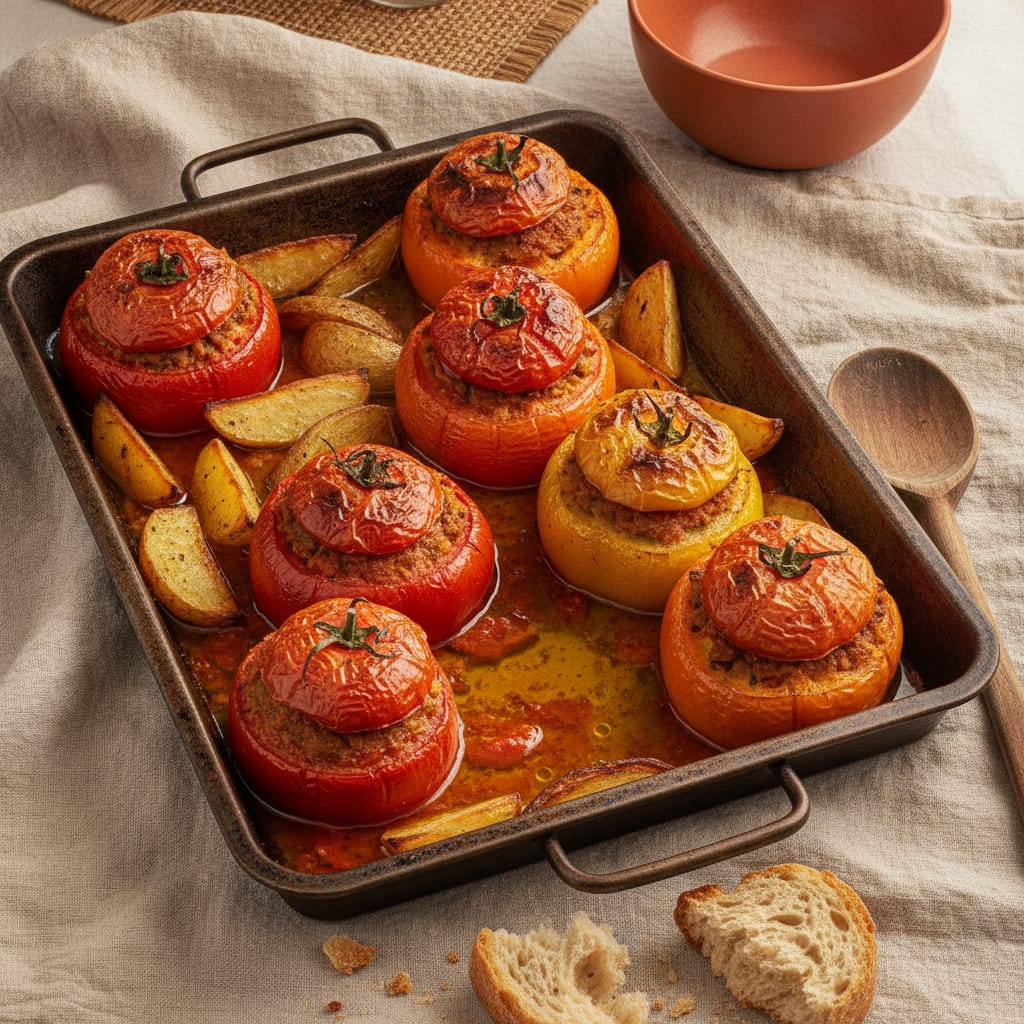
Greek rice-stuffed tomatoes and peppers baked in olive oil, two ways: herb-heavy filling, scooped-flesh sauce, potatoes wedged between to catch the juices.
- Prep
- 30 min
- Cook
- 1h 15min
- Total
- 1h 45min
- Servings
- 6
- Difficulty
- Easy
Getting ready…
Ingredients
For 6 servings · 17 items
For the vegetables
For the filling
To finish
Method
6 steps · check as you go
- →
Serve
Serve warm or at room temperature — never scalding. Spoon the tray sauce over each portion, give everyone a stuffed tomato, a pepper, and a potato wedge, and put bread on the table to wipe the plate. A wedge of lemon and, if you eat it, a slab of feta-style curd on the side. This is a whole meal; in Greece it needs nothing else but the bread.
The story
Athens, July 2017. By midsummer the heat in Plaka came up off the stone in waves, and Eleni stopped cooking anything that needed a hot pan after noon. What came out of her kitchen instead was gemista — trays of tomatoes and peppers she stuffed in the cool of the morning, baked before the worst of the day, and left to sit. She sold them at room temperature, the tops browned almost black, a slick of orange oil in the base of the tray that the regulars mopped with bread before they touched the rice. “Summer food,” she said, the way you’d state a law.
She was scornful of anyone who ate it hot. “You burn your mouth and taste nothing. Let it sit. The oil and the tomato have to find each other.” She’d press a thumb to a baked tomato to check it had slumped, then set the whole tray on the counter under a tea towel and ignore it for an hour. The first time I rushed a portion out to a tourist who wanted it steaming, she took the plate out of my hands and put it back.
Gemista is one of the oldest genuinely meat-free dishes in Greek cooking, and it didn’t get that way to please anyone modern. It’s a ladera — a dish cooked in olive oil — and a nistisimo, a fasting food eaten through the Orthodox calendar, most of all in the fortnight before the August Dormition fast, when much of Greece eats no animal products at all. Rice, herbs, pine nuts, oil. This is not a vegan version of gemista. It is gemista, the version that came first and the version Eleni baked every morning of that July.
À la maison
The weeknight reading is the recipe above, and it asks for almost no skill — only that you respect three things. Use raw rice and stuff the vegetables three-quarters full, because the rice nearly triples as it swells and will burst a packed tomato. Don’t cut the olive oil; this is a ladera, and the oil becomes the sauce. And let it rest — twenty minutes minimum, an hour if you can — because gemista is a room-temperature dish and the flavours only marry as it cools. Cover the tray to steam the rice through, then uncover to brown the tops and reduce the juices. The browned, almost-burnt caps are the prize.
Au bistrot
The bistronomique reading keeps the same filling and the same long bake, but composes a plate instead of a tray and turns the pooled oil into a proper dressing.
Stuff one tomato and one pepper per guest, but choose smaller, more even vegetables and trim their bases so they stand perfectly level. Bake them as before, then lift them out carefully. Take the rich orange tray juices — the emulsified oil and tomato — and reduce them in a pan to a glossy, spoonable sauce, finishing with a little lemon to cut the richness. Cook a few potato wedges separately so they crisp at the edges rather than steam, and crush some toasted pine nuts coarse. Plate one tomato and one pepper just off-centre, lids tilted so the rice shows, a brushstroke of the reduced sauce beneath, the crisp potato leaning in, a scatter of crushed pine nuts and torn mint across the top. The mint and a last drizzle of raw green olive oil go on at the table, so they hit the plate cold and bright against the warm, sweet rice.
Le dressage — Three-quarter, low. One stuffed tomato and one pepper standing level just off-centre, lids tilted to show the rice, a stroke of glossy reduced sauce beneath, crisp potato and crushed pine nuts alongside. Torn mint and a thread of raw olive oil over the top. Warm matte plate, soft directional light to catch the oil. The plate should say a peasant tray has been read as a course, with all its oil and sweetness intact.
What the other recipes get wrong
Most gemista recipes online — I read the top ten in March 2026 — tell you to add the rice already cooked, “to be safe,” so it doesn’t come out hard. That instruction quietly ruins the dish. I ran the test over a week that March: nine trays, identical filling and bake, only the rice treatment changed.
- Fully pre-cooked rice: mushy, swollen, with a porridge texture, and the grains tasted of the water they were boiled in, not the tomato. The filling slumped.
- Half-cooked (parboiled) rice: better, but still soft in the centre of the swell and one-note.
- Raw medium-grain rice, stirred in oil and tomato before stuffing: tender but distinct grains, each one tasting of the tomato it baked in, holding its shape under the lid.
The reason is where the water comes from. Raw rice baked inside a tomato drinks the tomato’s own juice and the oil-tomato liquid in the tray, so the starch gelatinises in flavour, not in plain water. Pre-cooked rice has already gelatinised in boiling water before it ever meets the tomato; baking it again only breaks the grains down further into starch paste. Across all nine trays, the raw-rice batches were the only ones where every grain stayed separate and carried tomato through to the centre. The trade is that raw rice needs the foil-covered steam stage and enough liquid in the tray — which is exactly what the cooked-rice shortcut is trying to avoid, and exactly what makes the dish.
The line I draw
I will not serve gemista hot from the oven. Not to a guest who’s hungry, not because it looks dramatic steaming. Gemista is a room-temperature dish by design — it’s a ladera, and the olive oil and tomato juice need to cool together into the thick, savoury sauce that is half the point. Served scalding, the oil is thin and greasy, the rice is loose and unsettled, and the herbs taste of nothing because heat has flattened them. Let it sit twenty minutes at least. Eleni took a plate back out of my hands over this, and she was right: hot gemista is gemista you can’t taste.
When this can fail
Three ways, all from my own kitchen between 2022 and 2026:
- The burst tomatoes. Packed the filling in tight to use it all up; the rice swelled and split every skin, and the filling spilled into the tray. Fix: fill to three-quarters and no more — the rice needs the empty space to grow into.
- The hard, chalky rice. Pulled the foil off too early to brown the tops, before the rice had steamed through; the centres came out crunchy. Fix: keep it covered the full 45 minutes first, check a grain, and only then uncover to brown.
- The dry, dull tray. Cut the olive oil back the first time I cooked it for someone watching their fat — no sauce formed, the tops burned instead of browning, the rice was bland. Fix: use the full amount of oil and the water in the base. This is a dish cooked in oil; the oil is not optional.
FAQ
QIs gemista vegan?
Traditionally, yes — this is one of the genuinely old vegan dishes of Greek cooking. Gemista belongs to the ladera family, dishes built on vegetables and olive oil with no meat or dairy, and it has long been a fasting dish (nistisimo), eaten especially during the fortnight before the Dormition fast in August. The rice, herbs, pine nuts, raisins, and olive oil are the classic filling. A meat version exists, but the olive-oil rice version is the original and the one most Greek families still make in summer.
QWhy is my gemista rice still hard?
Three usual causes. Not enough liquid — the rice needs the tomato pulp inside plus water or stock in the tray base to steam through. Packing the vegetables too full, so the grains have no room to swell and stay chalky in the middle. Or removing the foil too early, before the rice has steamed. Cover tightly for the first 45 minutes to cook the rice, then uncover to brown. If it's still hard, add a splash of hot water and cover again.
QShould gemista rice be cooked before stuffing?
No. The rice goes in raw, stirred through the oil and tomato so it's coated, then it cooks inside the vegetable, swelling as it drinks the tomato juice. Pre-cooked rice gives a mushy, overcooked filling because it cooks twice. Raw rice is how each grain ends up tasting of the tomato it baked in — which is the whole point of the dish.
QWhy do you put potatoes in gemista?
Two reasons, both practical. The potato wedges wedge into the gaps between the stuffed vegetables and hold them upright so they don't tip and spill. And they soak up the olive-oil-and-tomato juices that pool in the tray, juices that would otherwise reduce too far and burn. The potatoes come out soft, savoury, and slicked in sauce — for many Greeks they're the best thing on the tray.
QHow much olive oil does gemista need?
More than you think — this is a ladera dish, defined by being cooked in oil, and the oil is a flavour and a sauce, not just a cooking medium. Around 150 ml for a tray of six is right. As it bakes, the oil emulsifies with the tomato juices into the rich orange sauce you spoon over each portion and wipe up with bread. Cut the oil back hard and you get a dry, dull tray. The oil is the dish.