Stone, not steel.
Guacamole.
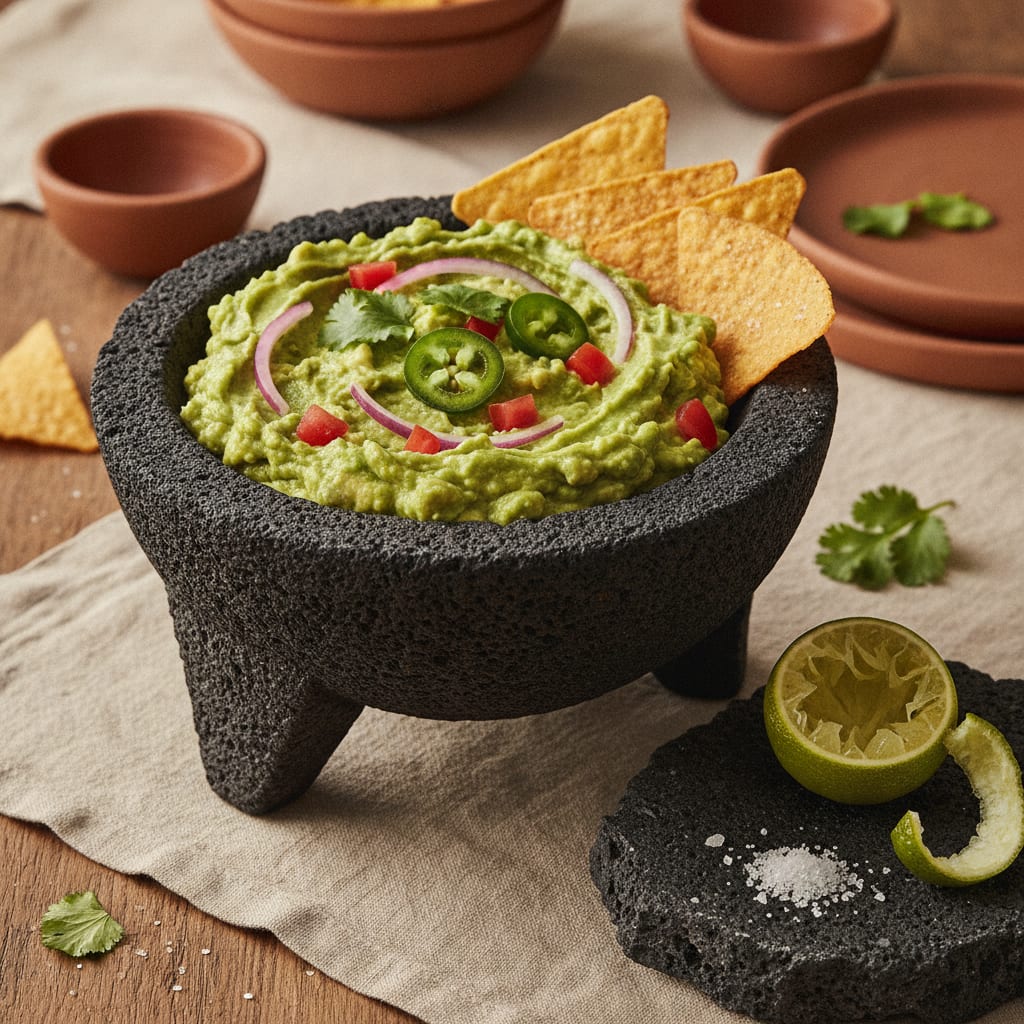
Avocado mashed coarse in a basalt molcajete with chile, onion, coriander and lime — the Aztec āhuacamōlli, texture and acid doing the work, no machine.
- Prep
- 15 min
- Cook
- 0 min
- Total
- 15 min
- Servings
- 4
- Difficulty
- Easy
Getting ready…
Ingredients
For 4 servings · 8 items
For the base paste
For the guacamole
To serve
Method
4 steps · check as you go
- →
Serve
Serve immediately, in the molcajete it was made in, with warm totopos or tortilla chips and a wedge of lime on the side. If it must wait, press cling film flat onto the surface and refrigerate no more than a couple of hours. A cold beer with lime, or a clean blanco tequila, is the table pour.
The story
Guacamole is older than its name suggests, and its name suggests it is very old. Āhuacamōlli is Classical Nahuatl — āhuacatl, avocado, plus mōlli, sauce — literally “avocado sauce,” the Aztec dish of avocado mashed in a stone bowl with chile and tomato, eaten with tortillas long before any Spaniard saw it. The conquistadors, after 1521, softened the spelling to guacamole and folded in their onion and lime. So the dish on your table is a Mexica recipe with a Spanish accent, and the bowl it is best made in — the molcajete, a tripod of porous basalt — is the same tool the Mexica used.
There is nothing to take out of guacamole. It is already avocado, chile, onion, coriander, lime — a dish that arrived plant-only and stayed that way for a thousand years. I include it here not because it needed translating but because almost everyone makes it wrong, and I made it wrong for years until a cook at a taquería counter in Washington in 2025 stopped me mid-sentence. I’d asked why hers tasted of more than mine. She didn’t answer; she pushed her molcajete across the counter, the aromatics already ground to a wet paste in the bottom, and said “primero esto” — this first. I don’t know her name. The whole secret was in the stone and the order of operations.
This is āhuacamōlli, made the way it has always been made: aromatics ground first with salt as the abrasive, avocado crushed coarse against basalt, lime for brightness and to hold the green. It is not a “vegan dip.” It never had anything in it to be vegan about. It is guacamole, made in the bowl it was invented for.
À la maison
The weeknight reading is the recipe above, and it is genuinely fifteen minutes with no cooking — but two moves separate it from the sad green paste at the back of every party. First: grind the onion, chile, coriander, and salt into a paste before the avocado goes in, so the seasoning dissolves through the whole bowl instead of sitting in lumps. Second: leave it chunky. A few firm presses against the stone, not a smooth mash. Lime at the end for taste and for green. If you have no molcajete, a heavy mortar or even a sturdy bowl and a fork will do — just keep it coarse and grind the aromatics first.
Au bistrot
The bistronomique reading keeps every element of āhuacamōlli and composes it as a plated, layered course rather than a shared bowl.
Split the avocado into two textures: pass half through the molcajete with the ground aromatics and a little oil into a silky purée, and hand-cut the other half into clean cubes dressed in lime so they hold their shape and shine. Build a quenelle or a low quenelle-and-cube stack in the centre of a cool plate: the smooth base, the cubes on top, then a fine confetti of the same red onion and chile (this time raw and bright for contrast), a brunoise of seeded tomato, micro-coriander, and a few toasted, salted pepita seeds for crunch — a nod to the seeds the Mexica ground alongside. Finish with a thread of chile oil and a grind of lime zest. Serve a single warm totopo, hand-fried and salted, balanced against the stack. Same five flavours, same coarse-and-creamy contrast, read as one composed bite.
Le dressage — Overhead, tight. Cool pale plate, a low stack of smooth avocado and bright cubes centred, confetti of red onion, chile, tomato and pepitas scattered odd-numbered, a thread of red chile oil, one warm totopo leaning in. Raking light to catch the gloss of the cubes. The plate should say an Aztec sauce, set down with restraint — ancient flavours, quiet plating.
What the other recipes get wrong
Most guacamole recipes online — I read the top ten in May 2026 — reach for the food processor “for speed,” and a few proudly mash it dead smooth. Both ruin it, and not for aesthetic reasons. I ran the test over a week in May 2026, four bowls, same ingredients in the same amounts, only the tool and the texture changed, and I checked the colour and taste at zero, one, and three hours:
- Food processor, smooth: pale, almost grey-green within the hour, whipped-looking, and noticeably flatter-tasting — air and heat had got into it. Browned fastest.
- Fork-mashed in a bowl, smooth: better than the processor but still aerated and quick to brown; the seasoning sat unevenly because the aromatics went in raw.
- Molcajete, mashed smooth: greener and cooler than the bowl, but mashing it smooth still beat in air and dulled the texture.
- Molcajete, aromatics ground first, avocado left coarse: stayed green and lush longest, tasted seasoned all the way through, and had body you could chew. Not close.
The reason is enzymes, air, and heat. Cut avocado browns when its enzyme (polyphenol oxidase) meets oxygen; anything that beats in air or warms the pulp speeds that reaction. A blender or processor does both — it whips in air and the blade friction raises the pulp’s temperature several degrees in seconds — so it browns faster and tastes flatter. Basalt, by contrast, crushes with a gentle shear that ruptures cells without aerating or heating, and grinding the salt-and-aromatic paste first means the seasoning is dissolved evenly rather than chewed in lumps. The lime is the chemical backstop: its acid lowers the pH and slows the enzyme, holding the green. Stone, coarse, lime: every bowl, greener and more seasoned than the machine.
The line I draw
I will not put avocado in a food processor to make guacamole. Not once, not “just to save time.” The machine does two things that are exactly wrong: it whips air into the pulp and it warms it with blade friction, and both of those accelerate the browning enzyme and flatten the flavour — you get a pale, fast-graying, smooth paste that is a dip, not guacamole. Guacamole has texture you can see and a green that holds because it was crushed cool against stone, not blended. If the only way you’ll make it is in a machine, make something else; this dish was built around the molcajete and it shows the moment you abandon it.
When this can fail
Three ways, all from my own kitchen between 2022 and 2026:
- The grey paste. Made it in a food processor for a crowd, ahead of time, smooth. It was grey-green and flat within the hour. Fix: crush coarse against stone (or fork-mash), keep it cool, lime it well, and make it within the hour you’ll serve it — or press film flat to the surface.
- The bland green. Stirred raw onion and chile into already-mashed avocado and under-salted it. It tasted of fat with islands of onion. Fix: grind the aromatics with the salt into a paste first so the seasoning dissolves through everything, and salt to taste.
- The grassy rock. Used under-ripe avocados because I was impatient. They wouldn’t mash and tasted green and bitter. Fix: use avocados that yield to gentle pressure; ripen firm ones in a paper bag with a banana for a couple of days first.
FAQ
QWhat does guacamole mean and where does it come from?
The word comes from Classical Nahuatl āhuacamōlli — āhuacatl, 'avocado,' plus mōlli, 'sauce' or 'mole' — literally 'avocado sauce.' It is an Aztec (Mexica) dish from Mesoamerica: avocado mashed in a molcajete with chile and, often, tomato, eaten with tortillas long before the Spanish arrived in 1521. After the conquest the Spanish reshaped the spelling to 'guacamole' and folded in ingredients like onion and lime that they had brought to the Americas.
QWhy use a molcajete instead of a food processor?
Texture and temperature. A basalt molcajete crushes the avocado with a gentle shearing action that ruptures the cells without whipping in air or generating heat, so the guacamole stays cool, green, and chunky. A blender or processor heats the pulp and beats in air — both of which speed browning — and purées it into a smooth dip that loses the body guacamole is meant to have. The rough stone also grinds the aromatics and salt into a fragrant base that seasons evenly.
QHow do you keep guacamole from turning brown?
Browning is an enzyme reaction (polyphenol oxidase) that needs oxygen. Lime juice fights it two ways: its acid lowers the pH and slows the enzyme, and it adds antioxidants. Beyond that, limit air contact — press cling film flat onto the surface so no air touches it, keep it cold, and avoid over-mashing, which exposes more surface to oxygen. Made fresh and served within the hour, it barely browns at all.
QShould guacamole have tomato in it?
It can — early Mesoamerican versions paired mashed avocado with chiles and tomatoes, so tomato is traditional, not a modern add. The choice is regional and personal: some prefer a pure avocado-chile-onion-lime version, others fold in diced tomato for sweetness and colour. If you add it, seed it first and fold it in last so it doesn't water down the guacamole.
QHow ripe should the avocados be?
Ripe but not mushy — they should yield to gentle pressure at the stem end. Rock-hard avocados are the one thing you cannot fix; they taste grassy and won't mash. Over-ripe ones go stringy and brown. If yours are firm, give them a few days in a paper bag with a banana, whose ethylene speeds ripening. Hass is the variety to look for: small, pebbly-skinned, and rich enough to carry the dish.