Crust like a drumhead.
Arepas.
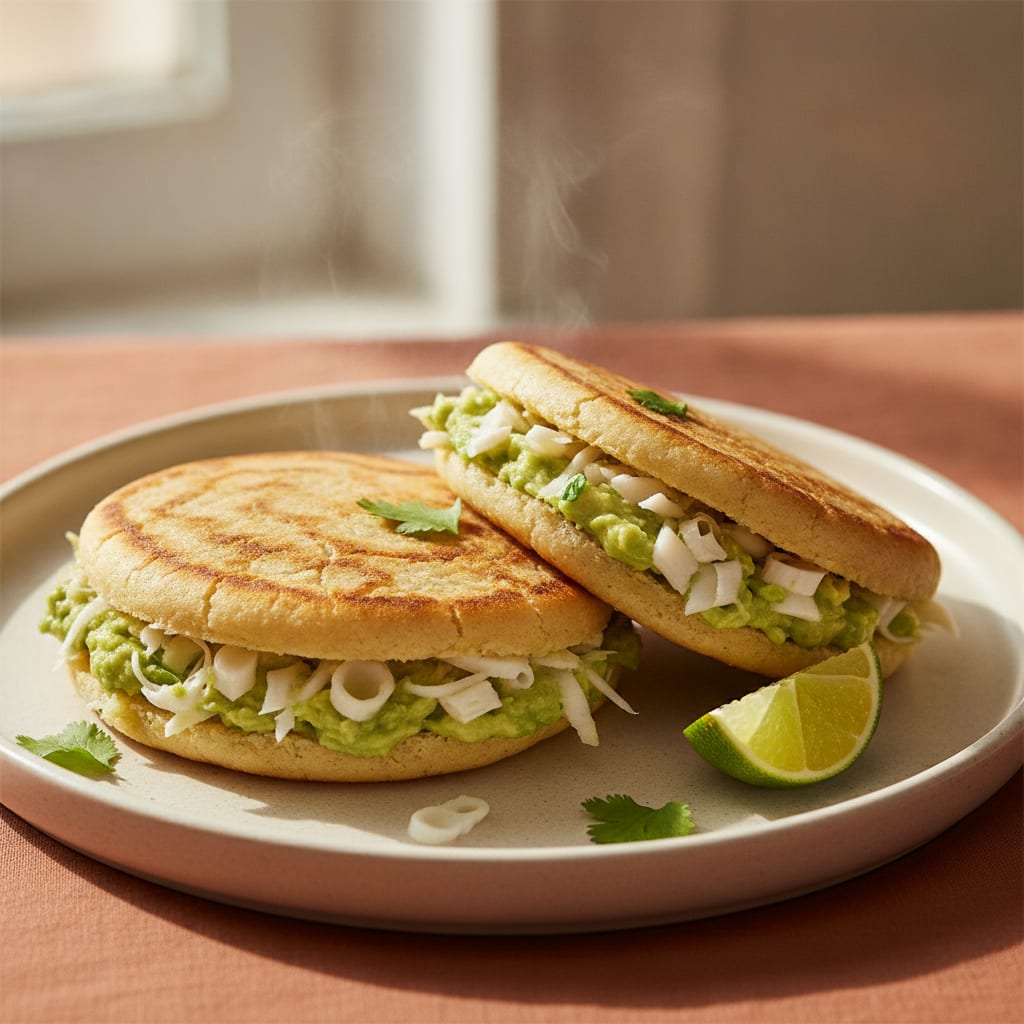
Masarepa corn cakes griddled then baked to a crackling shell and a steamy crumb, split and stuffed with a creamy avocado-and-heart-of-palm reina pepiada.
- Prep
- 15 min
- Cook
- 30 min
- Total
- 45 min
- Servings
- 4
- Difficulty
- Easy
Getting ready…
Ingredients
For 4 servings · 11 items
For the arepas
For the reina pepiada filling
Method
7 steps · check as you go
- →
Serve
Serve immediately, the arepa hot and crackling against the cool, creamy filling, with extra lime and a few coriander leaves. Eat with your hands over a plate; the filling will spill, and that is the point. A cold beer or a tart passion-fruit drink is the Caracas pour.
The story
An arepa is a corn cake split and stuffed, and it is older than almost anything else on the table. The indigenous peoples of present-day Venezuela and Colombia — the Cumanagotos, the Timoto-Cuicas, the Muiscas — were griddling cakes of ground corn centuries before any wheat loaf reached the continent, and the arepa has barely changed since: one of the few pre-Columbian foods that came through colonisation essentially intact. You are eating a pre-contact dish.
I first took arepas seriously in 2025, at a tiny Venezuelan counter in a food hall in Washington — a few stools, a flat-top, and a cook who pressed and flipped them without ever looking down. I asked her why mine at home came out like hockey pucks and she laughed and tapped one with a knuckle: it sounded hollow, like a small drum. “Así,” she said — like this. I don’t know her name. The crust was the whole answer: thin, crackling, drum-tight, against a soft steaming crumb that she split open and filled until it overflowed.
This arepa is corn and water and salt — it was never anything else. The crust-and-crumb is structure, not animal. The filling here is reina pepiada, the avocado classic born in 1950s Caracas and named for a beauty queen; in place of the shredded chicken I use fork-pulled hearts of palm, which fray into the same tender strands and let the avocado and lime lead. It is not a “vegan arepa.” It is an arepa, stuffed the way I was shown across a flat-top.
À la maison
The weeknight reading is the recipe above, and it hangs entirely on two things: the right flour and the right hydration. Buy masarepa — precooked corn flour, the P.A.N. yellow-or-white bag — and do not substitute masa harina, which is nixtamalised and a different food. Then chase the dough texture: soft, smooth, clay-like, with edges that don’t crack when you press a test disc. From there it’s just griddle-then-bake, which is the move most recipes skip — the griddle for the crackling shell, the oven for the fluffy inside. Split them hot and overstuff.
Au bistrot
The bistronomique reading keeps the same corn cake and the same filling and composes it as an open course rather than a stuffed pocket.
Make the arepas smaller — silver-dollar discs, arepitas — and griddle them harder for a darker, more pronounced drumhead crust, finishing in the oven so the crumb stays cloud-soft. Refine the reina pepiada into a proper avocado cream on one side and a sharp dice on the other: blitz half the avocado with lime, a little reserved heart-of-palm brine, and oil into a glossy purée, and keep the rest in clean diamonds so the plate has both silk and bite. Top each little open arepa with a swipe of the avocado cream, a tangle of the fork-shredded hearts of palm dressed in lime, a few cubes of avocado, a scatter of toasted corn nuts for crunch, and micro-coriander. Plate three across a long board, a cheek of charred lime at the end. The same crackle-against-cream contrast, read as a tasting of one bite.
Le dressage — Overhead, long crop. Three small dark-crusted arepitas across a slate board, each topped with pale avocado cream, shredded heart-of-palm, coriander, a glint of toasted corn nut. A charred lime cheek. Bright, even light to catch the crust’s crackle. The plate should say an ancient corn cake, plated three ways across one breath — rustic crust, refined top.
What the other recipes get wrong
Most arepa recipes online — I read the top ten in April 2026 — make one of two mistakes, and they are opposite mistakes: they griddle only (gummy inside) or they use the wrong corn flour entirely. I ran the test over a week in April 2026, four batches, same hydration, same filling, only the flour-and-cooking method changed:
- Masa harina (nixtamalised), griddled only: flat, dense, distinctly tortilla-tasting, no fluffy crumb. It is simply not what an arepa is made of.
- Masarepa, griddled only: good crust but a pasty, half-raw centre on the thicker ones — the inside never got enough gentle heat to steam through.
- Masarepa, baked only (no griddle): cooked through and soft, but pale and crustless — a corn bun, not an arepa.
- Masarepa, griddled then baked: thin crackling drumhead shell, fully cooked fluffy crumb, splits clean. Not close.
The reason is two different starches and two different heats. Masarepa is precooked but not nixtamalised; masa harina is soaked in alkaline lime (nixtamalisation), which gels the starch differently, raises niacin availability, and gives the flavour and structure of a tortilla — a genuinely different ingredient that cannot make an arepa crumb. And the cooking is two jobs: the dry, medium-hot griddle dehydrates and toasts the surface starch into the crackling shell, while the surrounding oven heat steams the dense interior so it sets soft instead of gummy. Skip the griddle and you lose the crust; skip the oven and you lose the crumb. Right flour, both heats: every batch, the drum sound and the cloud inside.
The line I draw
I will not make arepas from masa harina and call them arepas. I have been handed the bag by people who swore it was “the same corn flour,” and it is not: masa harina is nixtamalised, cooked in lime, built for tortillas and tamales, and it makes a flat, dense, tortilla-flavoured cake with none of the arepa’s fluffy steam-cooked crumb. Using it isn’t a shortcut, it’s a different dish wearing the name. If the bag doesn’t say precooked — precocida — it is not masarepa, and what you make from it is not an arepa.
When this can fail
Three ways, all from my own kitchen between 2022 and 2026:
- The cracked brick. Dough too dry; the discs cracked at the edges, and the baked arepas came out hard and crumbly with fissured shells. Fix: chase the hydration — knead in a tablespoon of water at a time until a pressed disc has smooth, crack-free edges and feels like soft clay.
- The gummy centre. Griddled only, and on a thick batch — the crust was lovely but the middle was raw, pasty, and stuck to my teeth. Fix: keep them to 1cm and always finish in the oven so the inside steams fully through.
- The wrong flour. Reached for masa harina once because it was what I had. Flat, dense, tortilla-tasting — not an arepa at all. Fix: buy masarepa, the precooked bag, and never swap it for nixtamalised masa.
FAQ
QWhat flour do you use for arepas — masarepa or masa harina?
Masarepa, and the distinction matters. Masarepa is precooked corn flour — corn that is cooked, dried, and ground — sold under brands like P.A.N. Masa harina is nixtamalised: corn soaked and cooked in an alkaline lime solution, which changes both flavour and chemistry and is used for tortillas and tamales. They are not interchangeable. Masa harina makes a flatter, distinctly different-tasting cake and won't give you the fluffy arepa crumb. Use masarepa for arepas.
QHow do you get a crispy crust on arepas?
Griddle, then bake. Cook the formed arepas on a lightly oiled, medium-hot cast-iron pan for 5–6 minutes a side until a deep golden crust forms and they sound hollow when tapped, then finish in a 200°C / 400°F oven for about 10 minutes. The dry griddle toasts the surface starch into a thin crackling shell; the oven cooks the inside to a soft, steamy crumb and sets the crust so it splits cleanly.
QWhat is a reina pepiada and how do you make it without chicken?
Reina pepiada is the classic Venezuelan arepa filling — creamy avocado folded with shredded chicken, mayo, lime, and coriander — invented in 1950s Caracas and named for the Miss World Susana Duijm. Without chicken, fork-shredded hearts of palm stand in beautifully: they pull into tender strands with a similar soft chew and let the avocado, lime, and coriander lead. Keep it chunky, season it well, and the dish reads exactly as reina pepiada.
QAre arepas pre-Columbian?
Yes — the arepa is one of the oldest continuously eaten foods in the Americas. Indigenous peoples of what are now Venezuela and Colombia, including the Cumanagotos, Timoto-Cuicas, and Muiscas, were grinding and griddling corn cakes long before European contact, and the arepa has stayed remarkably close to that pre-contact form. It predates the arrival of wheat bread and survived colonisation largely intact.
QCan I make arepas ahead?
The dough is best fresh but holds, covered, a few hours; rehydrate with a splash of water if it stiffens. Cooked arepas keep a day and reheat well — re-crisp them on the griddle or in the oven, not the microwave, which softens the shell. Make the reina pepiada filling no more than a few hours ahead and press cling film onto its surface so the avocado doesn't brown; the lime helps but air is the enemy.