Burgundy's cellar puff.
Gougères.
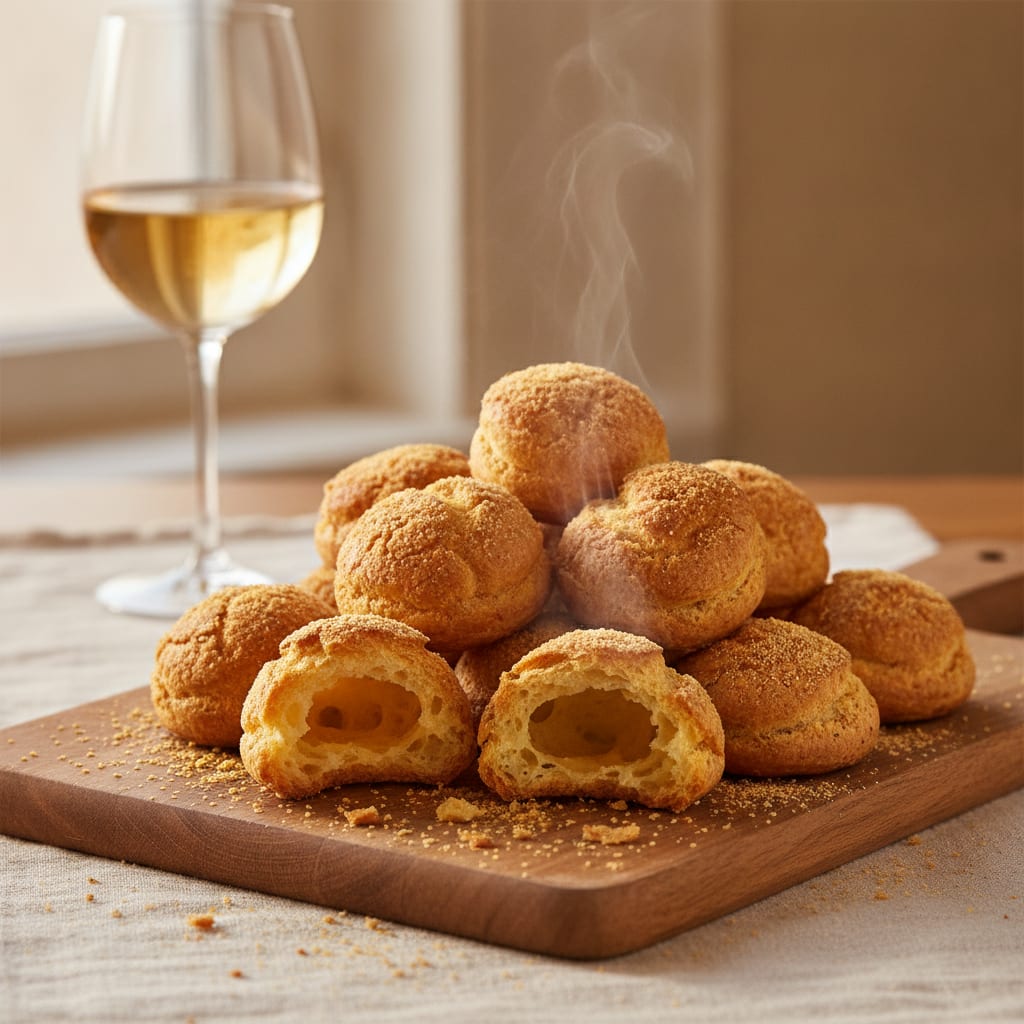
Burgundian cheese puffs, two ways: airy choux raised on steam alone, a cashew-miso-yeast cheese that carries the Comté savour, baked dark and hollow.
- Prep
- 25 min
- Cook
- 30 min
- Total
- 55 min
- Servings
- 6
- Difficulty
- Medium
Getting ready…
Ingredients
For 6 servings · 15 items
For the cheese paste
For the choux
To finish
Method
6 steps · check as you go
- →
Serve
Serve the gougères warm, piled on a board or in a bowl, within the hour — this is cellar food, eaten standing with a glass of cold Burgundian white (a Bourgogne Aligoté or a young Chablis) before a meal. They are best the moment the walls are still crisp and the inside still steams.
The story
A gougère is choux pastry that learned to love cheese — a savoury puff, baked dark, hollow inside, traditionally eaten in Burgundy with a glass of the local white in the cool of a wine cellar. The dish is old. Cheese pies under the name goiere appear in France in the fourteenth century, and choux pastry itself arrives with the Italian influence of the sixteenth; the gougère as we know it, the cheese-laced puff, is a Burgundian thing, and the village of Flogny-la-Chapelle still holds an annual festival claiming its paternity. It was cellar food: something dry and savoury to hand round while the wine was poured and judged, the salt and the fat setting up the palate for the tasting.
I relearned them in October 2024, in Paris, during a stretch working near Le 110 de Taillevent in the 8th, where the gougère is the thing that lands on the table before you have decided anything — warm, the size of a walnut, the cheese still molten in the middle. The chef I worked the cold station with would not let a tray out if the puffs hadn’t gone properly dark. “Pâle, c’est cru,” he said — pale is raw. He baked them almost to the edge of too far, and he was right: a blond gougère is a sad, doughy thing, and a dark one is hollow and crisp and tastes of toasted cheese.
This gougère has no egg and no Comté in it. It has a choux raised on aquafaba and steam, and a cheese built from cashew, nutritional yeast, and white miso folded through at the end. The method is unchanged — the boiled panade, the cooked-out flour, the hot oven that flashes the water to steam, the closed door. It is not a “vegan version” of a gougère. It is a gougère, baked as dark as the one I was handed in the 8th.
À la maison
The weeknight reading is the recipe above, and it turns on two moves. First, get the dough to the right slackness — it should drop off the spoon in a slow ribbon, not sit there in a stiff lump and not run. Second, respect the oven: start hot to blow the puffs open, drop the heat to dry them, and keep the door shut for the first fifteen minutes. The cheese paste you can make days ahead. Everything else is the ordinary discipline of choux: boil, beat, cool a little, beat in the liquid, bake hard. Eat them warm, standing up, with something cold and white in the other hand.
Au bistrot
The bistronomique reading is the same puff, made smaller and given a filling, so it lands as a precise one-bite course rather than a board to graze.
Pipe the gougères half the size — true amuse scale — and bake them just as dark. Once cool, split each one or pierce the base with a plain tip. Make a soft, pipeable filling from the same cheese paste loosened with a little plant cream and sharpened with extra Dijon and a grind of black pepper, almost a mornay in texture; fold in a few chopped chives. Pipe it into each hollow so the puff is full but not bursting. For contrast, brush the tops with a whisper of melted butter and re-crisp them for two minutes so the shell stays brittle against the cool, savoury cream inside. Serve three to a plate, on a folded napkin or a smooth slate, with a tiny mound of cracked pepper and, if you have it, a few shavings of cashew parmesan to echo the rind. The plate is small, deliberate, and warm — the puff crisp, the centre cool and rich, gone in two bites.
Le dressage — Macro, tight and low. Three small gougères on dark slate, one cut to show the pale cream filling against the hollow gold shell. Side light to find the crackle on the crust. A single chive tip, a dusting of pepper, nothing more. The plate should say one perfect bite — cellar snack turned into a course without losing the steam.
What the other recipes get wrong
Most eggless-choux recipes online — I read through the top ten in March 2026 — reach straight for commercial egg replacer or load the dough with baking powder, and you can taste it: either a chemical, slightly soapy note, or a puff that rises fast and collapses into a flat cake. The egg in choux is not just a leavener; it carries water and sets the walls. Replace it badly and the whole structure fails. I ran the test over a week in March 2026, four batches, same panade, same oven, only the egg stand-in changed:
- Commercial egg replacer: rose unevenly and left a faint chemical aftertaste under the cheese. Acceptable, not honest.
- Baking powder alone (2 tsp), no aquafaba: a fast rise, then a slump — they baked into dense, cakey nuggets with no hollow.
- Aquafaba alone, whisked to a froth: good puff, but the walls were fragile and a few collapsed as they cooled, with no insurance against a slightly cool oven.
- Aquafaba (room temperature) + 1/2 tsp baking powder: the best of both — the aquafaba carried the water that became steam and helped set the walls, and the small lift of baking powder gave a reliable, even rise with a true hollow centre.
The reason is the physics of choux. The primary leavening in a gougère is steam: the water in the dough flashes to vapour in a hot oven and inflates the shell, while the starch and proteins set around the void. In a classic gougère the egg proteins firm the walls so they hold when the steam escapes. Aquafaba — chickpea cooking water at around 1.5% protein, mostly albumins and globulins, with saponins that help it foam — brings both the water and a film-forming protein to firm the walls, the closest single plant analogue to what the egg did. The half-teaspoon of baking powder is just insurance for the moment the egg’s setting power isn’t fully matched. Hot start, closed door, aquafaba for the water and walls: every batch that followed those rules came out hollow.
The line I draw
I will not pull a pale gougère out of the oven. Not to save five minutes, not because they “look done,” not because I’m worried about the cheese on top. A gougère is supposed to be baked dark and dried through — the colour is toasted flavour, and the extra few minutes are what set the walls so the puff stays hollow instead of slumping into a damp little dome on the cooling rack. The chef in the 8th was right: pale is raw. An underbaked gougère deflates and goes gummy in the centre, and a gummy gougère is just seasoned dough. Bake it to the edge of too far, every time.
When this can fail
Three ways, all from my own kitchen between 2022 and 2026:
- The flat puffs. I beat too much aquafaba into the dough chasing a “glossy” look, and the slack dough spread into flat discs that never rose. Fix: add the aquafaba a splash at a time and stop when the dough falls in a slow ribbon — thick, not runny.
- The collapse. I opened the oven at the eight-minute mark to rotate the tray, the temperature dropped, and the half-set puffs caved in front of me. Fix: don’t open the door for the first 15 minutes, and only rotate once they’re risen and coloured.
- The seized cheese-dough. I beat the cheese paste in while the panade was still hot and it split into a greasy, grainy mess. Fix: cool the choux to just-warm before folding in the cheese paste, and fold only until streaky, not smooth.
FAQ
QCan you make gougères without eggs and cheese?
Yes. A gougère is choux pastry flavoured with cheese, and choux is raised by steam, not by eggs — the egg mainly sets the walls and enriches the dough. Aquafaba (chickpea cooking water) carries the water that becomes steam and helps set the structure, with a little baking powder as insurance. The cheese is built from cashew, nutritional yeast, and white miso, which together give the nutty, aged-Comté savour. It puffs and reads as a gougère because it follows the choux method.
QWhy won't my gougères puff up?
Usually the dough was too stiff or too wet, or the oven wasn't hot enough to flash the water to steam. The dough should fall from the spoon in a slow, glossy ribbon. Start the bake hot — 200°C (400°F) — so the steam blows the shell open fast, and only then drop the temperature to dry it. And don't open the door in the first 15 minutes: the cold air collapses the half-set puff.
QWhat cheese stands in for Comté or Gruyère in gougères?
A blend does the work one cheese can't. Cashew gives the fat and body, nutritional yeast gives the nutty, brothy note that aged Comté has, and a spoon of white miso gives the funky, savoury depth of long-aged cheese. Blend them into a thick paste and fold it through the choux at the end so it stays in melting pockets. Dijon and lemon sharpen it the way a real aged cheese has bite.
QWhy use soy milk instead of water in the choux?
Soy milk has more protein than other plant milks, and that protein browns and sets the walls better, giving a deeper colour and a sturdier shell. Half water, half soy milk is the balance I settled on: all water and the puffs are pale and fragile, all soy milk and they can go heavy. The water also still flashes to steam, which is what raises them.
QCan I make gougères ahead?
Pipe the mounds and freeze them raw on the tray, then bake from frozen, adding a few minutes — this is how a lot of bistro kitchens hold them. Baked gougères are best within an hour but can be refreshed: 3–4 minutes in a 180°C (350°F) oven crisps the walls and brings back the hollow. Avoid the microwave, which steams them limp.