The soup a spoon stands up in.
Garbure.
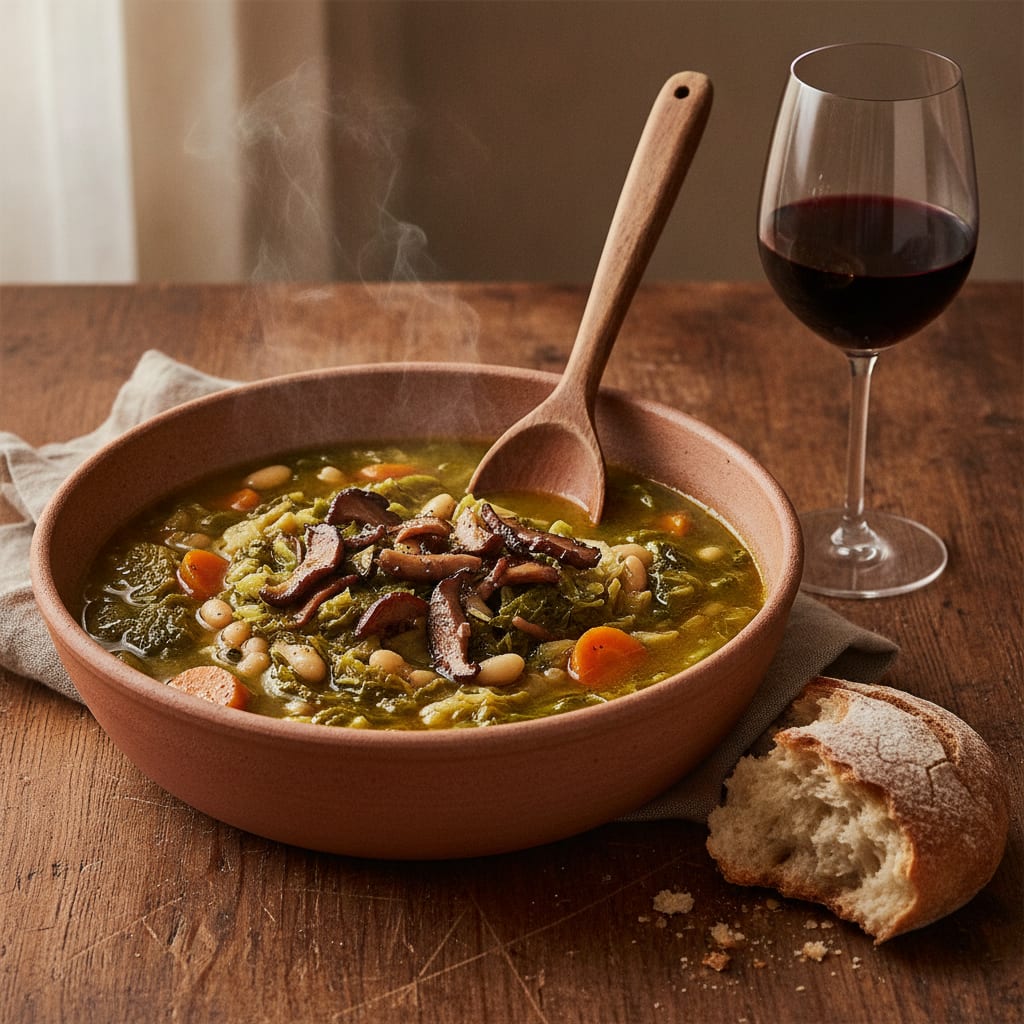
The Gascon cabbage-and-bean soup, two ways: smoky confit mushrooms and white beans cooked thick enough to stand a spoon in, finished with the chabrot pour.
- Prep
- 25 min
- Cook
- 1h 30min
- Total
- 1h 55min
- Servings
- 6
- Difficulty
- Medium
Getting ready…
Ingredients
For 6 servings · 20 items
For the confit mushrooms
For the soup
To serve
Method
6 steps · check as you go
- →
Serve
Ladle the garbure into deep, warm bowls, thick and steaming, with crusty country bread for dunking. Then teach the table the chabrot: when the bowl is nearly empty, pour a splash of red wine into the last few spoonfuls of hot soup, swirl, and drink it straight from the bowl. A rustic southwest red — a Madiran or a Cahors — is both the pour and the chabrot wine.
The story
A garbure is the soup that fed Gascony — cabbage, white beans, whatever roots the garden held, and a piece of preserved meat for richness, cooked down until it stopped being a soup and became something closer to a meal you eat with a spoon stood upright. The name comes from the Gascon garburo, and the dish was daily peasant food across Béarn and Gascony, different in every house and every season, made with rye bread, vegetables, and goose or duck confit. It has two unbreakable traditions. The first is thickness: a true garbure is dense enough that a spoon will stand in it. The second is the chabrot — the custom of pouring red wine into the last hot spoonfuls and drinking it from the bowl, a word that traces back to a Latin root meaning to drink like a goat.
I learned it in the winter of 2022, in the Languedoc, in a stone house outside Montpellier where the woman renting me a room — Mireille, who cooked for herself and occasionally, grudgingly, for me — made garbure on the cold days and treated my thin first attempt with open pity. “Ce n’est pas une soupe, c’est un repas,” she said, planting her spoon in her own bowl so it stood straight up. It is not a soup, it is a meal. Then she showed me the chabrot — wine into the dregs, swirled, drunk straight from the rim — and looked genuinely offended when I hesitated.
This garbure has no duck confit and no ham in it. It has mushrooms cooked slowly in oil until dark and rich, kombu and miso for the savoury depth of the bone, and the cabbage, beans, and roots cooked thick the way they always were. The method is unchanged — the confit, the gentle beans, the staged cabbage, the crushed-bean thickening, the spoon that stands. It is not a “vegetable version” of a garbure. It is a garbure, thick enough that Mireille’s test would pass.
À la maison
The weeknight reading is the recipe above, and it’s forgiving in everything but two things. First, thickness: let the potatoes break down and crush a ladleful of beans and potato into the pot so the soup is dense, not brothy — a thin garbure isn’t a garbure. Second, the cabbage in two stages, so you get both the melting, sweet cabbage that thickens it and a fresher layer with bite. The confit mushrooms are the one extra step, and they’re worth it — make them while the beans cook. Serve it thick, with bread, and do the chabrot at the end; it’s the whole point of the bowl.
Au bistrot
The bistronomique reading is the same soup, refined and composed, so the rustic garbure arrives as a deliberate plated bowl without losing its weight.
Cook the garbure as above, then split it. Blend a third of the soup smooth and silky with a little olive oil into a velvety bean-and-cabbage velouté — that becomes the base of the bowl, poured at the table. Keep the rest chunky and reduce it slightly so the vegetables glisten. For garnish, crisp a separate batch of the confit mushrooms hard in a dry pan until their edges go properly dark and chewy — the most concentrated bite of confit on the plate. Add a few whole Tarbais beans glazed in a spoon of their own cooking liquid, a single soft-braised cabbage leaf folded into a neat parcel, and a chiffonade of raw cabbage dressed in lemon for a fresh, sharp lift against all that depth. In a wide bowl, arrange the chunky garnish off-centre — beans, the cabbage parcel, the crisp mushrooms — then pour the warm velouté around at the table, and finish with a thread of the confit oil and a few drops of red-wine reduction as a nod to the chabrot.
Le dressage — Overhead, then a second frame at the pour. Wide shallow bowl, dark crisp mushroom and pale glazed beans arranged off-centre, the green velouté poured tableside so it catches the light. A thread of golden oil, a few dark drops of wine reduction. The plate should say peasant soup, plated honest — all the depth of the pot, composed but never fussy.
What the other recipes get wrong
Most garbure recipes online — I read the top ten in January 2026 — make a perfectly nice cabbage-and-bean soup and stop there, thin and brothy, missing the two things that make it a garbure: the thickness and the smoky, confit depth. A garbure is supposed to be a meal you eat with a fork as much as a spoon. I ran the test over a week in January 2026, four pots, same vegetables, same beans, only the body and the savoury base changed:
- Brothy, no thickening, plain water base: a thin vegetable soup. Pleasant, but the spoon fell over, and Mireille’s test failed on sight.
- Thickened with flour: it held a spoon, but it had a pasty, gluey texture and a floury taste that sat on top of the vegetables.
- Thick from crushed beans, but no confit or kombu: good body, but flat and one-note — it tasted of boiled cabbage with nothing underneath.
- Crushed beans and potato for body, confit mushrooms, kombu, and miso for depth: thick enough to stand a spoon, dark and smoky underneath, layered. This was a garbure.
The reason is half tradition, half chemistry. The thickness is structural: starch from the broken-down potatoes and crushed beans suspends through the broth and binds it, which is how Gascon cooks got body before anyone reached for flour. And the depth that cured meat used to give is umami — glutamate. Kombu is dense in free glutamate (the compound Kikunae Ikeda first isolated from it in 1908 and named umami), and the slow-confit mushrooms plus white miso pile on more savour and a fermented, almost-meaty length. Drop the thickening and it’s not a garbure; drop the umami base and it’s a sad one. Crushed beans for body, kombu and confit and miso for depth: every pot that did both stood a spoon and tasted of something that had simmered a bone.
The line I draw
I will not serve a thin garbure. Not because I’m short on time, not because someone “prefers a lighter soup,” not because the pot looks full enough. The thickness is not a texture preference — it is the definition of the dish. A garbure is a soup cooked to the edge of a stew, dense enough that the spoon stands, and the moment it’s brothy and thin you’ve made a cabbage-and-bean soup that happens to share the ingredients, not a garbure. The body comes from the vegetables themselves — broken potato, crushed beans — not from flour or cream, which would mask the dish. Mireille planted her spoon upright for a reason. If the spoon falls, it goes back on the heat.
When this can fail
Three ways, all from my own kitchen between 2022 and 2026:
- The thin pot. I added too much liquid and didn’t crush any of the beans, and the garbure came out as a brothy soup the spoon couldn’t stand in. Fix: hold back on the water, let the potatoes break down, and crush a ladleful of beans and potato back into the pot to thicken without flour.
- The tough beans. I salted the beans at the start to “season as I went,” and an hour later they were still chalky in the centre. Fix: cook the beans gently from a cold start with kombu and no salt, and season only once they’ve softened.
- The soured miso. I stirred the miso in and let the pot boil on while I set the table; by serving it had gone flat and slightly sour. Fix: whisk the miso into a ladleful off the heat, at the very end, and don’t boil it after.
FAQ
QCan you make a real garbure without duck confit or ham?
Yes. A garbure is defined by what it is — a thick Gascon soup of cabbage, beans, and winter vegetables, cooked dense enough to stand a spoon in — not strictly by the meat, which varied house to house with what people had. Mushrooms slow-cooked in oil with garlic, thyme, and smoked paprika give the dark, rich, smoky note of confit and cured ham, and kombu plus white miso build the savoury depth the ham bone gave. Thickened with crushed beans and potato, it eats as a garbure because it follows the garbure's shape.
QHow thick should a garbure be?
Thick enough that a spoon nearly stands up in it — that's the traditional test in Gascony. A garbure is a soup at the edge of a stew, dense with cabbage, beans, and vegetables in just enough broth to bind them. You get that body by letting the potatoes break down and by crushing a ladleful of cooked beans and potato against the side of the pot and stirring it back, with no flour or cream needed.
QWhat is faire chabrot in a garbure?
Chabrot is the old Occitan custom of finishing the bowl by pouring a splash of red wine into the last spoonfuls of hot soup, swirling, and drinking it straight from the bowl. The word traces to a Latin root meaning to drink like a goat. It likely arose where food was scarce but wine was plentiful, as a way to get every last drop of the soup. It's part of how garbure is eaten in the southwest, not a garnish.
QWhat beans go in a garbure?
Traditionally the white Tarbais bean of the southwest — a large, thin-skinned, creamy bean grown around Tarbes that holds its shape through long cooking. If you can't find Tarbais, cannellini or other white beans work well. Soak them overnight and cook them gently from a cold start with a piece of kombu, and don't salt until they've softened, so they stay creamy rather than splitting or toughening.
QIs garbure better the next day?
Yes. Like most thick peasant soups, garbure deepens overnight as the cabbage, beans, and confit settle together, and it thickens further as the starch sets. Reheat it gently with a splash of water or stock to loosen, taste for salt, and add a fresh grind of pepper. It keeps three to four days refrigerated. Traditionally the pot was kept going and refreshed over several days.