The milk börek.
Galaktoboureko.
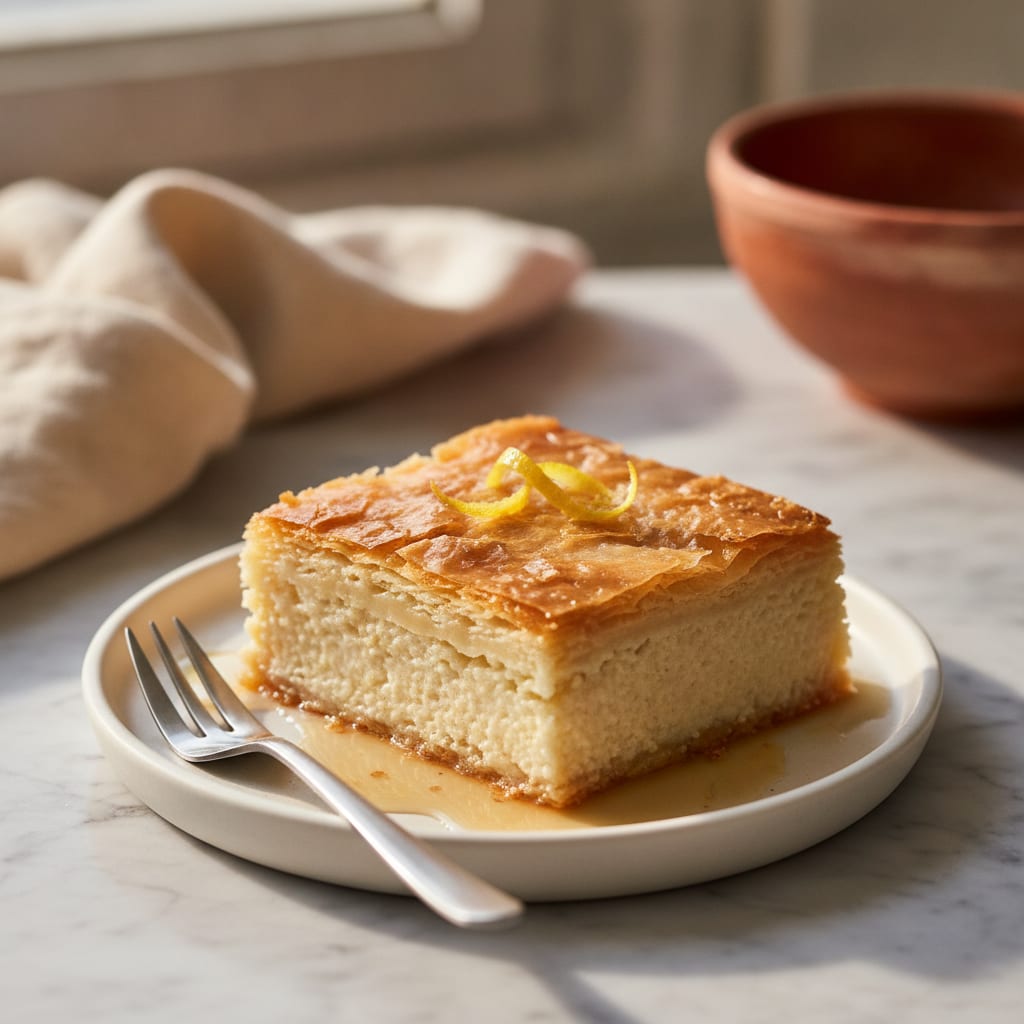
Greek milk pie, two ways: a slow semolina custard set without egg, wrapped in buttered phyllo, baked gold, then drowned in cold citrus syrup for the crackle.
- Prep
- 30 min
- Cook
- 50 min
- Total
- 1h 20min
- Servings
- 9
- Difficulty
- Medium
Getting ready…
Ingredients
For 9 servings · 14 items
For the syrup (make this first, it must be cold)
For the custard
For assembly
Method
7 steps · check as you go
- →
Serve
Serve at room temperature, never fridge-cold — cold mutes the syrup and dulls the custard. Cut along the scored lines into squares, lift each with a thin spatula so the crisp base comes away clean, and finish with a dusting of cinnamon or a strip of lemon zest. A small cup of strong coffee alongside, the Athens way.
The story
I learned this in Athens, in the Plaka, in the spring of 2017, in a taverna kitchen that belonged to a woman named Eleni. The Plaka is the old quarter under the Acropolis — narrow lanes, cats, the marble worn smooth — and Eleni’s kitchen was a long galley that smelled of lemon and hot butter from ten in the morning. She made galaktoboureko every day. She would pull the tray out of the oven, scorching, and pour cold syrup over it from a height, and the whole surface would crackle like ice on a pond — a sound I can still hear. “Akous?” she’d say. You hear it? That sound is the dish.
Eleni’s galaktoboureko had eggs in it, the way most do. Mine does not. The custard here is set the way the name promises it can be — by semolina, which is the heart of galaktoboureko and always was. Fine semolina swells and gelates in hot milk into a custard you can cut into squares; a little cornstarch tightens it as it cools. The milk is plant milk. Everything else — the buttered phyllo, the lemon, the cold-syrup crackle — is unchanged.
This is not a “vegan version” of galaktoboureko. The name means milk börek: a milk-filled pastry. It is still milk, still börek, still drowned in cold syrup the second it leaves the oven. It is galaktoboureko, made with what is in my hands now.
À la maison
The weeknight reading is the recipe above, and it stands on two moves. First: make the syrup before anything else, so it is properly cold when the pie comes out. Cold syrup on hot pastry is the entire dish — get the temperatures wrong and you have a soft, sweet sponge instead of a crackling one. Second: butter every phyllo sheet, no skipping. That is what turns a pale slab into shattering golden leaves. The custard itself is forgiving — whisk constantly so it doesn’t catch, cook it to a glossy pudding, and let semolina do the setting that eggs would otherwise do.
Au bistrot
The bistronomique reading keeps the pie honest but composes the plate around it, and pushes the custard one notch finer.
For the plate, I bake the galaktoboureko a little thinner and cut it into a single clean rectangular bâton per guest, so every layer reads in cross-section — gold phyllo, pale custard, the glossy syruped base. I infuse the milk for the custard with a strip of mastic-scented lemon and a breath of orange-blossom water, the old Smyrna note, so the custard tastes of more than vanilla. Alongside the bâton goes a quenelle of lightly whipped coconut cream folded with a little of the lemon syrup, and a scatter of toasted crushed pistachios for the green and the crunch. A thread of the cold syrup is dragged across the plate, and a few candied lemon-peel slivers go on for sharpness against all that sweet. The point of the plate is restraint: one perfect bâton, the crackle still audible if you press a fork to the top, nothing hiding the layers.
Le dressage — Side-on and close, at the height of the bâton so the three layers stack in frame. Dark slate plate, the gold of the phyllo glowing against it. A low warm light raking across the top so the crisp leaves throw shadow. A quenelle of cream, a drag of syrup, a few pistachios and candied peel — odd numbers, off-centre. The plate should say layers, not abundance.
What the other recipes get wrong
Most galaktoboureko recipes online — I read the top ten in February 2026 — treat the syrup temperature as a soft suggestion, or worse, tell you to pour hot syrup over the hot pie. So I ran the test: nine pies over two weeks in February 2026, in my Washington kitchen, same custard, same phyllo, same oven, changing only the syrup-and-pie temperature pairing at the moment of pouring.
- Hot syrup on hot pie: the top layers soaked through and went to wet paper within minutes. No crackle, no crisp. The most common online instruction, and the worst result.
- Warm syrup on warm (rested) pie: better, but the phyllo stayed chewy and pale-tasting, the syrup sitting heavy rather than crisping the top.
- Cold syrup on scorching-hot pie, poured the instant it left the oven: an audible crackle, a top that stayed shattering-crisp for two full days, and a custard that drank the syrup evenly from below. This was not close.
The reason is physics, not preference. Phyllo crisps when its surface water flashes off; the hottest possible pastry does that fastest. Cold syrup poured onto that hot surface is drawn down into the porous custard and lower leaves by capillary action while the top layers, already crisping in the oven’s residual heat, set before they can absorb enough to soften. Hot syrup, by contrast, carries its own water and steam straight into the top leaves and limps them. The temperature differential is the technique. Across all nine pies, cold-on-hot won every time, and it was the only pairing that crackled.
The line I draw
I will not pour warm syrup over a galaktoboureko, not even once, not to save the twenty minutes of chilling it. The crackle is the dish — it is the thing Eleni made me listen for. The instant the syrup is warm, it stops being drawn cleanly into the custard and starts steaming the phyllo from above, and the whole top goes from shattering to chewy. There is no recovering crisp phyllo once it has sogged; you cannot re-bake the syrup out of it. So the syrup gets made first, hours ahead, and it goes on cold, onto a pie straight from the oven. If you cannot hear it crackle, you poured it too warm.
When this can fail
Three ways, all from my own kitchen between 2022 and 2026:
- The grainy custard. Used coarse semolina once because it was what I had; the custard cooked up sandy and never smoothed out, no matter how long I stirred. Fix: fine semolina only, and rain it in slowly while whisking so it hydrates evenly instead of clumping.
- The pale, soft top. Pulled a pie at 35 minutes because the kitchen smelled done; the phyllo was blond and went limp the moment the syrup hit. Fix: bake to genuine deep gold, 45–50 minutes — pale phyllo has no crispness to lose, and the syrup will only finish it off.
- The shattered top at cutting. Skipped the pre-bake scoring and tried to cut squares after; the baked phyllo exploded into shards and the squares tore. Fix: score the top layers only before baking, so the cut lines are set, and lift each square with a thin spatula once the pie has rested.
FAQ
QCan you make galaktoboureko without eggs?
Yes. Galaktoboureko is a semolina-custard pie, and semolina is what sets it — fine semolina starch swells and gelates as it cooks, thickening the milk into a sliceable custard. A spoonful of cornstarch tightens the set further as it cools. Eggs in many recipes add richness and a firmer set, but they are not what defines the dish; the semolina is. Built on plant milk with semolina and cornstarch, the custard cuts into clean squares and tastes of milk, lemon and vanilla, exactly as it should.
QWhy does galaktoboureko go soggy, and how do I stop it?
Soggy galaktoboureko is almost always a temperature mistake: hot syrup poured over hot pie, or warm syrup over warm pie. The rule is cold syrup onto scorching-hot pastry, the second it leaves the oven. The hot phyllo flash-crisps on contact while the cool syrup is drawn down into the custard rather than steaming the layers limp. Make the syrup first so it has time to chill completely, and brush butter between every single phyllo sheet so the leaves fry crisp instead of gluing together.
QWhat does the name galaktoboureko mean?
It means milk börek. Galakto- is the Greek root for milk, and -boureko comes from börek, the Turkish word for a filled pastry — the same family as the savory cheese and spinach böreks of the wider region. The name is a small piece of history: the syrup-soaked phyllo tradition reached Greece through the Ottoman centuries, and galaktoboureko is, quite literally, a milk-filled börek. The custard is the milk; the phyllo is the börek.
QWhat kind of semolina should I use?
Fine semolina, not coarse. Fine semolina dissolves and gelates into a smooth, sliceable custard with just enough body to bite. Coarse semolina (the kind for pasta or couscous) stays gritty no matter how long you cook it and gives a sandy custard. If your packet only says 'semolina', the fine grind feels like soft sand; the coarse feels like tiny pellets. When in doubt, fine.
QCan I make galaktoboureko ahead?
Yes, and it is actually better a few hours after syruping, once the custard has fully set and the syrup has settled through. Make it in the morning to eat that evening. It holds 2–3 days at room temperature, loosely covered — do not refrigerate if you can help it, as the cold firms the custard and deadens the syrup. If you must chill it, bring squares back to room temperature before serving so the flavor opens up.